
LÉGION'ARTS




PRESIDENT OF THE REPUBLIC.
POPULARITY OR EXPERIENCE?
By Louis Perez y Cid
The world is reeling. International tensions are escalating, power struggles between major powers are hardening, and conflicts remind us daily that peace is never truly secure. In this context, France is preparing to enter a new presidential campaign period.
At the same time, the film Jupiter, which plunges us into the confines of a bunker where the decision on a nuclear retaliation is being made, confronts us with a dizzying reality: that of a man who, in the name of the Nation, may have to make a decision whose consequences would surpass anything we can imagine.
This film should resonate with every citizen of voting age. For one question arises: are we truly attentive to the qualities and experience of the person to whom we entrust the destiny of our country?
A Role That Cannot Be Improvised
The President of the Republic is not an elected official like any other. He is the guarantor of the institutions, the commander-in-chief of the armed forces, and the political authority who makes the ultimate decision regarding the use of nuclear weapons.
He represents France on the international stage and must, in the most serious circumstances, make decisions that could determine the future of our country and the lives of millions of people.
Such a responsibility demands far more than simply knowing how to convince a majority of voters.
We, former legionnaires, have learned that a significant responsibility is not entrusted lightly. In our ranks, command is based neither on popularity nor on the ability to charm. It requires experience, competence, discernment, an understanding of people, and, above all, the capacity to decide and to bear the consequences of those decisions.
Of course, this is not to say that a president must have been a military man. But can one reasonably claim to lead a country without mastering the major issues of defense, diplomacy, the economy, and national security? Can one hold such a position without a thorough understanding of international institutions and power dynamics? Composure, maturity, and the ability to listen to opposing viewpoints cannot be improvised during an election campaign. So, when we choose our president, do we truly give these qualities the importance they deserve?
When Popularity Takes Precedence Over Competence
Over the years, the presidential election has become a massive media event. Polls, social media, sound bites, communication strategies, and televised clashes play a significant role.
The candidate's personality, their ease in front of the cameras, and their ability to mobilize voters sometimes seem to matter more than their background, experience, and knowledge of state affairs. Candidacies are multiplying. Everyone is free to have presidential ambitions and to propose a vision for France. But does having the ambition to lead a country necessarily mean being prepared to do so?
There is a fundamental difference between knowing how to win an election and knowing how to wield power.
A candidate may be popular, an excellent communicator, and particularly effective on social media. But do they possess the necessary economic knowledge? Do they understand the geopolitical issues? Are they capable of assessing the consequences of a military or diplomatic decision? Will they be able to handle a major crisis without succumbing to haste or public pressure?
Popularity is one thing. Competence is another.
This is not about denigrating newcomers to politics, nor about assuming that seniority alone guarantees quality. Unconventional career paths can reveal genuine abilities. But how do we distinguish a charismatic personality from a candidate truly prepared to assume the highest responsibilities of the state?
Let's ask the question differently. Would we entrust the command of a unit to someone solely because they can persuade a crowd, without considering their training, experience, and judgment? Why would we accept lesser standards when it comes to leading France?
1962: General de Gaulle's Choice
Before 1962, the President of the Republic was elected by an electoral college. Under the 1958 Constitution, General de Gaulle himself was elected by a college of approximately 80,000 representatives, including members of parliament and local elected officials.
General de Gaulle wanted to give the Head of State stronger popular legitimacy. He believed that the President should embody the Nation and not be dependent on the arrangements and alliances between political parties.
On October 28, 1962, the French were called upon to vote in a referendum on the direct election of the president by universal suffrage. The "yes" vote prevailed with approximately 62% of the votes cast. The reform was significant. From then on, the president would derive his mandate directly from the French people.
This decision reflected an institutional and political logic specific to the time. It strengthened the authority of the head of state and his national legitimacy. But more than sixty years have passed. The world has changed, the stakes have shifted, and presidential responsibilities have taken on considerable dimensions.
Are we therefore justified in considering that the system conceived in 1962 is necessarily the best suited to today's challenges? An institution is not immutable simply because it has existed for a long time. The right to question its relevance is also part of democracy.
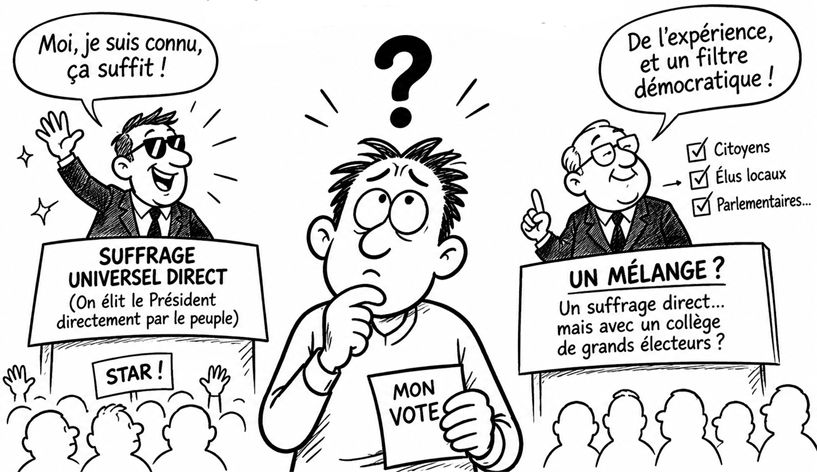
Should we rethink our method of election?
Direct universal suffrage possesses an essential quality: every citizen has a vote to choose the head of state. This is a fundamental democratic principle that it would be dangerous to dismiss out of hand. But this system also has its limitations. To be elected, one must convince millions of people, mobilize, rally support, and dominate the media. The campaign then becomes an exercise in winning over public opinion, sometimes far removed from the realities of the office to be held.
The risk is confusing the ability to win an election with the ability to govern a state.
The elected president must, however, govern for the entire nation, including those who did not vote for him. His electoral legitimacy does not mean that he enjoys the support of everyone, nor does it guarantee his competence. Should we then consider another system?
Indirect suffrage, which prevailed before 1962, could be a possible avenue for reflection. A modernized electoral college, composed of members of parliament, local elected officials, and representatives of regional and local authorities, could help put institutional experience and knowledge of public responsibilities back at the heart of the presidential election.
But let's not be naive. The electoral college is not infallible. Partisan interests, alliances, and political calculations can also distort their judgment. Indirect suffrage alone does not guarantee the selection of the best candidate.
This isn't about defending a ready-made solution, but about daring to ask the question: Is our current system truly the most appropriate for choosing the person who will have to face the crises of tomorrow?
To whom do we entrust the keys to the nation? We, former legionnaires, also know that certain decisions leave no room for improvisation. Responsibility isn't measured by the popularity of the leader, but by their ability to cope when everything becomes uncertain. The presidential office demands the same thing, albeit on a completely different scale.
In a world where an international crisis can escalate in a matter of hours, can we be satisfied with a system that risks prioritizing the art of seduction over the capacity for decisive action?
The film Jupiter reminds us that behind the presidential office lies an immense human, political, and strategic responsibility. The person who occupies that seat does not have the margin for error that a mere candidate on the campaign trail might allow themselves.
The choice of direct universal suffrage was approved by the French. But does that prevent us from reflecting on its evolution?
Ultimately, our question is simple, but it is essential.
Do we want to elect the person who knows best how to get elected, or the person who is best prepared to serve as President of the Republic? We must, however, have the courage to look at where we have arrived.
France should not be entrusted to the person who makes the best promises, but to the person who will be ready to deliver when history demands an accounting.