




If you notice any errors in the translations, remember:
"In the Legion, of the 144 languages, there is only one language: understanding each other."
Edito from PYC
PYC'S EDITORIAL
At the request of my friends at Legion'arts, I am launching a new column today, "PYC's Editorial."
In this space, I will take up my pen to discuss current topics concerning the Legion, history, geopolitics, and many other themes that shape our era.
Some may be sensitive, sometimes even disturbing. But they will always be approached with an essential requirement: the facts.
I will take full responsibility for them, because writing also means accepting the responsibility for one's words.
Legion'arts does not endorse the opinions expressed here. But the site defends a fundamental principle: everyone's right to express their own.
And that is precisely where its strength lies.
Louis Perez y Cid
"The Legion doesn't ask where you come from, but only if you are ready to serve."
On March 10, 1831
The Creation of the Foreign Legion
On March 10, 1831, by royal decree, King Louis-Philippe officially created the French Foreign Legion.
The use of foreign soldiers was not a new phenomenon in French military history. Since the Ancien Régime, France had often called upon troops from elsewhere; Swiss, Germans, Irish, and Poles had long served under its flag.
These units, however, retained their own structures, traditions, uniforms, and sometimes even their national regulations.
The creation of the Foreign Legion marked a profound shift. The foreign volunteers who enlisted now relinquished all national military identity to adopt that of the French army. Organization, discipline, traditions—everything now linked them to the French infantry.
Thus emerged a new figure: the legionnaire. ... Read more...
The use of foreign soldiers was not a new phenomenon in French military history. Since the Ancien Régime, France had often called upon troops from elsewhere; Swiss, Germans, Irish, and Poles had long served under its flag.
These units, however, retained their own structures, traditions, uniforms, and sometimes even their national regulations.
The creation of the Foreign Legion marked a profound shift. The foreign volunteers who enlisted now relinquished all national military identity to adopt that of the French army. Organization, discipline, traditions—everything now linked them to the French infantry.
Thus emerged a new figure: the legionnaire. ... Read more...
Views of the Elders
Letter from My Garden 5
Letter from My Garden:
Louis is a man preoccupied with reflecting on everything that comes his way. On the website he manages, the texts follow, drawn from a collection of volunteer authors chosen and selected for the light they shed on the meaning and use of the key word: "freedom of expression." These readings offer immediate entry into a world of sensitive and imaginative motifs.
Each article offers a different perspective on the man, the legionnaire, his inspiration, his thoughts on literature, his intellectual commitments, his language. These words will serve as a key to understanding the avid readers and writers, the painters, the photographers, and many others. ... Read more...
Louis is a man preoccupied with reflecting on everything that comes his way. On the website he manages, the texts follow, drawn from a collection of volunteer authors chosen and selected for the light they shed on the meaning and use of the key word: "freedom of expression." These readings offer immediate entry into a world of sensitive and imaginative motifs.
Each article offers a different perspective on the man, the legionnaire, his inspiration, his thoughts on literature, his intellectual commitments, his language. These words will serve as a key to understanding the avid readers and writers, the painters, the photographers, and many others. ... Read more...
Reflexions
The lights will not go out… they are simply waiting to be brought to light.
By Louis Perez y Cid
The Cycles of Power
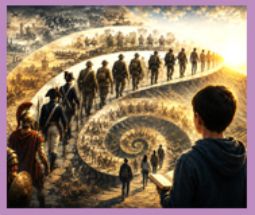
History does not progress in a straight line; it moves. It glides from one center of gravity to another.
The European upheaval of the 15th and 16th centuries was not primarily military, but intellectual. The rediscovery of ancient texts, the circulation of Byzantine manuscripts, the printing press, humanist thought, the work of Nicolaus Copernicus and Galileo—all these created fissures in a world ordered around the Holy Roman Empire and religious authority. This moment has a name: the Renaissance.
Innovation arises when knowledge circulates; power follows.
The 15th-century Portuguese opened maritime routes.
The 16th-century Spanish organized the empire.
The 17th-century Dutch invented modern finance.
The 18th-century French structured political thought.
The 19th-century British industrialized the planet.
But history is not simply an alternation of dominations. It is a succession of anthropological models. Each, in turn, imposes its way of organizing humanity, power, and the world.
These powers were unequal, sometimes brutal, always rivals. Their confrontation culminated in the two world wars, a European suicide that ushered in the 20th century, dominated by others: the United States and the Soviet Union.
The 20th century was bipolar, and the 21st century seems hesitant. The question is not only who dominates today. It is to understand what makes power endure... Read more...
The European upheaval of the 15th and 16th centuries was not primarily military, but intellectual. The rediscovery of ancient texts, the circulation of Byzantine manuscripts, the printing press, humanist thought, the work of Nicolaus Copernicus and Galileo—all these created fissures in a world ordered around the Holy Roman Empire and religious authority. This moment has a name: the Renaissance.
Innovation arises when knowledge circulates; power follows.
The 15th-century Portuguese opened maritime routes.
The 16th-century Spanish organized the empire.
The 17th-century Dutch invented modern finance.
The 18th-century French structured political thought.
The 19th-century British industrialized the planet.
But history is not simply an alternation of dominations. It is a succession of anthropological models. Each, in turn, imposes its way of organizing humanity, power, and the world.
These powers were unequal, sometimes brutal, always rivals. Their confrontation culminated in the two world wars, a European suicide that ushered in the 20th century, dominated by others: the United States and the Soviet Union.
The 20th century was bipolar, and the 21st century seems hesitant. The question is not only who dominates today. It is to understand what makes power endure... Read more...
Facts
Laotian Chronicle 6/6
By Lt. Colonel (TE-er) Antoine Marquet
After a pleasant train journey, we arrived back in Vientiane and settled into the Hotel Le Charme. We felt like we'd stepped back into 1950 in this vintage hotel, with its enormous rooms and, as in all the other hotels, beds that could accommodate three or four people!
We spent the day visiting temples and a museum. We had lunch in a small restaurant run by a Frenchman. The whirring of the microwave suggested that the food was reheated, but tasty and of good quality.
In the afternoon, we continued our sightseeing until evening.
After an aperitif that turned into dinner, Jean showed us a very elegant bistro located on the first floor of a completely unassuming building. A hushed atmosphere and soft lighting pervade the various small rooms of the bistro, which features a central island where a large and efficient staff prepares the most exquisite cocktails or serves the most sought-after whiskies. I confess, though I'm not a heavy drinker, that if I lived in Vientiane, I would become a regular at this bistro! Read more...
After a pleasant train journey, we arrived back in Vientiane and settled into the Hotel Le Charme. We felt like we'd stepped back into 1950 in this vintage hotel, with its enormous rooms and, as in all the other hotels, beds that could accommodate three or four people!
We spent the day visiting temples and a museum. We had lunch in a small restaurant run by a Frenchman. The whirring of the microwave suggested that the food was reheated, but tasty and of good quality.
In the afternoon, we continued our sightseeing until evening.
After an aperitif that turned into dinner, Jean showed us a very elegant bistro located on the first floor of a completely unassuming building. A hushed atmosphere and soft lighting pervade the various small rooms of the bistro, which features a central island where a large and efficient staff prepares the most exquisite cocktails or serves the most sought-after whiskies. I confess, though I'm not a heavy drinker, that if I lived in Vientiane, I would become a regular at this bistro! Read more...
Literary Explorations
The 18
Based on the true story of Fernando Magellan's voyage
A graphic novel series by Louis Perez y Cid.
In 1519, 240 men set sail from Seville. Seasoned sailors, inexperienced foreigners, men haunted by their past, and children.
Five ships embarked for the Ocean Sea under the command of Fernand Magellan.
No one knew their true destination. Two years' worth of provisions were on board.
The maps stopped where their route began. They set off into the void.
Three years later, only one ship returned, carrying several tons of cloves and… 18 survivors.
Captain Juan Sebastián Elcano completed the first circumnavigation of the globe in history.
But between departure and return, there was no glory.
There is hunger, fear, betrayal, cold, suffocating heat, mutiny, fighting, and blood—lots of blood.
This is not a legend. It's worse.
All this is happening above our heads
Solar Eclipses.
By Michel Gravereau
For some time now, I have been drawing your attention to Wednesday, August 12, 2026, in the late afternoon, when we will witness a solar eclipse, almost total if you are in the far south of France.
Many remember the one on August 11, 1999, which passed through northern France.
Always an extraordinary phenomenon to behold, it is worth recalling how it occurs.
Seen from Earth, the Moon and the Sun appear the same size.
This "disappearance" of the Sun would not take place before our eyes without a fortunate coincidence: seen from Earth, the celestial body of our nights and the celestial body of our days have the same apparent size. This similarity is only apparent because, while the Moon is approximately 3,700 km in diameter, the Sun is 1,400,000 km. The average distance from the Moon to Earth is 380,000 km, while the Sun is nearly 150 million km away.Read more...
Seen from Earth, the Moon and the Sun appear the same size.
This "disappearance" of the Sun would not take place before our eyes without a fortunate coincidence: seen from Earth, the celestial body of our nights and the celestial body of our days have the same apparent size. This similarity is only apparent because, while the Moon is approximately 3,700 km in diameter, the Sun is 1,400,000 km. The average distance from the Moon to Earth is 380,000 km, while the Sun is nearly 150 million km away.Read more...
Don't miss any of our publications and creations!
WHO WE ARE
Légion’Arts is an independent publishing house created by former legionnaire artists: preserving and sharing the memory of the Foreign Legion through authentic, human, and inspiring works. Every legionnaire has a voice. With Légion’Arts, these stories become a collective memory, accessible to all.