






All this is happening above our heads
The Sky Is Falling on our heads
By Michel Gravereau.
All children are fascinated by dinosaurs, strange and imposing creatures that we no longer encounter in our meadows, but only in museums, thanks to the tireless work of paleontologists who search for traces and bones of these animals that disappeared 65 million years ago.
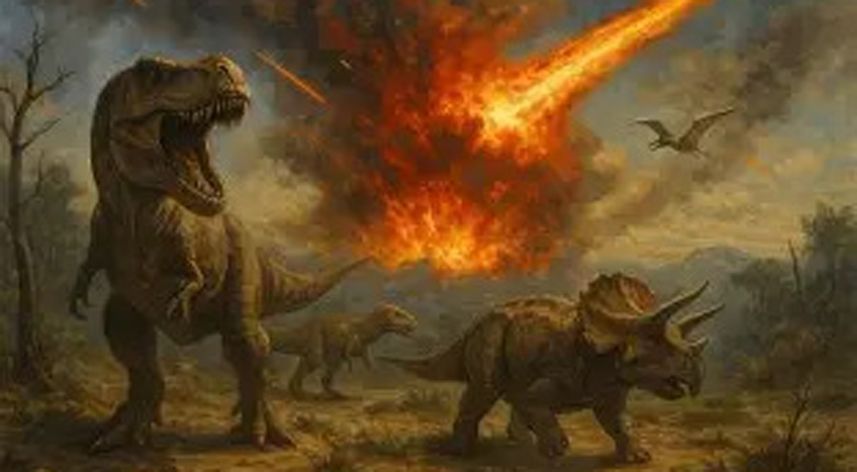
Better than anyone, these witnesses to the past know what "the sky is falling." Indeed, their extinction was due to a brutal collision between our planet and a body that emerged from the night: an asteroid 12 km in diameter. The point of impact likely occurred in the Gulf of Mexico, on the Yucatan Peninsula.
The shock was so powerful that it triggered tsunamis, fires, and propelled an immense amount of dust into the atmosphere, darkening the sky so completely for 800 years that vegetation died and the dinosaurs, vegetarians before their time, perished. It was their extinction. Read more...
Exoplanets
By Michel Gravereau.
Are we alone in the Universe? Is there life elsewhere? And where?
These are the eternal questions that humankind asks without finding definitive answers. Yet, it's not for lack of searching.
Modern times have provided us with tools capable of better understanding our space environment: probes are in situ, while ground-based telescopes, subject to Earth's atmospheric constraints, deprive us of a more precise view.
Although we still call certain areas on the Moon "seas," we have long known that there is no water there, just as there is no water on Mars, where water once flowed so much. Where did it go?... Read more...
Constellations, an Invention of Humankind
By Michel Gravereau
Since humankind first appeared on Earth, we have had above our heads this canopy of stars that tirelessly returned, night after night, to the same positions relative to one another. Being able to orient ourselves using these stars became second nature. So, taking seven here, twelve there, and deciding that they represented an object, an animal, or a person in a drawing stemmed from the boundless imagination of Homo sapiens.
Thus, constellations were born.
Therefore, in astronomical terms, while stars, planets, asteroids, quasars, nebulae, comets, etc., truly exist, constellations have no reality. They are simply the grouping of stars by the will of humankind, who lives on this observatory we call Earth.
But if, with a means of transport yet to be invented, we could position ourselves in record time at 90° to the Big Dipper, very far away in space, this constellation would no longer appear to us in its familiar shape of a saucepan. Read more...

Does the Sun Rise in the East?
From our earliest childhood, in primary school or at home, we've heard our elders tell us time and again that the Sun rises in the East, that at noon it's in the South, and that it sets in the West.
Is all of this correct?
Throughout the year, the Sun follows a path called the ecliptic, inclined at 23° and 27' to the celestial equator.
Around March 20th or 21st, the two lines intersect, and this point is called the vernal equinox. This is springtime, and it's also the spring equinox, when the Sun is equidistant from the South and North Poles. Day and night are equal, each lasting 12 hours.
If you take out a compass to see precisely where the Sun will have risen above the horizon, it will indeed point to the East. That's 90°. Just like in the evening, it will touch the ground exactly in the West. 270°. So, what our ancestors told us is true? In this case, yes, but let's look further... Read more...

Do you know…Eratosthenes?
By Michel Gravereau
The world we live in today holds many surprises. The rise of social media and its influencers sometimes makes us question what past civilizations have taught us.
For example, the idea of a flat, motionless Earth, the center of the Universe, so dear to Claudius Ptolemy, has taken root. It is round, animated by a dozen or so movements, and caught up in a barely imaginable stellar choreography.
Yet, if we are to believe recent surveys, it would seem that a large proportion of our teenagers still believe, through the manipulation of social media, that the Earth is flat. Ah, those flat-Earthers!
It's a shame they get their information from their phones rather than from books that recount the lives of great men and their discoveries. Of course, during their time in middle and high school, they will learn about Thales and his parallel lines, they will find the hypotenuse of a right triangle thanks to Pythagoras, they will learn that you can shout "Eureka!" while taking a bath, or that someone else thought of using a telescope to better see what was happening far away in the sky. Galileo Galilei, known as Galileo, will become familiar to them. ...Read more...
The Solar Eclipse of August 12th
By Michel Gravereau
Wherever you are in mainland France, on the evening of August 12th, you will be able to observe the partial solar eclipse. A magical spectacle to experience live, with family, and especially with children.
What is a solar eclipse?
Let's briefly recall what an eclipse is.
In its orbit around the Earth, which takes just under a month, the Moon regularly passes between the Earth and the Sun. However, its inclined plane means that at certain times, it passes slightly above or below the Earth-Sun axis. Nothing happens in these cases. On the other hand, twice a year currently, the Moon passes exactly in alignment with the Sun and obscures it. This is an eclipse that can therefore only occur during a New Moon. On August 12th, the sky will treat us to this spectacle... Read more...

Venus, the cursed planet.
By Michel Gravereau
You can't miss Venus in the sky right now and in the coming weeks.
Indeed, as soon as the Sun sets, a very bright point appears not very high in the sky towards the western horizon. Its brightness will far exceed that of the stars: that's Venus.
The second planet from the Sun in our solar system is there, like a beacon.
If you have the opportunity to look at it through a telescope, the view will astonish you. Every evening, when I point it out, I hear this comment: "That's the Moon." No, it's not the Moon, but it appears like a half-moon. At roughly the same distance from the Sun, it is illuminated by half, like all the planets, and we therefore see it edge-on. On the right, the sunlit side; on the left, the side in darkness.
Since it is only 100 million kilometers from the Sun, compared to Earth's 150 million, Venus will pass between Earth and the Sun in November. Traveling faster than Earth in its orbit around the Sun, it will approach us, appearing larger and larger to the naked eye, but through a telescope, it will appear as a crescent moon. It will descend to the horizon and remain visible for shorter and shorter periods each evening. Read more...

The Light-Year
By Michel Gravereau
Elementary school teaches us that our beloved France measures approximately 1,000 km from north to south and that the Earth's circumference is around 40,000 km.
The Sun is already 150 million kilometers away from us, and the closest star to our solar system, Proxima Centauri in the constellation Centaurus, is no less than 40 trillion kilometers away—enough to make your head spin and, above all, to make mistakes when writing down its distance.
The same is true for every object in the sky: stars, planets, asteroids, star clusters, nebulae, and galaxies.
Therefore, we had to adopt another unit of measurement: the light-year. At the current stage of our knowledge, nothing can travel faster than light. It propagates at 300,000 km per second. A light-year (or LY) is the distance that light travels in one year. It may seem paradoxical at first to express a distance by what appears to be a time, but that's how it is. Our Sun ejects particles of light, photons, which take a little over 8 minutes to reach us. 8 light-minutes. Read more...

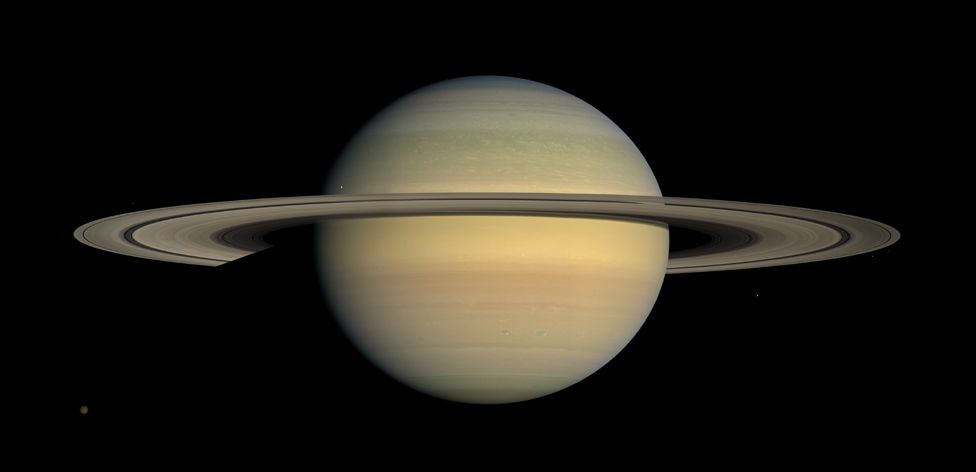
Saturn, the ringed planet
By Michel Gravereau
The summer sky is gradually arriving, and all amateur astronomers and astronomy enthusiasts are eagerly awaiting the appearance of the celestial marvel: Saturn.
It still rises a little late, around 2:00 a.m., but day by day, its rising time is advancing by four minutes, which means that in August, it will deign to appear before us at convenient hours and enchant all our autumn and winter nights.
A marvel of celestial marvels, I said. But only with a telescope, because to the naked eye, nothing distinguishes it from an ordinary star. Read more...
The Sun Shines
By Michel Gravereau
On these sweltering days, when presenting the Sun to the public, the inevitable question arises: is the Sun responsible for this heat we are experiencing?
Of course, it would be completely foolish to answer that it has nothing to do with it, since we have been living thanks to the Sun and the heat it has been radiating for nearly 5 billion years.
But it must be strongly stated that these changes observed in the various climates of planet Earth and their resulting consequences are, so to speak, the product of human activities and their influence on the atmospheric layers that are supposed to protect us, but which will kill us in the long term if we continue to alter their composition. See the articles published on this site concerning the greenhouse effect.
Once again, it is absolutely essential not to systematically link solar activity and global warming.
The Sun shines brightly and bathes us in a thousand lights because it has at its center an immense nuclear power plant which, from matter, produces energy in the form of light and heat... Read more...

ISS, International Space Station
By Michel Gravereau
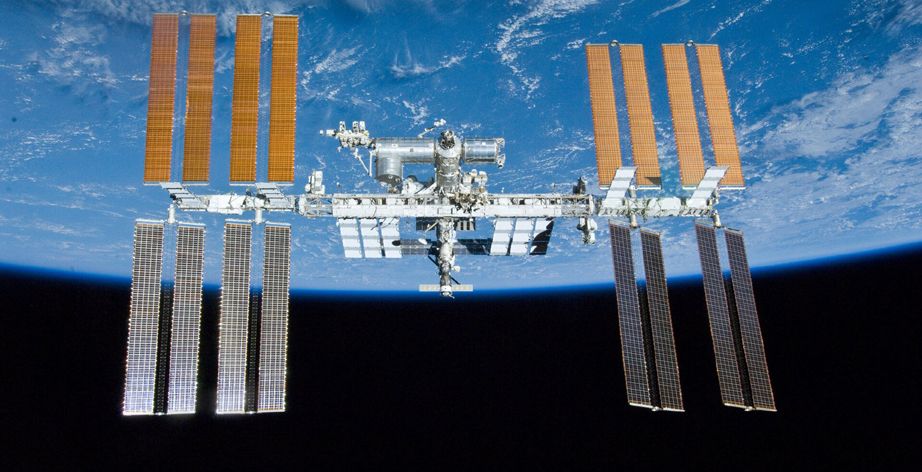
While our stargazing evenings certainly captivate audiences with the sight of craters on the Moon or the beauty of Saturn's rings, I've long noticed that another event thrills young and old alike: the anticipated arrival of the International Space Station in the sky.
Indeed, moving from west to east, on certain evenings (or mornings), a small point of light appears above the horizon and rises in the sky, increasing in brightness until it sometimes becomes the brightest object in the sky.
Its slow passage, lasting approximately 5 to 6 minutes, allows it to be admired by everyone. When this sighting is combined with a live image from the "Destination Orbit" website, projected onto a large screen, it's no longer just an activity we're doing, it's magic, and the audience's satisfaction is immense.
What is the ISS? ... Read more...
Pluto, Dwarf Planet
By Michel Gravereau
We all learned that the solar system had nine planets. A single sentence could even help us place them in order of distance from the Sun: Me (Mercury) Here (Venus) All (Earth) Cute (Mars), I (Jupiter) Am (Saturn) One (Uranus) New (Neptune) Planet (Pluto).
Today, in schools, our children are learning that our large family, the solar system, has shrunk to eight. What happened? Who stole the ninth?
Let's find out.
In January 1930, a young American astronomer, Clyde Tombaugh, took two photos of the same part of the sky, a week apart. Comparing the two images, he declared victory: he had found what he was looking for. A tiny dot had shifted in the space of a week. It can only be a planet. Read more...

The Constellations of the Zodiac.
By Michel Gravereau
Since the beginning of my articles, I have discussed the constellations, and often I talk about the Zodiac. Just last week, when discussing Jupiter and Venus, I placed them in Gemini.
Why do these constellations attract more attention than others?
Of course, everyone knows the Big Dipper, the Little Dipper, and the three constellations that house the three summer stars: Cygnus, Lyra, and Aquila.
Everyone also knows their Zodiac sign.
What is it, one of our brilliant leaders might have asked?
The Zodiac is the band of the sky where we see the Sun, the Moon, and the planets move, as seen from Earth. Indeed, since the solar system is relatively located on a disk, with the exception of Pluto, which is seen from Earth, they can only appear in the same "corridor." A highway, in a way, for our star, our natural satellite, and the other planets.
In antiquity, the Greek Hipparchus (2nd century BC) divided this band of the sky into twelve segments: the constellations of the Zodiac.
For reference, these are Aries, Taurus, Gemini, Cancer, Leo, Virgo, Libra, Scorpio, Sagittarius, Capricorn, Aquarius, and Pisces... Read more...

Venus Passes Ahead of the Sun
Even before night spreads its black velvet cloak over us, a firefly appears above the point where the Sun has retreated for the night, towards the western horizon. It is Venus, the second planet from the Sun in our solar system.
When this article is published on June 9th, Jupiter will deign to show itself, right next to Venus, also in the constellation of Gemini. Then, day after day, the two planets will seem to move further apart. On the 17th, you will be able to admire Venus flirting with the Sun in the form of a thin crescent moon. No doubt that with Jupiter below, the spectacle will be well worth a few moments of attention and reverie before the beauty of the celestial vault. Read more...

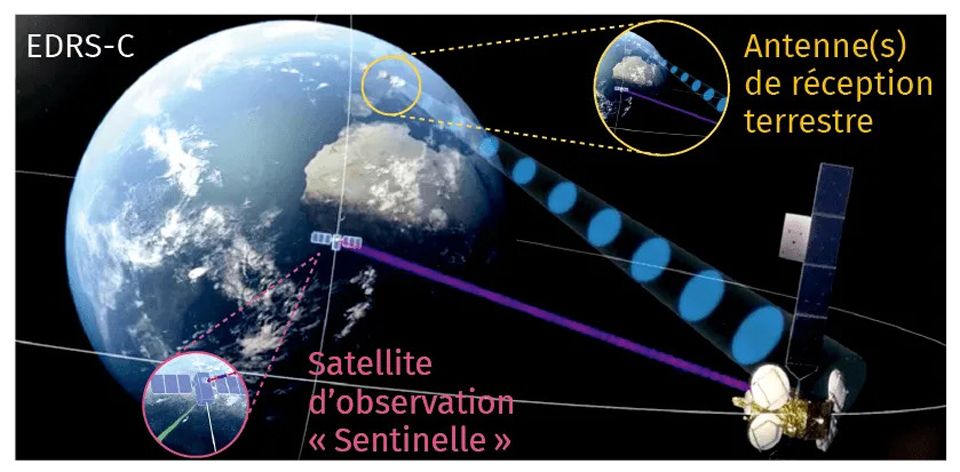
Geostationary Satellites
How many times, during our evenings, while admiring the satellites streaking across our sky, have I heard it said that geostationary satellites don't move in the sky, that they are motionless. A fundamental error.
Placed into orbit for specific purposes, such as weather forecasting (Meteosat satellites for Europe), telecommunications and television (Eutelsat for European coverage), or specific area monitoring (agriculture, military situation, urban planning, GPS), these satellites occupy a well-defined position relative to Earth.
The Earth rotates on its axis in 23 hours, 56 minutes, and 4 seconds. Therefore, the satellite must rotate at the same speed to always appear in the same position in the sky, as seen from Earth. Read more...
The Influences of the Moon.
By Michel Gravereau
The belief that the Moon influences humans is lost in the mists of time. It is still present in our vocabulary: don't we say of a person with changeable behavior that they are "moody"?
And of someone in a bad mood, that they are "in a bad mood"?
As for the myth of the werewolf, it is said to reflect the strange behavior of certain animals during a full moon. However, the only proven fact is that the Moon, when full, considerably illuminates the night sky, and that animals are sensitive to this variation in brightness.
So what are the known influences? ... Read more...
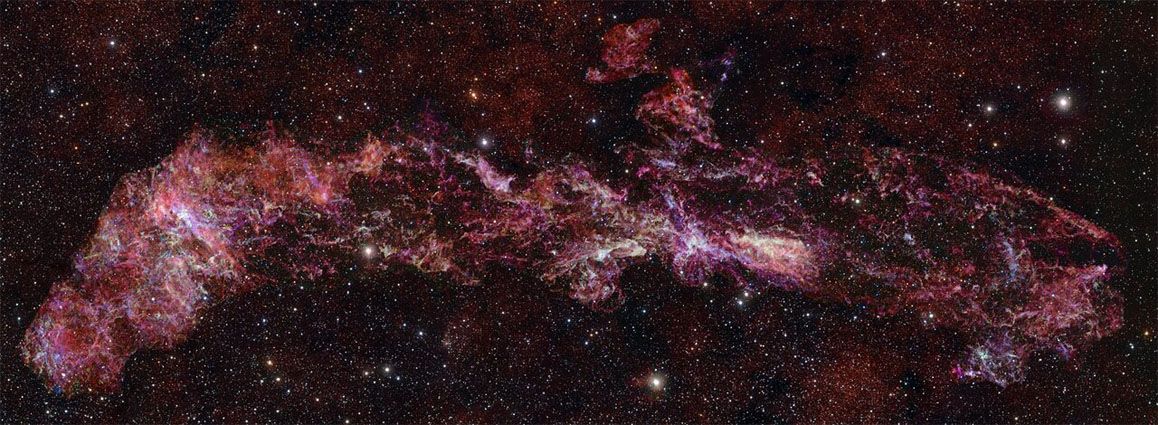
Red Sun
Who hasn't marveled at a magnificent sunset at the end of the day, alone, as a couple, or with friends? This breathtaking spectacle, which illuminates the horizon with its coppery hue, gives the sun a red tint, almost visible to the naked eye, whereas just a few minutes earlier, the sunlight was simply unbearable.

When the sun reaches the lowest point of the horizon, its light passes through ten times more atmosphere than when it is high in the sky. Let's not forget, once again, that the Earth is round and that for the same thickness of atmosphere, the tangent from your observation point will pass through more atmospheric gas than a vertical line.
I've already had occasion to... Read more...
The Spectacular Phases of the Moon
By Michel Gravereau
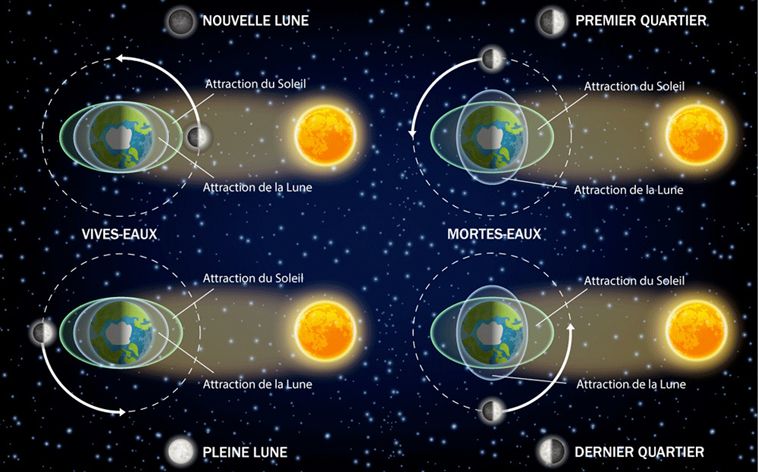
Since time immemorial, humankind has observed, day after day, night after night, Earth's natural satellite, the Moon, in its perpetual journey around our planet. And each day, it is different; either it reveals a little more, it is waxing, or it hides a little more from us, it is waning.

Why do we have this spectacle?
First, let's remember that the Moon is round and that the light of the Sun, our star, only illuminates half of it, as with any sphere.
The Moon orbits the Earth at approximately 480,000 km, while the Sun is infinitely farther away, at 150 million kilometers. In its journey, the Moon will therefore pass between the Earth and the Sun. ...Read more...
The night is dark
By Michel Gravereau.
While during the day the Sun illuminates our entire environment—cities, landscapes, oceans—when it dips below the horizon in the evening, everything becomes dark again, without brilliance. The streetlights have gone out, and these thousands, these billions of stars appear, each a streetlight in its own right. With this armada of fireflies, shouldn't our sky be permanently lit? A vast question that has fascinated astronomers for four centuries.
We know that light travels at a finite speed in space, on the order of 300,000 km per second. Therefore, it takes a certain amount of time to reach us, coming from stars located at varying distances. The light from some celestial bodies located very far from us has not yet reached us. If this weren't the case, our nights would be intensely bright.
Assuming an infinite Universe containing an infinite number of stars, the light generated should illuminate the firmament as if it were broad daylight.
In reality, beyond a certain point, no light source can illuminate us... Read more...
Temperatures in Space
By Michel Gravereau
We Earthlings cannot imagine the extreme conditions that prevail beyond our atmosphere.
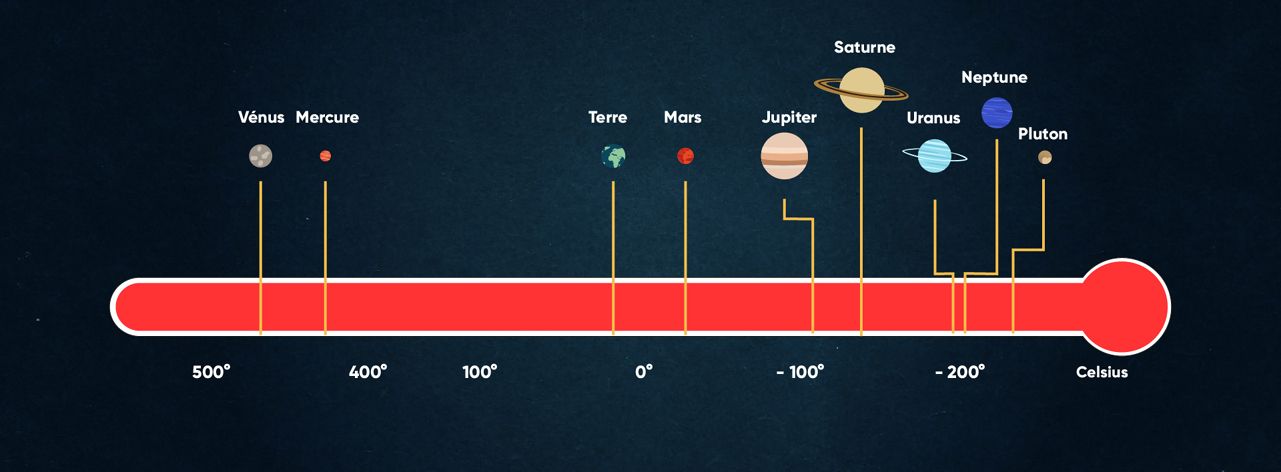
Indeed, even if a seasoned traveler on Earth can encounter significant temperature variations, whether strolling under the scorching African sun or visiting Antarctica, this is nothing compared to our astronaut who would be taking their spacesuit, even just within the solar system.
Let's consider the thermal protection they would need to carry.
First, while temperatures can reach millions of degrees above zero, the lowest temperature in the Universe, far from any heat source, cannot fall below -270°C.
However, as soon as one approaches a heat source—a star, planet, or gas cloud—the temperature rises very rapidly, but always remains proportional to the distance. ...Read more...
Managing the Passing Days
By Michel Gravereau
Marignan: 1515.
How many times have you been asked your date of birth?
Do you know anyone born on February 29th who only celebrates their birthday every four years?
We could go on with these kinds of questions for a long time, questions that relate to the passage of time inscribed on our calendars.
Speaking of which, our 28, 29, 30, or 31-day calendar, where does it come from, and isn't it the result of humanity's perpetual concern with knowing how to measure time?
The Romans.
More than 2,000 years ago, in 46 BC, Julius Caesar commissioned the Greek astronomer Sosigenes of Alexandria to invent a calendar that would put an end to the enormous imperfections of the previous one, which, depending on the year, had 12 or 13 months. Indeed, it was based on the phases of the Moon, which renew themselves every 29.5 days. Thus, we had months of 29 and months of 30 days, totaling 354 days in the year.
To correspond with the seasons, it was necessary to add a thirteenth month every three years.
To achieve this, Sosigenes took the solar year, 365.25 days, and had the idea of dividing it into 12, alternating months of 30 and 31 days. Since February was the first month of the year for the Romans, it would only have 28 months. To reach 0.25 and align with the Sun, it was necessary to add a day every 4 years, hence the famous leap year... Read more...
The Distance to the Stars
By Michel Gravereau
With modern geolocation instruments, GPS in particular, it is easy these days to know exactly where we are.
But as soon as we leave Earth, distances seem to increase at a considerable rate, and the units known on Earth for calculating distance seem quite insignificant in space.
On Earth, dragging a topographical line behind us, like a legionnaire in French Guiana during a deep-sea mission, the markers on our roads, the surveyor's measuring tape, etc., are no longer sufficient.
How can we find the distance between Earth and a planet, or a star?
To the human eye, stars appear fixed relative to one another throughout our lives. This is only an illusion, because nearby stars move across the celestial sphere if we observe them six months apart.
In reality, this very slight movement is solely due to the Earth's movement in its orbit around the Sun, like when you travel by train and see the landscape "go by." This apparent movement is a boon for astronomers: however tiny it may be, it allows them to measure the distance to nearby stars... Read more...

Telescopes
Eye glued to the end of the telescope.
Since the beginning of my publications, I've been talking to you about telescopes, those instruments capable of admiring the sky up close, where we find the Moon, the planets, the stars, the nebulae, the galaxies, and more.
But what are these instruments, and who invented the principle?
Before 1671, there was the astronomical telescope, which allowed for the magnification of distant objects. It consisted of a tube with a glass lens at the entrance (where the light enters) and another at the exit (where the observer looks).
In 1608, the Dutch optician Hans Lippershey developed a spyglass, which made it possible to see distant objects more clearly. The problem was that the magnification achieved significantly distorted the objects. The following year, Galileo learned of this invention and undertook to improve it in order to point it towards the stars. Galileo's telescopes were not all of high quality; the image was still quite distorted. However, these telescopes were the most powerful of their time, magnifying celestial objects up to 30 times.
In 1671, the great English scientist Isaac Newton, whom some scientists consider one of the greatest geniuses of all time, presented a completely new observational instrument. This instrument used mirrors instead of glass lenses, like the telescope Galileo had used in 1609: the telescope was born. Read more...
.jpg?t=aeb8a500_42ca_451a_ab7f_8e5528b4f20b)
Man on the Moon
We are approaching the launch of Artemis 2, perhaps on April 1, 2026, and Artemis 3 next year. This latter mission should see humans set foot on the Moon again, this time not to collect rocks and study them in laboratories after their return to Earth, but to build a permanent base where teams of humans will take turns conducting scientific studies in a non-terrestrial environment.
Man on the Moon. How many men have walked on the lunar surface? More than 50 years after the last mission, when I ask this question, I never get an answer... Read more...
Orion, a magnificent constellation.
Around mid-May, it will disappear from view as the Sun moves into the neighboring constellations of Aries, Taurus, and then Gemini. So, while there's still time to observe it, a few words about this constellation.
According to legend, Orion was a hunter who roamed the celestial expanses.
From the end of December, in the early evening, this magnificent constellation begins to rise above the horizon. It is then visible in the early evening during the long winter nights. It offers the observer one of the most beautiful celestial jewels: the Great Orion Nebula, one of the few deep-sky objects visible to the naked eye. Certainly, after the Moon, it is also the most photographed object by amateur astronomers. ... Read more...

Solar Eclipses.
By Michel Gravereau
For some time now, I have been drawing your attention to Wednesday, August 12, 2026, in the late afternoon, when we will witness a solar eclipse, almost total if you are in the far south of France.
Many remember the one on August 11, 1999, which passed through northern France.

Seen from Earth, the Moon and the Sun appear the same size.
This "disappearance" of the Sun would not take place before our eyes without a fortunate coincidence: seen from Earth, the celestial body of our nights and the celestial body of our days have the same apparent size. This similarity is only apparent because, while the Moon is approximately 3,700 km in diameter, the Sun is 1,400,000 km. The average distance from the Moon to Earth is 380,000 km, while the Sun is nearly 150 million km away.Read more...
When the Sun Dies
We have become accustomed to thinking that the beginning of the Universe was marked by that immense explosion called the "Big Bang," about 15 billion years ago.
Our solar system was born much later, only 4.8 billion years ago. At the center, the Sun, our star, reigns supreme. It seems eternal, indestructible, and yet, like everything else, like all stars, it was born, it lives, and it will die.
It is currently halfway through its existence.
Here, in broad strokes, is the chronicle of this predicted death.
In about 5 billion years, it will swell enormously, reaching a size 20 times greater than its current size, and will begin to shine brighter than ever before. It will then engulf most of the planets in the Solar System, including Earth, in its blaze.
Its programmed end will be full of twists and turns. Its brightness, size, and temperature will fluctuate until it reaches the final stage of its life, becoming a dark, cold body that will slowly burn out.
For us, who have warmed ourselves in its light since the beginning of time, it's hard to imagine that it isn't eternal.
During this long agony, and contrary to what one might think, the planets closest to it won't freeze solid but will be charred by the Sun's intense heat... Read more...

The Moons of the Solar System.
Since the launch of numerous man-made satellites of all kinds—communication, weather, military, etc.—the term "satellite" has been applied to them, and the natural satellites of the planets have taken the official name "moon."

Are there moons around all the planets?
Indeed, Mercury and Venus have no moons.
Earth has one, 3,476 km in diameter. Earth is considered the poor relation in terms of the number of its moons, as the other planets have plenty... Read more...
Shooting Stars
Especially when summer arrives and the sky is perfect for a few nighttime strolls, our gaze turns to the celestial vault. There, the stars shine brightly, the planets illuminate us with a more intense glow, and the Moon plays with its quirks.
Sometimes, the sky is streaked with these phenomena we call "shooting stars." A time to make a wish. But what exactly is a shooting star?
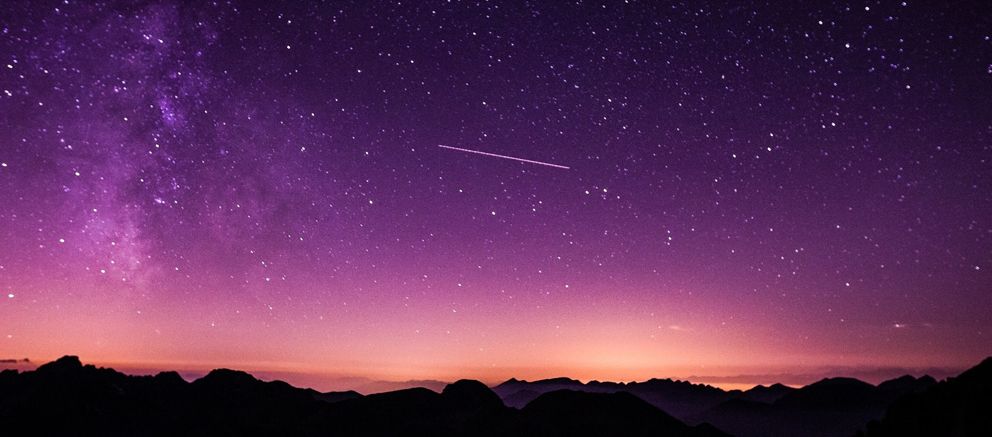
About ten times a year, Earth passes through a region rich in comet debris, resulting in a meteor shower.
The ancients believed that stars could detach from the celestial sphere and fall towards Earth. This, at least, is how they explained these strange and ephemeral luminous trails that we now call "shooting stars."
We now know that this phenomenon does not occur in the distant cosmos, but in Earth's atmosphere, and that it involves not stars, but small masses, typically weighing only a few grams.
Earth receives 10 tons of this material per day.
Comets
By Michel Gravereau
I have often addressed the topic of comets, often called "the great travelers." Where do they come from, and what do they represent?
In the past, humankind has often asked itself many questions and has been unable to help but attach undue importance to the appearance of these celestial bodies in the sky.
Imagination has gone far beyond what is reasonable.
.jpg?t=aeb8a500_42ca_451a_ab7f_8e5528b4f20b)
Where do comets come from?
Surrounding the solar system, two large reservoirs provide the majority of the comets we see passing through our sky.
The Oort Cloud
There, in a vast, icy expanse, orbit blocks of ice and rock, the nuclei of future comets. Astronomers estimate... Read more...
The Moon: Creation and Hidden Side. 2/2
The Far Side of the Moon.
The Moon always shows the same face to Earth. This is due to its very particular motion: the Moon takes exactly the same amount of time to rotate on its axis as it does to orbit the Earth. Viewed from Earth, the Moon therefore has a visible side and an invisible side, known as the far side.
The far side remained truly unknown until October 1959. At that time, the Soviet probe Luna 3 transmitted average-resolution images of this side. Since then, the American Lunar Orbiter probes, between August 1965 and 1966, have revealed high-resolution images. The Apollo missions contributed to further understanding.
Today, the Moon is fully mapped with very high precision. Read more...
.jpg?t=aeb8a500_42ca_451a_ab7f_8e5528b4f20b)
The Moon: Creation and Hidden Side. 1/2
By Michel Gravereau
When this text is published, the media will undoubtedly be reporting on a current global event: for over 50 years, three men and one woman have been orbiting the Moon in the Orion capsule, before humans establish a permanent base, likely next year.
This will remind older generations of that memorable Christmas night in 1968 when Apollo 8, carrying Frank Borman, James Lovell, and William Anders, orbited our natural satellite, the final rehearsal for the historic day of July 20, 1969.
The Moon. The one that attracts all eyes, that is involved in so many supposed dramas, that stirs our oceans with the ebb and flow of the tides, the moon of gardeners.
But do we know the latest news about this Moon, its creation, and especially what its hidden side is? Let's try to shed some light on the subject.
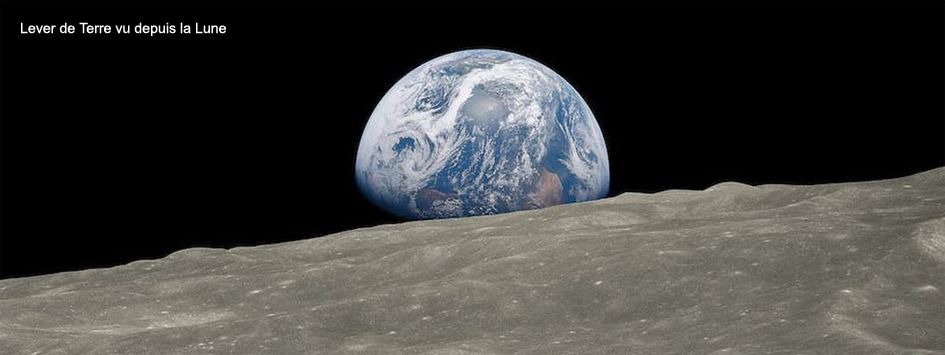
A long time ago, when I started studying astronomy, four theories were debated about its creation. It seems that today, only one is accepted.
Our satellite, the Moon, was born from a tremendous collision 4.5 billion years ago: that of the very young Earth with a celestial body the size of Mars (half the size of Earth). The force of the impact pulverized part of our planet's mantle. These debris, ejected into space, would then have formed a ring of matter around Earth, before quickly coalescing to give birth to a single celestial body: the Moon. Read more...
Our Atmosphere and the Greenhouse Effect. 2/2
A global hothouse.
The greenhouse effect is a natural phenomenon: certain gases present in the atmosphere from the beginning, primarily carbon dioxide, act as veritable heat traps. They are called "greenhouse gases" because they transform the atmosphere into a gigantic hothouse, allowing sunlight to penetrate but preventing heat from escaping. Sunlight warms the Earth's surface. After being absorbed by the ground, this heat is re-emitted outwards and, if there were nothing to prevent its escape, it would be immediately released into space.
In this case, the temperature at Earth's surface would be -22°C. At such a temperature, all the water on Earth would be frozen, making the environment hostile to the development of life. Fortunately, greenhouse gases in the atmosphere act as a "lid": the heat radiated by the surface "bounces" off their molecules, like light off a mirror, and returns to the surface.
The heat eventually dissipates, but not without bouncing back several times, which helps maintain the atmosphere at an overall temperature of 15°C. Nevertheless, an excess of greenhouse gases can cause global overheating, as is the case on Venus, whose atmosphere is very rich in carbon dioxide. Consequently, the surface of Venus is a veritable inferno: temperatures there reach 480°C. The level of carbon dioxide, the main greenhouse gas, has increased by more than 30% in 150 years due to industrial emissions. This results in a 1°C increase in the average global surface temperature and a 20 cm rise in sea level due to melting ice. Read more...

Our Atmosphere and the Greenhouse Effect. 1/2
By Michel Gravereau
Not a day goes by without hearing in the media that this or that event is due to "global warming." It's a convenient scapegoat.
Undeniably, the warning lights are flashing red, and despite the good decisions made by some, bad habits persist. The latest report indicates a slowdown in the reduction of greenhouse gas emissions for France in 2025 and a significant increase in emissions for the United States. France accounts for only 1 percent of global emissions.
I would like to remind you that scientists' concern about global warming is not new, since as early as 1873, the World Meteorological Organization (WMO) was already holding meetings on the subject. This would lead much later to the first Earth Summit, held in Rio in 1992.
At the time, Mr. Diesel hadn't invented his engine, and airplanes weren't crisscrossing our atmosphere. Let's try to get a clearer picture of our Earth's atmosphere and what we call greenhouse gases.
How far does the Earth's atmosphere extend?

Jupiter, the largest planet in the solar system.
Jupiter easily wins the title of largest planet in the solar system. Its diameter at the equator, 142,800 km, is more than 11 times that of Earth (12,760 km), giving it a volume equivalent to 1,400 times that of our planet. Only Saturn, with its 120,600 km diameter at the equator, could hope to rival it, but even then, Jupiter remains undefeated. It is, however, still modest compared to the Sun, whose diameter is nearly 10 times greater.
Jupiter, a true giant. It is not for nothing that it bears the name of the father of all the gods in Roman mythology.
To get an idea of the size difference between Jupiter and Earth, imagine that Earth is represented by a cherry; Jupiter would be a soccer ball (22.4 cm). The Sun, on the other hand, would be a sphere 2 m in diameter. Read more...

Life on Earth
On Earth, the extinction of the dinosaurs and the emergence of humankind.
I was surprised by an image depicting men, admittedly dressed in animal skins, hunting dinosaurs. How can we allow the idea to creep into the minds of our children that these two living species could have coexisted?
Let's briefly recall these periods when Earth was home to these two "colonizers," dinosaurs and humans.
The Extinction of the Dinosaurs
Our solar system, including Earth, was born a little less than 5 billion years ago, to round off the figures.
We have to go back a little over 500 million years to see the Earth begin to show signs of life. Jellyfish and fish began to populate the seas. Then, on the continents, lichens and plants colonized the land.
Next came mammals and dinosaurs at the end of the Paleozoic Era, 250 million years ago. Read more...
_(1).jpg?t=aeb8a500_42ca_451a_ab7f_8e5528b4f20b)
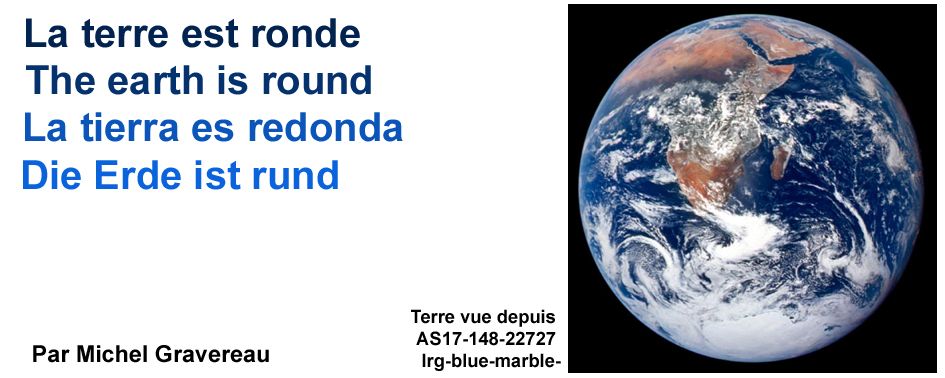
“In the old days,” before a book was published, its content was verified, modified if necessary, and could even lead to legal action.
Today, you don’t need to possess knowledge to claim the right to disseminate and share it. Any fool can enter our homes and spew their ideas through our screens. A new profession has emerged: influencer. Previously, it was called sales representative.
And the worst is yet to come. Artificial intelligence is taking its place in this deluge. Every day, stunned, we witness this drama unfolding before our eyes. We no longer know if this information is real or entirely fabricated.
It's no wonder that weak minds are so easily disturbed.
In my remarks today, I will only mention a recent IFOP poll: 9% of French people believe the Earth is flat, and this figure rises to 24% among teenagers.
Our Earth, what is its shape?
Christmas and the Legionnaire 3/3
Gifts from the Legionnaires
The two photos that follow are characteristic of the enduring spirit of this immortal Legion. General Philippe Rollet at Christmas, speaking with a legionnaire, and a few decades later, General COMLE, Alain Bouquin, presenting a legionnaire with his Christmas gift.

Christmas and the Legionnaire 2/3
Beyond Different Religions
Christmas is a Christian holiday, but throughout the world it symbolizes something powerful. A time to look out for one's neighbor, to share a few words of friendship, messages of hope, and truces in conflicts. One only needs to look at television screens to take a tour of the world of the magical Christmas Eve celebrated across the globe, in the icy cold of Scandinavia, on the sunny beaches of the Southern Hemisphere, among revelers who spend exorbitant sums for the occasion, or with the destitute in the poorest neighborhoods who mark this special day with what little they have.
Regardless of their status, people are keen to mark this tradition of sharing with gifts, and children receive presents commensurate with their social standing. All countries, in a great ecumenical communion, celebrate Christmas, even if they revert to their old habits the very next day. Yes, Mr. Fourcade, it's a shame there's only one Christmas a year! Read more...

Christmas and the Legionnaire 1/3
Then humankind established that the day was the time it took for the Earth to rotate on its axis and the year to complete one orbit around the Sun.
For legionnaires, who have invented their own unique language, the time spent under the seven-flamed grenade is counted differently: "I spent 23 Camerone Days in the Legion." This is, in a way, the "Official Clock." But they can also refer to this time with Christmas, as this moment is a high point in the calendar and activities of our Institution. "Oh time, suspend your flight."
Every officer, non-commissioned officer, or legionnaire remembers with melancholy this holiday that leaves such a deep impression, for it is so naturally aligned with the Legion's raison d'être: to find refuge for wandering people, rejected by society. This refuge offers them solidarity, understanding, material and moral support, and comfort.
But what does Christmas represent on Earth, beyond religions, in its very definition, its date, and of course, the importance this holiday holds for the Legion and its carefully and enduring rituals, established over generations? In this very special time, let us reflect on late December and the symbolism of Christmas. Read more...

The Southern Cross and the Legionnaire.
Every legionnaire today is intimately familiar with the current regiments and their deployments. Some participated in their most recent missions and interventions: the Balkans, Afghanistan, the Sahel. A glance at their decorations is enough to convince oneself, as Napoleon might have said to his veterans at Austerlitz, that "they were there."
For others, older members of our veterans' associations, the memory of the Gulf War, Kolwezi, North Africa, and, more rarely, Indochina, is also etched on their chests.
But these heroic deeds should not make us forget all those units, admittedly less well-known and now defunct, that contributed to maintaining peace, stabilizing our borders, providing aid to populations, and safeguarding France's presence in what we called our colonies. Algeria was the birthplace of the Legion. And on this land, to which they tirelessly returned after their hard-fought battles, to heal their wounds and rebuild their battered ranks, the Legion established numerous small outposts in the Sahara Desert, as it would later do in Indochina, in the Delta, and in the jungle.
Some of these units bore the insignia of the Cross of Agadez, or Southern Cross. These were the CSPL, the Saharan Motorized Company of the Legion.
It would be far too lengthy to mention all these units that proudly displayed the seven-flamed grenade. Life is made up of choices.
Therefore, keeping the "connection" from the heavens—that is, the Southern Cross—as our guiding thread, let us humbly recall some of these ephemeral garrisons established in the middle of nowhere, where the legionnaire once again demonstrated his incredible ability to adapt to climatic, territorial, and human conditions. Apologies in advance to our veterans who may have served in companies not listed here. Read more...

What if we were talking about Mars…in December?
Mars in the human imagination.
How many novels and films have depicted the invasion of Earth by these creatures from elsewhere, from our galaxy or even further afield?
Aboard flying saucers, their movements sometimes shrill, sometimes perfectly still, depending on the witness, equipped with extravagant lights, they come to spy on us, mainly at night, provoking insurmountable anxieties and psychedelic episodes in some humans.
Certainly, they differ from us physically. The authors' imaginations know no bounds. Slanted eyes, missing fingers, including a small one that remains raised, a language supposedly understandable by humans.
And in the majority of these works, one constant remains: they come from Mars. The little green men are after our planet.
When we invite people to look at the Moon through telescopes at our parties, it's not uncommon, far from it, to hear some ask: "Can we see the Martians?" It just goes to show, they're everywhere.
How did they come into being? What does Mars represent? Is it comparable to ours? And when will we see humans on Mars?
Let's try to answer these questions. Read more...
Modern tools for amateur astronomers.
Gone are the days when we had to wait for night to envelop us and gradually reveal its beauty by lighting up the stars, one after another.
Only then could we discover an intruder in a particular constellation: a planet passing through on its eternal journey around the Sun; or even better: the ultimate surprise, the presence of a comet.
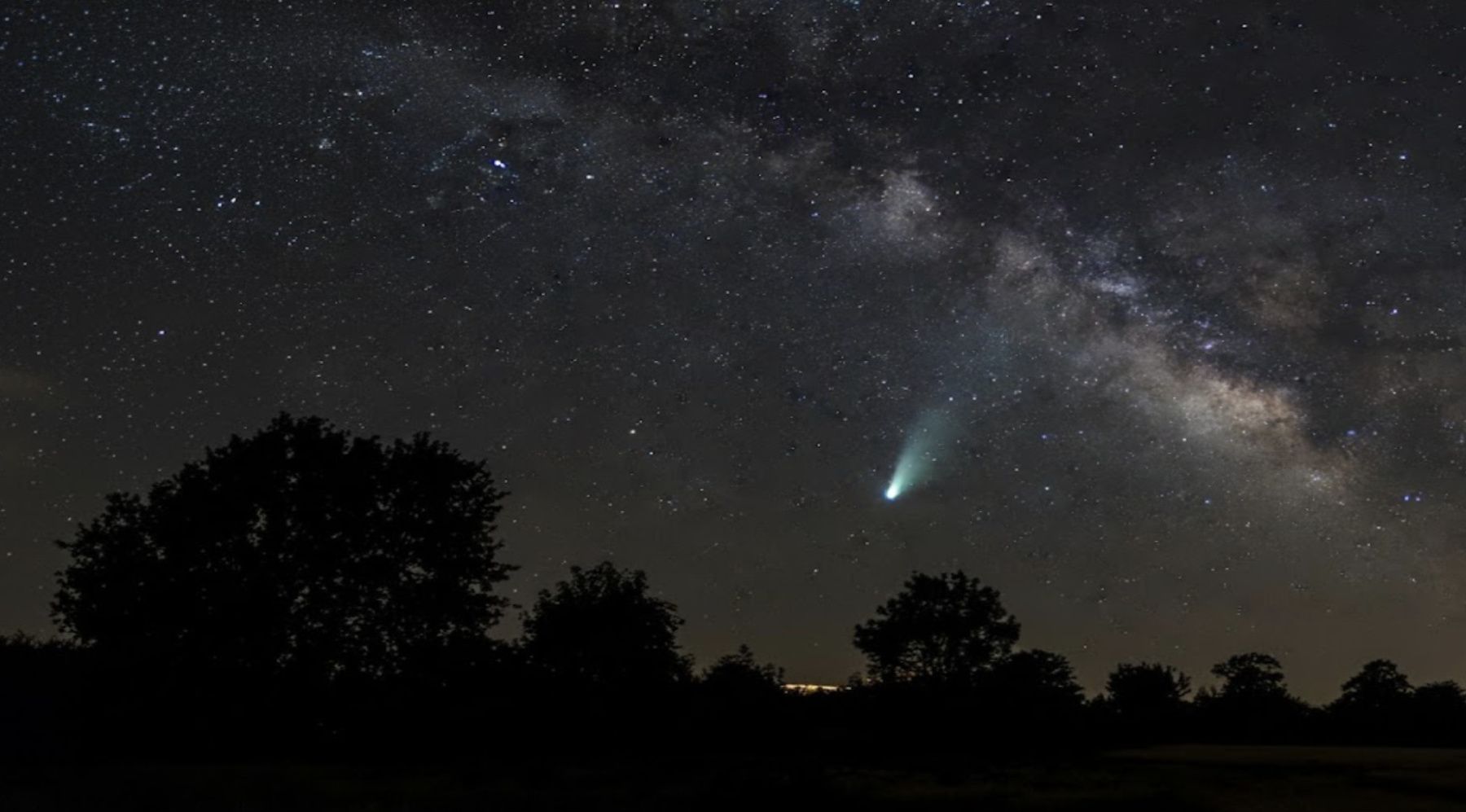
The highlight of the evening: we invite the audience to look towards a very specific point in the sky, and at the appointed minute, we point a laser at this small luminous object that will slowly traverse the celestial vault: the ISS, the International Space Station. Down to the exact hour, to the second. Enough to make our SNCF railway workers dream! Read more...
The Sky and the Legionnaire
One might think it's the title of a fairy tale. It's not. Simply a parallel one might dare to draw. It's risky, but on closer inspection…
The war memorial in Aubagne displays, in its gilded splendor, the countries where the Legion has fought throughout its history.
In Sidi Bel Abbès, our predecessors began their careers at the foot of this monument and returned there tirelessly to finish their journey.
Stone by stone, this symbol was dismantled and brought back to Aubagne, where today's legionnaire begins and ends his time in the Legion. At the foot of the Boule, as some say.
All one sees is the gold, symbolizing the battles fought by this troop that came from everywhere to fight everywhere. There is nothing more powerful. Read more...

The Constellations of the Zodiac
Night after night, the stars return to the same positions relative to one another. Since their arrival on Earth, humans, observing the sky revolving around them, quickly understood that they could use it as a guide.
To this end, they soon divided the celestial vault into drawings representing objects, animals, and figures. The constellations were born.

Observational Instruments
Some will have the brilliant idea of ordering a telescope, a chance to travel into space and escape from earthly worries.
With a little over 60 years of experience, may I offer some useful advice to these future astronomers? For years, I've organized practical evenings for the setup of telescopes sold by chain stores, whose salespeople, despite the inscription on the back of their T-shirts, are not necessarily experts in the field. What should you choose?

Observational Instruments
Some will have the brilliant idea of ordering a telescope, a chance to travel into space and escape from earthly worries.
With a little over 60 years of experience, may I offer some useful advice to these future astronomers? For years, I've organized practical evenings for the setup of telescopes sold by chain stores, whose salespeople, despite the inscription on the back of their T-shirts, are not necessarily experts in the field. What should you choose?
First of all, I'm clear: the most important thing in a refractor or telescope is its mount. It sounds strange, but that's how it is. Lightweight mounts, made of plastic or aluminum, should be avoided. We observe the sky OUTSIDE, therefore, exposed to the slightest breeze. If your instrument experiences even the slightest tremors, this refractor, this telescope, will soon end up in the back of the garage. Disgusted.
The Sky of Camerone
April 30, 1863. Camerone. It is the privileged moment when we feel the pulse of legionary solidarity. Across the earth, we share in the memory of these 63 men who, that day, inscribed in the most glorious pages of the French Army, their courage and respect for their given word. In all the regiments, in all the Veterans' Associations, we listen at attention to the account of this memorable battle.

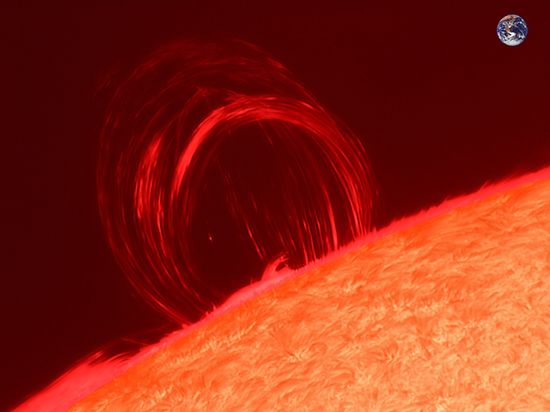
WHAT IS THE NORTH STAR
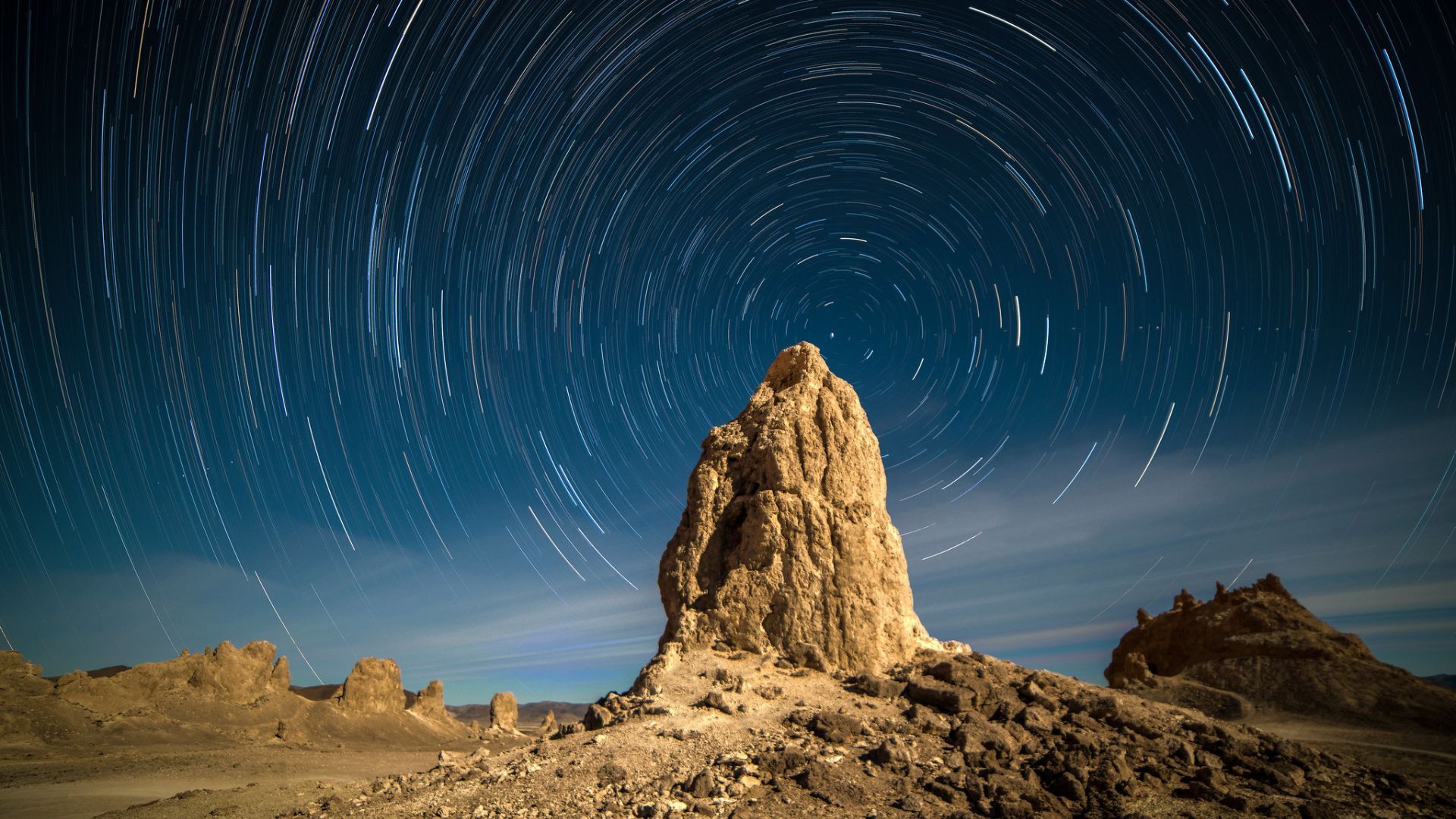
WHAT IS THE SKY

Which Legionnaire has never looked up at the celestial vault, whether in the vast deserts of Africa, offshore on a Polynesian atoll, or simply far from any human presence?
Alone facing the sky, everyone has at one time or another wondered about the universe and the place of our "nanoplanet" in this infinity. Questions abound, answers are rare.
Sometimes, one of us, a little more versed in astronomy, would point out a few stars, and a small group would immediately form around him, eager for explanations. This shows how deeply this immensity speaks to us.
Our comrade and friend, Michel Gravereau, a former member of the Legion whom I met in 1983 at the 3rd REI in French Guiana, has been passionate about astronomy since childhood. I asked him to share his knowledge in a dedicated section on our website. He readily and enthusiastically accepted.
Thank you, Michel.
Louis Pérez Y Cid