






All this is happening above our heads
ISS, International Space Station
By Michel Gravereau
While our stargazing evenings certainly captivate audiences with the sight of craters on the Moon or the beauty of Saturn's rings, I've long noticed that another event thrills young and old alike: the anticipated arrival of the International Space Station in the sky.
Indeed, moving from west to east, on certain evenings (or mornings), a small point of light appears above the horizon and rises in the sky, increasing in brightness until it sometimes becomes the brightest object in the sky.
Its slow passage, lasting approximately 5 to 6 minutes, allows it to be admired by everyone. When this sighting is combined with a live image from the "Destination Orbit" website, projected onto a large screen, it's no longer just an activity we're doing, it's magic, and the audience's satisfaction is immense.
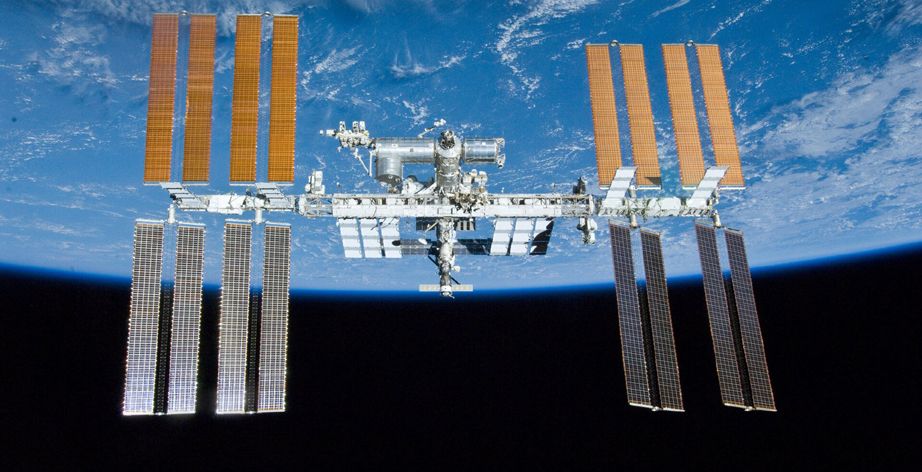
What is the ISS?
While Americans were frolicking on the Moon collecting rocks, in 1971, the Soviets placed the first space station, Salyut 1, into orbit around the Earth. It remained in orbit for 175 days, and cosmonauts lived aboard for 23 days.
A new step had been taken. Humans could live somewhere other than on Earth. Salyut saw other models follow, culminating in Mir. The Americans also embarked on this path of the space station, particularly with Skylab.
Then, under Reagan's leadership, in 1984, the project to install a large station up there was decided. NASA was joined by the Japanese (JAXA), European (ESA), Canadian (CSA), and finally Russian (ROSCOSMOS) agencies in 1993 after the dissolution of the Soviet Union.
The first elements of the station were delivered in 1998 using the five space shuttles Columbia, Endeavour, Challenger, Discovery, and Atlantis.
This process lasted 13 years, until July 2011 when the final element was assembled.
It took 146 shuttle flights to build this giant Lego set, this Meccano set of spacecraft, allowing crews to stay there for an average of six months per mission. Resupply of water, fuel, clothing, various equipment, and food is provided by large Japanese HTVs, European ATVs launched from Kourou, or Russian Progress spacecraft.
Once unloaded, they are filled with station waste and then descend back to Earth at 29,000 km/h, where they disintegrate in the atmosphere over the Pacific Ocean.
Which subway line should I take to get to the ISS? Initially, after the retirement of the Space Shuttle in 2011, the Russians were the only ones capable of transporting humans. Launch from Baikonur in Kazakhstan.
The Soyuz capsule had three seats, which were always occupied by an American and a Russian on each mission. It's encouraging to see that the scientific community is more reasonable than the political one. People can work together.
A new step had been taken. Humans could live somewhere other than on Earth. Salyut saw other models follow, culminating in Mir. The Americans also embarked on this path of the space station, particularly with Skylab.
Then, under Reagan's leadership, in 1984, the project to install a large station up there was decided. NASA was joined by the Japanese (JAXA), European (ESA), Canadian (CSA), and finally Russian (ROSCOSMOS) agencies in 1993 after the dissolution of the Soviet Union.
The first elements of the station were delivered in 1998 using the five space shuttles Columbia, Endeavour, Challenger, Discovery, and Atlantis.
This process lasted 13 years, until July 2011 when the final element was assembled.
It took 146 shuttle flights to build this giant Lego set, this Meccano set of spacecraft, allowing crews to stay there for an average of six months per mission. Resupply of water, fuel, clothing, various equipment, and food is provided by large Japanese HTVs, European ATVs launched from Kourou, or Russian Progress spacecraft.
Once unloaded, they are filled with station waste and then descend back to Earth at 29,000 km/h, where they disintegrate in the atmosphere over the Pacific Ocean.
Which subway line should I take to get to the ISS? Initially, after the retirement of the Space Shuttle in 2011, the Russians were the only ones capable of transporting humans. Launch from Baikonur in Kazakhstan.
The Soyuz capsule had three seats, which were always occupied by an American and a Russian on each mission. It's encouraging to see that the scientific community is more reasonable than the political one. People can work together.

The third seat was assigned to either an American, a Russian, a Japanese, a Canadian, or a European. Thus, on November 17, 2016, Thomas Pesquet launched from Baikonur for his first mission to the ISS.
The station is designed to accommodate two crews, or six people. But, starting in 2020, seven people will have to live up there, since Elon Musk's SpaceX will add another means of transporting astronauts: the four-seat Crew Dragon capsule. In 2021, our very own Thomas will launch on his second mission. He will even take command in July 2021.
Today, French Air Force officer Sophie Adenot has been aboard the ISS since February 13, 2026.
Before space and its various platforms one day welcome tourists, for the time being, the International Space Station is reserved for scientists. The latest news predicts that it will remain in service until 2030. And after that? That's the big question, because since 2014, its expiration date has been pushed back year after year.
Some facts about the ISS:
It orbits approximately 400 km above the Earth's surface.
It completes one revolution around the Earth in 1 hour and 35 minutes. That means it travels at 29,000 km/h. 18 revolutions per day. This also means that for 45 minutes, the station is illuminated by the Sun, and for 45 minutes, it is in the Earth's shadow.
You can see it pass across the French sky in the morning, before sunrise. Otherwise, to see it in the evening, given its orbit, the next time it will appear in the evening will be on July 5th at 11:38 PM, when it will be particularly bright.
I'm giving you two websites to consult.
Heavens Above for the various passes. Remember to locate yourself on the map; otherwise, it won't work.
Destination Orbite where you constantly have two live images of the Station: one vertical, and another from a different camera that allows you to watch our planet Earth scroll by below.
Enjoy your viewing, everyone.
The station is designed to accommodate two crews, or six people. But, starting in 2020, seven people will have to live up there, since Elon Musk's SpaceX will add another means of transporting astronauts: the four-seat Crew Dragon capsule. In 2021, our very own Thomas will launch on his second mission. He will even take command in July 2021.
Today, French Air Force officer Sophie Adenot has been aboard the ISS since February 13, 2026.
Before space and its various platforms one day welcome tourists, for the time being, the International Space Station is reserved for scientists. The latest news predicts that it will remain in service until 2030. And after that? That's the big question, because since 2014, its expiration date has been pushed back year after year.
Some facts about the ISS:
It orbits approximately 400 km above the Earth's surface.
It completes one revolution around the Earth in 1 hour and 35 minutes. That means it travels at 29,000 km/h. 18 revolutions per day. This also means that for 45 minutes, the station is illuminated by the Sun, and for 45 minutes, it is in the Earth's shadow.
You can see it pass across the French sky in the morning, before sunrise. Otherwise, to see it in the evening, given its orbit, the next time it will appear in the evening will be on July 5th at 11:38 PM, when it will be particularly bright.
I'm giving you two websites to consult.
Heavens Above for the various passes. Remember to locate yourself on the map; otherwise, it won't work.
Destination Orbite where you constantly have two live images of the Station: one vertical, and another from a different camera that allows you to watch our planet Earth scroll by below.
Enjoy your viewing, everyone.
