



All this is happening above our heads
Do you know…Eratosthenes?
By Michel Gravereau
The world we live in today holds many surprises. The rise of social media and its influencers sometimes makes us question what past civilizations have taught us.
For example, the idea of a flat, motionless Earth, the center of the Universe, so dear to Claudius Ptolemy, has taken root. It is round, animated by a dozen or so movements, and caught up in a barely imaginable stellar choreography.
Yet, if we are to believe recent surveys, it would seem that a large proportion of our teenagers still believe, through the manipulation of social media, that the Earth is flat. Ah, those flat-Earthers!
It's a shame they get their information from their phones rather than from books that recount the lives of great men and their discoveries. Of course, during their time in middle and high school, they will learn about Thales and his parallel lines, they will find the hypotenuse of a right triangle thanks to Pythagoras, they will learn that you can shout "Eureka!" while taking a bath, or that someone else thought of using a telescope to better see what was happening far away in the sky. Galileo Galilei, known as Galileo, will become familiar to them.
The list would be so long that it would fill an entire article.
I will focus on a figure who has long occupied the podium of these extraordinary men, ahead of their time, geniuses who were nevertheless not given the recognition they deserved, such as Galileo, Newton, or Leonardo da Vinci, perhaps because technology did not keep pace with the excellence of their minds.
This man is Eratosthenes. He lived 22 centuries ago. A Greek, he lived in Egypt. Alexander the Great had passed through there during his conquests.

His story is remarkable.
On June 21st, the summer solstice, he noticed that the sun was reflected on the surface of a well in Syene at noon. This city exists today as Aswan. It marks the beginning of Lake Nasser on the Nile and is located on the Tropic of Cancer at 23.5° North.
On the same day, at the same time, he knew that the obelisk in Alexandria, standing perfectly upright, cast a shadow of approximately 7°.
Let's consider this observation. The historical record doesn't specify whether it was the same year or if two different people made this observation.
However, he knew very well the distance between these two cities: 5,000 stadia, which corresponds to approximately 800 km today. Along the Nile, there were no kilometer markers, but the camels' pace was a remarkable metric for all the caravan drivers.
On June 21st, the summer solstice, he noticed that the sun was reflected on the surface of a well in Syene at noon. This city exists today as Aswan. It marks the beginning of Lake Nasser on the Nile and is located on the Tropic of Cancer at 23.5° North.
On the same day, at the same time, he knew that the obelisk in Alexandria, standing perfectly upright, cast a shadow of approximately 7°.
Let's consider this observation. The historical record doesn't specify whether it was the same year or if two different people made this observation.
However, he knew very well the distance between these two cities: 5,000 stadia, which corresponds to approximately 800 km today. Along the Nile, there were no kilometer markers, but the camels' pace was a remarkable metric for all the caravan drivers.
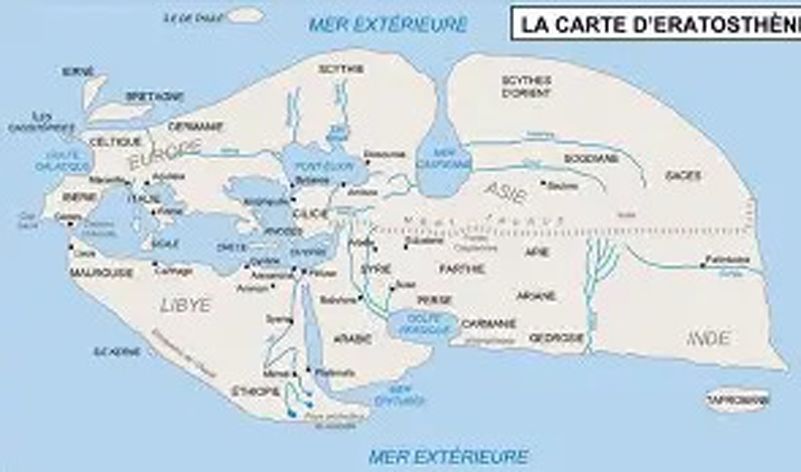
Eratosthenes' reasoning was as follows: if we consider the Earth to be flat, a very distant light source (the Sun) must necessarily be directly overhead at both points simultaneously. If this is not the case, then the surface is not flat, but round.
And he inquired to determine what this sphere on which we live, the Earth, was.
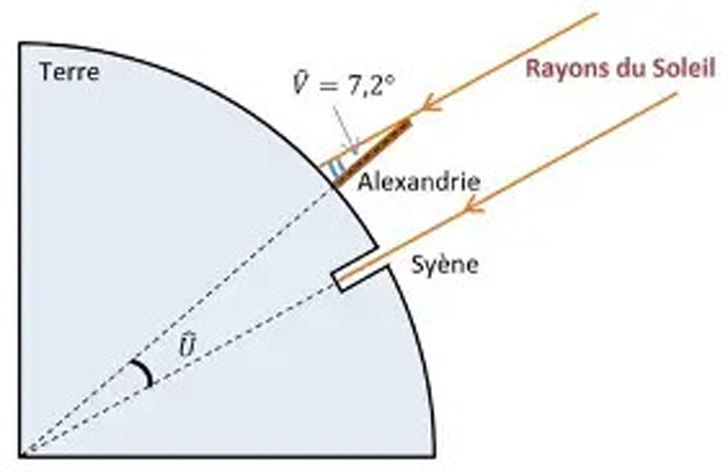
As the diagram indicates, the angle at the Earth's center intercepts an arc that is equivalent in degrees. He calculated 7° for the shadow of the obelisk, so the central angle was 7°, or one-fiftieth of 360°. He simply multiplied the distance between Syene and Alexandria by 50, and he obtained the Earth's circumference. Even in elementary school, 50 x 800 = 40,000.
And he inquired to determine what this sphere on which we live, the Earth, was.
As the diagram indicates, the angle at the Earth's center intercepts an arc that is equivalent in degrees. He calculated 7° for the shadow of the obelisk, so the central angle was 7°, or one-fiftieth of 360°. He simply multiplied the distance between Syene and Alexandria by 50, and he obtained the Earth's circumference. Even in elementary school, 50 x 800 = 40,000.
This is how a man, seemingly outside of time, through a simple observation of the Sun on a specific day, was able to deduce knowledge about our planet.
It's no wonder he is considered the inventor of geography, a term still in use today.
He was certainly not some ordinary man who came from nothing. Quite the contrary. After some twenty years of study with the great scholars of the time, he was appointed director of the Library of Alexandria under Ptolemy III. He had Archimedes' phone number and email address. He taught Aristophanes.
As a philosopher, he wrote numerous works, notably the Suda, which remains famous.
As a mathematician, he developed a sieve, a method used to calculate prime numbers. He worked on the multiplication of the cube and invented the Mesolabus, an instrument that allowed for the calculation of proportional means.
An astronomer, he developed a way to predict eclipses and compiled a catalog of 736 stars. Finally, he demonstrated that the Earth is tilted at 23° 51' relative to the ecliptic, the Sun's equator.
This great man, having become blind, could no longer gaze at the stars. Legend has it that he starved himself to death.
Let us remember Eratosthenes as one of the greatest scientists the Earth has ever known. And before blindness overtakes us, let us sit at night in our garden, on a beach, in peace and quiet, and feast our eyes on the myriad tiny candles that dance above our heads.
It's no wonder he is considered the inventor of geography, a term still in use today.
He was certainly not some ordinary man who came from nothing. Quite the contrary. After some twenty years of study with the great scholars of the time, he was appointed director of the Library of Alexandria under Ptolemy III. He had Archimedes' phone number and email address. He taught Aristophanes.
As a philosopher, he wrote numerous works, notably the Suda, which remains famous.
As a mathematician, he developed a sieve, a method used to calculate prime numbers. He worked on the multiplication of the cube and invented the Mesolabus, an instrument that allowed for the calculation of proportional means.
An astronomer, he developed a way to predict eclipses and compiled a catalog of 736 stars. Finally, he demonstrated that the Earth is tilted at 23° 51' relative to the ecliptic, the Sun's equator.
This great man, having become blind, could no longer gaze at the stars. Legend has it that he starved himself to death.
Let us remember Eratosthenes as one of the greatest scientists the Earth has ever known. And before blindness overtakes us, let us sit at night in our garden, on a beach, in peace and quiet, and feast our eyes on the myriad tiny candles that dance above our heads.
