




All this is happening above our heads
The Solar Eclipse of August 12th
By Michel Gravereau
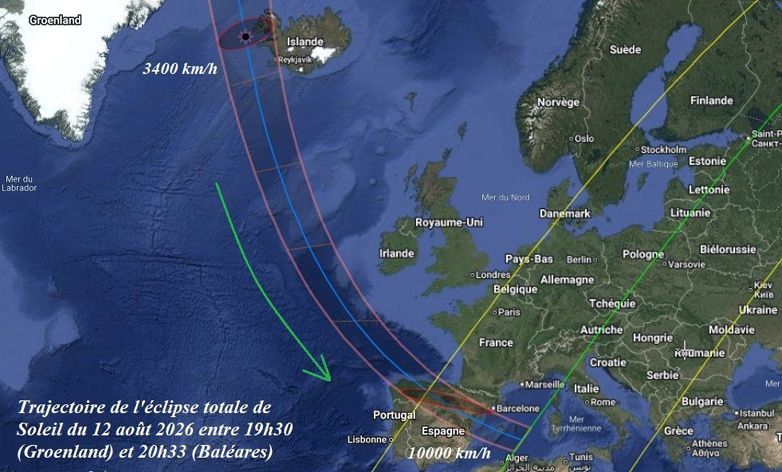
Wherever you are in mainland France, on the evening of August 12th, you will be able to observe the partial solar eclipse. A magical spectacle to experience live, with family, and especially with children.
What is a solar eclipse?
Let's briefly recall what an eclipse is.
In its orbit around the Earth, which takes just under a month, the Moon regularly passes between the Earth and the Sun. However, its inclined plane means that at certain times, it passes slightly above or below the Earth-Sun axis. Nothing happens in these cases. On the other hand, twice a year currently, the Moon passes exactly in alignment with the Sun and obscures it. This is an eclipse that can therefore only occur during a New Moon. On August 12th, the sky will treat us to this spectacle.

To fully enjoy this celestial event, however, it's important to follow certain location and safety recommendations. My goal is to provide them to you.
This eclipse will begin in France around 7:30 pm, that is, at the very end of the day. This means the Sun will be very low on the horizon, at 14 degrees. To give you an idea, your index finger, held at arm's length, represents 10 degrees.
You should therefore choose a location clear of any obstacles—houses, trees, mountains—towards the western horizon. When the eclipse reaches its maximum, it will be 8:30 pm, and the Sun will be very close to the horizon. It will set at 8:50 pm. This means we won't see the Moon disappear from in front of the Sun. I therefore advise you to prepare for this observation by finding a high point near your home, like a hill, or better yet, a mountain, or the edge of the Atlantic Ocean. In short, a place where the Sun will appear to touch the horizon.
How to observe the eclipse?
It's obvious that our eyes can't withstand the intense sunlight. You absolutely must find a way to protect them to see the Moon pass between the Earth and the Sun.
The media will naturally tell you about the special glasses sold for this occasion. That's a good idea; you can find them for around €1 a pair.
They are made with a flexible material called Mylar. Don't crumple them beforehand, as scratches or cracks could let the Sun's rays through.
A pair of your own glasses will also work. And you won't magnify the Sun.
Hence my suggestion, which I will develop in Mèze, at the port, in agreement with the municipality. To allow as many people as possible to enjoy this, you can occasionally bring out an "old pair of binoculars."
WARNING. It is absolutely out of the question to look directly at the Sun with them. This is obvious and would be a crime.
Follow my instructions. Cover one of the eyepieces of the binoculars from the front (the larger end), place your binoculars on the back of a chair, for example, or any other stable support, then, about 1 meter away from the binoculars, place a sheet of white paper and gently move the Sun onto it. You will obtain a disk approximately 10 cm in diameter. If you adjust the focus, you may even be able to detect sunspots as small black dots. The ultimate observation.
This eclipse will begin in France around 7:30 pm, that is, at the very end of the day. This means the Sun will be very low on the horizon, at 14 degrees. To give you an idea, your index finger, held at arm's length, represents 10 degrees.
You should therefore choose a location clear of any obstacles—houses, trees, mountains—towards the western horizon. When the eclipse reaches its maximum, it will be 8:30 pm, and the Sun will be very close to the horizon. It will set at 8:50 pm. This means we won't see the Moon disappear from in front of the Sun. I therefore advise you to prepare for this observation by finding a high point near your home, like a hill, or better yet, a mountain, or the edge of the Atlantic Ocean. In short, a place where the Sun will appear to touch the horizon.
How to observe the eclipse?
It's obvious that our eyes can't withstand the intense sunlight. You absolutely must find a way to protect them to see the Moon pass between the Earth and the Sun.
The media will naturally tell you about the special glasses sold for this occasion. That's a good idea; you can find them for around €1 a pair.
They are made with a flexible material called Mylar. Don't crumple them beforehand, as scratches or cracks could let the Sun's rays through.
A pair of your own glasses will also work. And you won't magnify the Sun.
Hence my suggestion, which I will develop in Mèze, at the port, in agreement with the municipality. To allow as many people as possible to enjoy this, you can occasionally bring out an "old pair of binoculars."
WARNING. It is absolutely out of the question to look directly at the Sun with them. This is obvious and would be a crime.
Follow my instructions. Cover one of the eyepieces of the binoculars from the front (the larger end), place your binoculars on the back of a chair, for example, or any other stable support, then, about 1 meter away from the binoculars, place a sheet of white paper and gently move the Sun onto it. You will obtain a disk approximately 10 cm in diameter. If you adjust the focus, you may even be able to detect sunspots as small black dots. The ultimate observation.
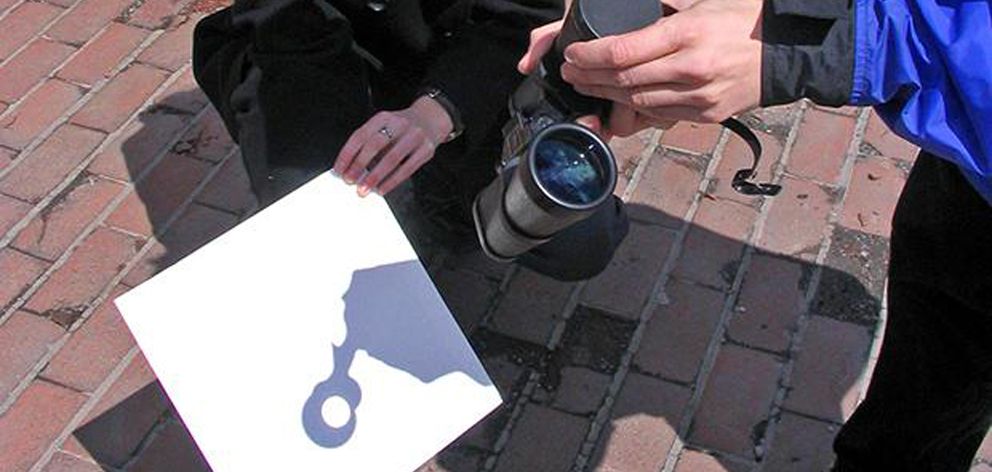
Another method: The skimmer.
If you'd like to entertain your friends and family on this occasion—and I certainly will—grab a regular skimmer from your kitchen drawer. Just like with binoculars, hold the skimmer vertically in relation to the direction of the sun, cast the shadow onto a piece of paper, and you'll get a large number of tiny points of light, each representing a crescent-shaped eclipse.
Finally, and to leave you to prepare for this magical moment, I remind you that eclipses have existed since the solar system formed, and we are witnessing an extraordinary coincidence. The sun is 400 times larger than the moon, but it is also 400 times farther away, which means we see both celestial bodies with an equivalent apparent diameter, about half a degree. A marvel of nature!
All civilizations have been interested in this phenomenon of the eclipse, and the Mesopotamians, Chaldeans, and Babylonians even calculated its cycles. To do this, they invented a term we still use today: the Saros.
You will witness the eclipse of Saros 126.
And since eclipses are cyclical events, they repeat themselves every 18 years and 11 days. This one took place on August 1, 2008, and was visible in Russia. It will repeat itself in 18 years and 11 days.
If we recall OUR eclipse of August 11, 1999, which passed over France, it was repeated on August 22 and it was in 2017 and crossed the United States. It will return on September 1, 2035, in another part of the world.
To see a total eclipse in France, I advise you to maintain your athletic physique and pray that medicine makes progress, because you'll have to wait until September 3, 2081.
If you'd like to entertain your friends and family on this occasion—and I certainly will—grab a regular skimmer from your kitchen drawer. Just like with binoculars, hold the skimmer vertically in relation to the direction of the sun, cast the shadow onto a piece of paper, and you'll get a large number of tiny points of light, each representing a crescent-shaped eclipse.
Finally, and to leave you to prepare for this magical moment, I remind you that eclipses have existed since the solar system formed, and we are witnessing an extraordinary coincidence. The sun is 400 times larger than the moon, but it is also 400 times farther away, which means we see both celestial bodies with an equivalent apparent diameter, about half a degree. A marvel of nature!
All civilizations have been interested in this phenomenon of the eclipse, and the Mesopotamians, Chaldeans, and Babylonians even calculated its cycles. To do this, they invented a term we still use today: the Saros.
You will witness the eclipse of Saros 126.
And since eclipses are cyclical events, they repeat themselves every 18 years and 11 days. This one took place on August 1, 2008, and was visible in Russia. It will repeat itself in 18 years and 11 days.
If we recall OUR eclipse of August 11, 1999, which passed over France, it was repeated on August 22 and it was in 2017 and crossed the United States. It will return on September 1, 2035, in another part of the world.
To see a total eclipse in France, I advise you to maintain your athletic physique and pray that medicine makes progress, because you'll have to wait until September 3, 2081.