






All this is happening above our heads
Exoplanets
By Michel Gravereau.
Are we alone in the Universe? Is there life elsewhere? And where?
These are the eternal questions that humankind asks without finding definitive answers. Yet, it's not for lack of searching.
Modern times have provided us with tools capable of better understanding our space environment: probes are in situ, while ground-based telescopes, subject to Earth's atmospheric constraints, deprive us of a more precise view.
Although we still call certain areas on the Moon "seas," we have long known that there is no water there, just as there is no water on Mars, where water once flowed so much. Where did it go?
In our quest for extraterrestrial life, we have, if not visited, at least closely approached the various planets of the solar system, and we must admit that we have nothing to show for it. So, with super-sophisticated technologies, our gaze turned elsewhere: the stars. Because while astronomers were certain of their existence, they had no proof.
How could they imagine that only our Sun could proudly display a retinue of planets, while the other stars had nothing? It would have taken a tremendous amount of presumptuousness.
So, with new techniques, they began to look at the stars differently and finally discovered other planets: exoplanets.
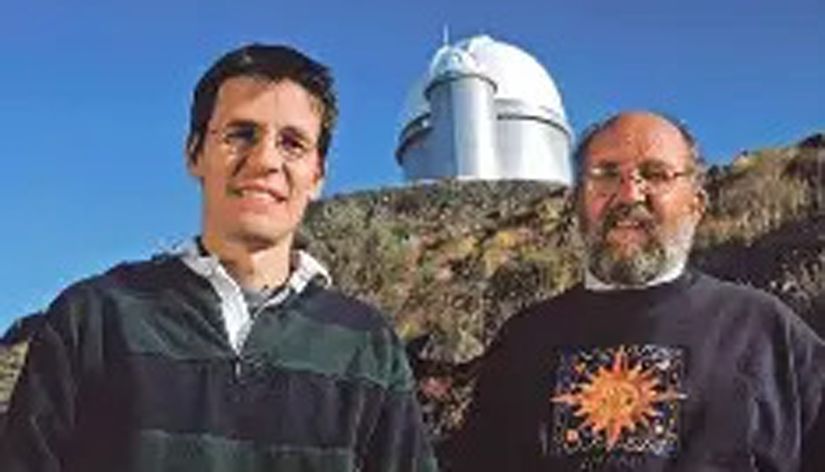
Thirty-one years ago, the Swiss astronomer Michel Mayor and the French astronomer Didier Queloz, working at the OHP (Haute-Provence Observatory), discovered the first exoplanet in the constellation Pegasus, 51 Pegasi b. They didn't observe it directly. They deduced its existence through complex calculations. Their discovery was awarded the Nobel Prize in Physics in 2019.
Since 1995, discoveries have been made one after another, and thousands of exoplanets have been identified, thanks in particular to space telescopes like the European CoRoT (2006-2014), the first probe dedicated to detecting exoplanets.
It is estimated that in about ten years, we will know of 100,000! According to astronomers, the majority of stars in our Universe certainly have at least one planet.
For a long time, it was impossible to detect exoplanets because they are so far from Earth. Consider that the closest star in our galaxy is located 40 trillion km from Earth (4 light-years).
Advances in observation have triggered a significant harvest. What are they?
Coronography.
The intense light emitted by a star obscures the planet(s) orbiting it. To reduce this glare, coronagraphy is used. This technique involves blocking the star to reveal the fainter celestial bodies around it, much like the methods used in the past to observe prominences on our Sun. However, this only allows direct observation of the largest planets, especially those located very far from their star.
It is estimated that in about ten years, we will know of 100,000! According to astronomers, the majority of stars in our Universe certainly have at least one planet.
For a long time, it was impossible to detect exoplanets because they are so far from Earth. Consider that the closest star in our galaxy is located 40 trillion km from Earth (4 light-years).
Advances in observation have triggered a significant harvest. What are they?
Coronography.
The intense light emitted by a star obscures the planet(s) orbiting it. To reduce this glare, coronagraphy is used. This technique involves blocking the star to reveal the fainter celestial bodies around it, much like the methods used in the past to observe prominences on our Sun. However, this only allows direct observation of the largest planets, especially those located very far from their star.

In the future, around 2040, NASA plans to send a super telescope equipped with a coronagraph to detect smaller planets closer to their star (Habitable Worlds Mission). The American James Webb Space Telescope carries a coronagraph capable of such missions.
The Transit.
Some telescopes are equipped with light-sensitive sensors. When a planet passes in front of its star, it blocks some of the star's light, causing it to diminish before regaining intensity once the transit is complete. Thus, the regular variation in a star's brightness can indicate the presence of a planet that passes by repeatedly. By noting the frequency and duration of these passes, information is gathered about the time it takes the planet to orbit the star, as well as its size. The European satellites CoRoT (2006-2014) and CHEOPS (2019) use this method.
A Diversity of Worlds
For over 30 years, since the search for exoplanets began, only diversity has been observed. From very large and massive planets, up to 25 times the size of Jupiter, our largest planet in the solar system, to smaller ones comparable in size and mass to Earth.
The Transit.
Some telescopes are equipped with light-sensitive sensors. When a planet passes in front of its star, it blocks some of the star's light, causing it to diminish before regaining intensity once the transit is complete. Thus, the regular variation in a star's brightness can indicate the presence of a planet that passes by repeatedly. By noting the frequency and duration of these passes, information is gathered about the time it takes the planet to orbit the star, as well as its size. The European satellites CoRoT (2006-2014) and CHEOPS (2019) use this method.
A Diversity of Worlds
For over 30 years, since the search for exoplanets began, only diversity has been observed. From very large and massive planets, up to 25 times the size of Jupiter, our largest planet in the solar system, to smaller ones comparable in size and mass to Earth.
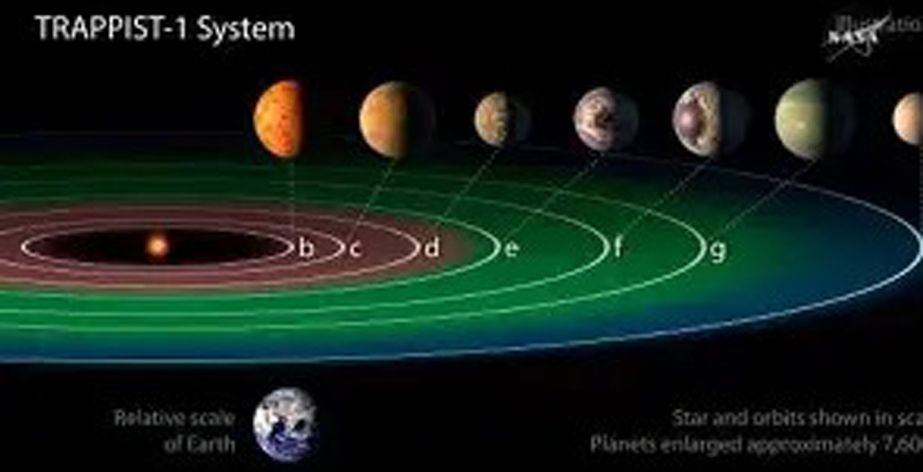
The hottest exoplanet, KELT-9b, has a surface temperature approaching 4,000°C, very close to its star. OGLE-2005-BLG-390Lb is an icy exoplanet where the thermometer reads -223°C!
Like the planets in our Solar System, exoplanets have different compositions, being made of rock, ice, or gas. Exoplanets are very far away and therefore reflect very little light. It's like trying to spot a firefly from Paris flying in the beam of a lighthouse in the port of Marseille. Only the largest, or very hot ones, reflect enough light to be seen by powerful telescopes. But it is from space that they reveal themselves best.
Looking at exoplanets discovered at different stages of their lives teaches us about how a planet is born, forms, and dies. They allow us to better understand the odyssey of our own Solar System.
Searching for potential extraterrestrial life is the goal of many scientists. Could these planets be habitable? Even inhabited? Or at least, do they possess an environment compatible with some form of life (an atmosphere, a surface temperature that allows for the presence of large quantities of liquid water, the presence of carbon and methane)? Molecules linked to the chemistry of living organisms.
While we wait to learn more about what orbits other stars, we can still enjoy these celestial splendors that beckon to us during our balmy summer evenings. Carpe Diem.
Like the planets in our Solar System, exoplanets have different compositions, being made of rock, ice, or gas. Exoplanets are very far away and therefore reflect very little light. It's like trying to spot a firefly from Paris flying in the beam of a lighthouse in the port of Marseille. Only the largest, or very hot ones, reflect enough light to be seen by powerful telescopes. But it is from space that they reveal themselves best.
Looking at exoplanets discovered at different stages of their lives teaches us about how a planet is born, forms, and dies. They allow us to better understand the odyssey of our own Solar System.
Searching for potential extraterrestrial life is the goal of many scientists. Could these planets be habitable? Even inhabited? Or at least, do they possess an environment compatible with some form of life (an atmosphere, a surface temperature that allows for the presence of large quantities of liquid water, the presence of carbon and methane)? Molecules linked to the chemistry of living organisms.
While we wait to learn more about what orbits other stars, we can still enjoy these celestial splendors that beckon to us during our balmy summer evenings. Carpe Diem.
.jpg?t=aeb8a500_42ca_451a_ab7f_8e5528b4f20b)