





All this is happening above our heads
Extraterrestrials in Fiction
By Michel Gravereau
Even today, lacking the capacity to explain certain past achievements—I'm thinking of the pyramids or the Nazca Lines—some people readily invoke the intervention of extraterrestrials. This shortcut allows them to avoid thinking critically and, above all, to remain the intelligent, unparalleled human being in contrast to the humans of the past.
While a true encounter has yet to occur, novels, films, and television series have accustomed us to the presence of extraterrestrials to such an extent that their existence remains a perennial possibility.
Extraterrestrials are classic figures in fiction, which, like zombies and other ghosts, allow us to question our relationship with others… but also, and especially, with our own species.
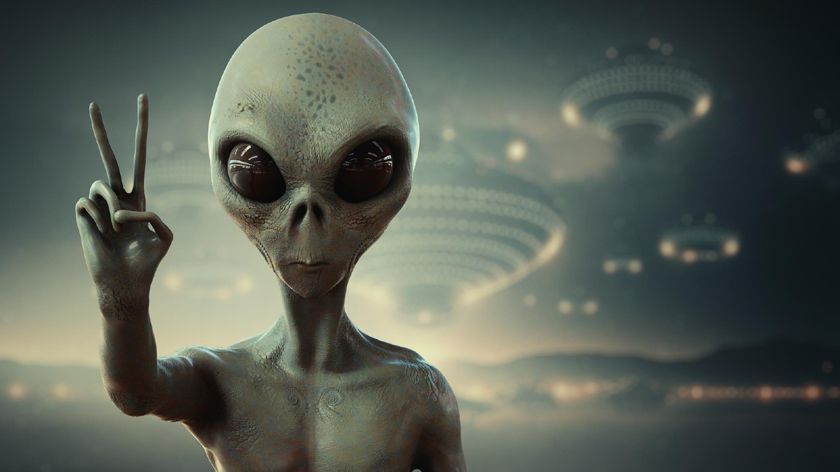
And this is nothing new. Let us recall, for example, that Voltaire, in *Micromégas*, invites us to philosophize with the inhabitant of a planet orbiting the star Sirius.
In our literature, we have extraterrestrials who come from much closer still: the Moon. The Selenites. In the second volume of his lunar adventures, published in 1869, *Around the Moon*, Jules Verne depicts the hidden side of the structures built by the Selenites. Selenites whom the astronauts in the novel naturally imagine to be more evolved than us. And when Georges Méliès adapted the novel for the screen in *A Trip to the Moon*, he portrayed the Selenites as very hostile and less civilized. Costumed and masked, these first extraterrestrials in the history of cinema resembled the Western imagination of savage tribes.
But the Selenites were quickly supplanted by the famous Martians, who had the advantage of living farther away.
In 1898, in his novel *The War of the Worlds*, H.G. Wells imagined belligerent Martians come to crush our species. For decades afterward, the small green man with a prominent skull and large black eyes, the Martian, became the archetype of the extraterrestrial, almost a synonym. Wells, in *The War of the Worlds* in 1898, did not hesitate to paint a most flattering portrait: "The Martians seem to have calculated their descent with sure and astonishing subtlety, their mathematical science being obviously far superior to ours, and to have carried out their preparations successfully with almost perfect unanimity."
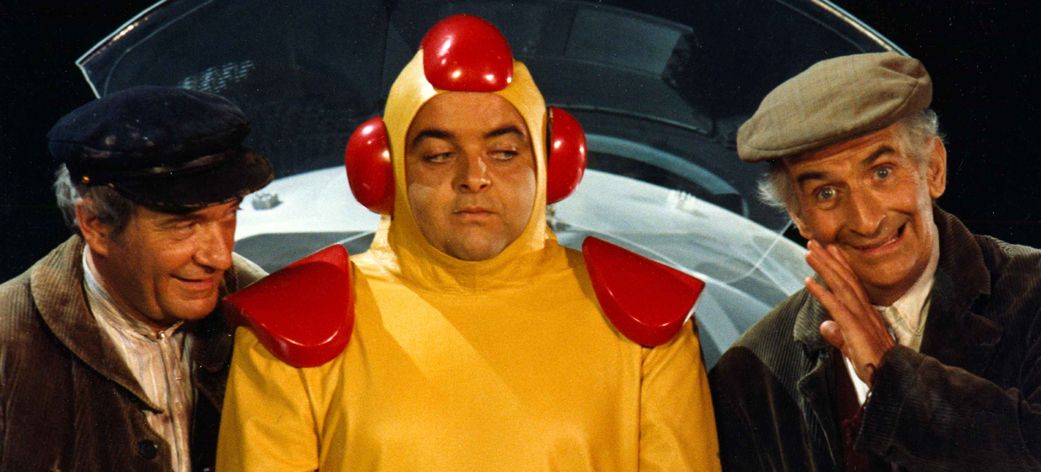
Extraterrestrial encounters touch on all areas of life. Comedies depict them with great kindness and affection. Jacques Villeret in *La Soupe aux Choux*, Alf in the series of the same name, or E.T., who constantly calls home.
But some of these visitors from elsewhere take advantage of their journey to impart a few moral lessons: in Coline Serreau's *The Green Beautiful*, the extraterrestrial wants to teach us to live more peacefully, and Klaatu in *The Day the Earth Stopped* firmly asks humans to halt their mad arms race. "How you run your planet is none of our business. But if you threaten to spread your violence, your Earth will be reduced to a pile of ashes. Your choice is simple: join us and live in peace, or continue on your path and expose yourselves to destruction." This is the extraterrestrial's message to humanity.
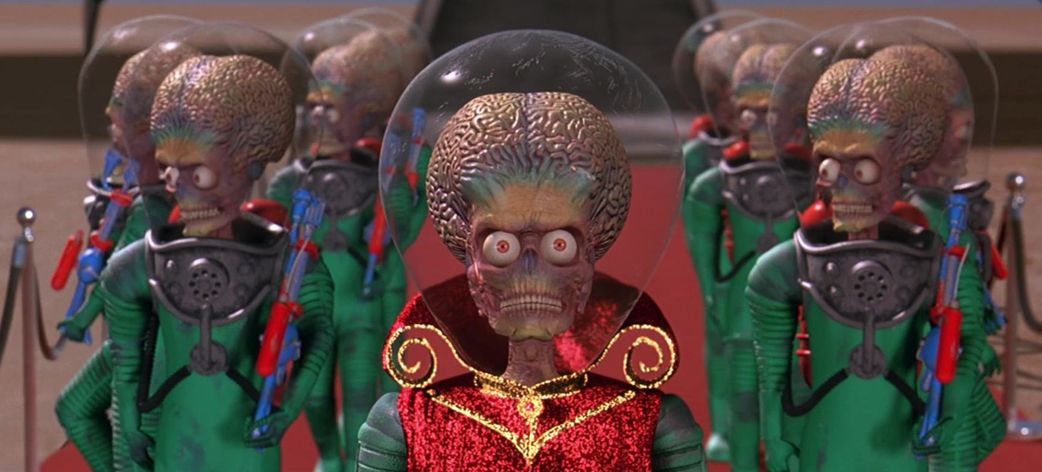
In the vast majority of cases, extraterrestrials land not to chat and make friends, but to wage real battles with their flying saucers against our fighter jets. From *War of the Worlds* to *Independence Day* and *Mars Attacks*. This is an opportunity for Hollywood productions to extol the virtues of heroism and patriotism, which allow Americans to prevail despite their numerical and technological inferiority. They have kept the surprise attack on Pearl Harbor fresh in their minds.
How can you recognize an extraterrestrial?
Many artists have portrayed extraterrestrials, including the French actors Jacques Villeret and Didier Bourdon, and the Americans Christopher Reeve, Keanu Reeves, and David Bowie. Most of the time, they had a human appearance. But to add a touch of the bizarre, they were sometimes given masks, prosthetics, and given strange fingers and pointed ears.
But more fundamentally, these humanoids from elsewhere illuminate the anthropocentrism of science fiction. Like the robot, the extraterrestrial in fiction always allows us to question our humanity by holding up a mirror to ourselves. A mirror that often reflects an unflattering image of our species and our societies.
How to communicate with an extraterrestrial?
Many science fiction works address the question of communicating with extraterrestrials. This highlights the extent to which we project our very human imagination onto these distant species. The encounter with an extraterrestrial in fiction often resembles like Christopher Columbus landing in America or botanists discovering a new plant species. In other words, we communicate with extraterrestrials. Conveniently, in many films, aliens speak our language. It's normal; they're more intelligent than us.
But sometimes, before communicating, we have to make an effort, like the hero of Avatar who has to learn Na'vi, or E.T. who learns his first English words in Elliot's room in Spielberg's film. But speaking the same language isn't always possible. In Close Encounters of the Third Kind, Spielberg, with his composer John Williams, invented a famous musical "phrase" that allows for an initial exchange with the extraterrestrials.
Science fiction, a favorite playground for some who are unaware of the reality of our solar system, our galaxy, our Universe.
While we await the first real contact, broadcast live on our television channels and not in private, secluded moments in the woods for a select few, we can only contemplate this stellar immensity from which these creatures imagined by the human mind might emerge.
Will they have large ears to listen to us better, large eyes to see us better, or large teeth to devour us better? Like the wolf in Little Red Riding Hood.
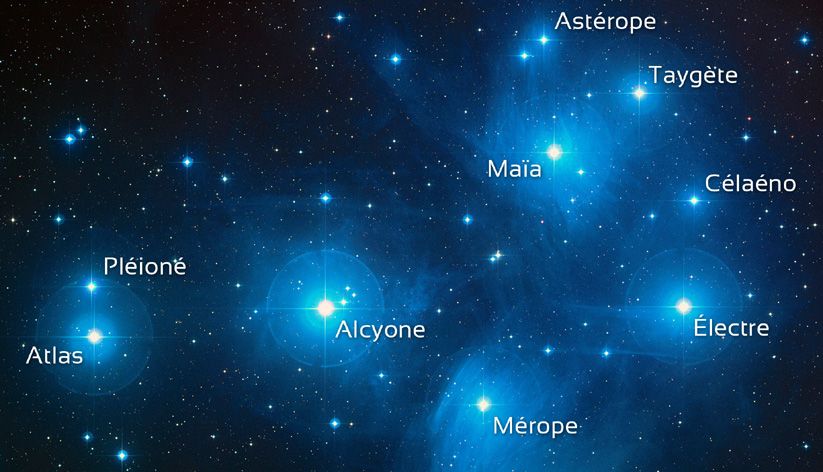
Enjoy the nights that are arriving earlier and earlier, revealing Saturn reigning in the sky and, later, the beautiful Orion.
Here's a little exercise to test your visual acuity. Take a star chart and locate the Pleiades star cluster. Count them. If you can't distinguish them, a word of advice: consult your eye doctor.