






Letter from My Garden
Spirou, the Undiminished Breath of Our Childhood Dreams
By Christian Morisot
At the heart of our childhood lie the great adventures fueled by fantastical stories, disseminated through comics. We all imagined an extraordinary life and destiny through our reading. Our heroes feared nothing, always managing to survive in the most perilous conditions imposed upon them.
Thanks to them, we developed our imaginations and learned how to face danger and adversity.
This summer, we want to embark on an adventure and relive the happy hours of our childhood summer holidays…
That's why we're adding to our articles on "Tintin." A clarification is necessary, for me, a native of Dunkirk on the Belgian border; Comics are primarily Belgian comics: Tintin and Snowy, Spirou, Lucky Luke, Alix and Enak, Jerry Spring, the Smurfs, Blake and Mortimer, and Olrik.
In fact, Hergé's fluid and clear style contrasts with Franquin's, and despite many similarities, they represent two distinct schools that nonetheless form a very coherent whole. This is how Spirou stands out, distinguished above all by the "impulses of the brush, humor, fantasy, and dreamlike quality," compared to Tintin's adventures, which are more marked by a certain overly serious tone and whose adventures end with the death of their creator.
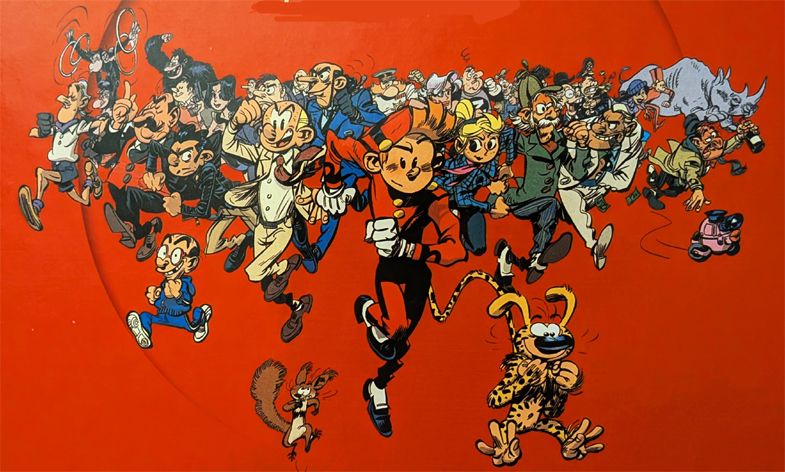
In conclusion, it would be pointless to try to compare these two comic book stars. Spirou hasn't generated the clutter of more or less pompous exegeses that Hergé's creation has. Born in the late 1930s, with a golden age in the late 1950s, the clever-looking little bellhop is more than just the eternal hero of comics. His colorful and whimsical cohort—Fantasio, Spip, the Count of Champignac, Zorglub, Gaston, and the Marsupilami—deserve more than just an amused or nostalgic smile.
That's why we're adding to our articles on "Tintin." A clarification is necessary, for me, a native of Dunkirk on the Belgian border; Comics are primarily Belgian comics: Tintin and Snowy, Spirou, Lucky Luke, Alix and Enak, Jerry Spring, the Smurfs, Blake and Mortimer, and Olrik.
In fact, Hergé's fluid and clear style contrasts with Franquin's, and despite many similarities, they represent two distinct schools that nonetheless form a very coherent whole. This is how Spirou stands out, distinguished above all by the "impulses of the brush, humor, fantasy, and dreamlike quality," compared to Tintin's adventures, which are more marked by a certain overly serious tone and whose adventures end with the death of their creator.
In conclusion, it would be pointless to try to compare these two comic book stars. Spirou hasn't generated the clutter of more or less pompous exegeses that Hergé's creation has. Born in the late 1930s, with a golden age in the late 1950s, the clever-looking little bellhop is more than just the eternal hero of comics. His colorful and whimsical cohort—Fantasio, Spip, the Count of Champignac, Zorglub, Gaston, and the Marsupilami—deserve more than just an amused or nostalgic smile.

Spirou, still imbued with the genius of Franquin, his most famous creator, still exists and has never abandoned his "Cabin Boy" uniform. Instinctively, driven by nostalgia, I remain a devoted fan of the magazine, even if a certain evolution, in my opinion, reflects a primarily commercial approach… Such is the way of the world, and such is the way of the film. Please, gentlemen writers, stay focused on what truly matters: the dream!
Share your writing
Elders of the Legion: about the Legion and other topics
Supporters: about the Legion