






Before Camerone,
Between Memory and History
By Christian Morisot
Foreword
I am careful not to proclaim myself a “historian”—too much of a good thing, especially since so many readily claim this title and meticulously distort the past by interpreting it in their own way, making the events seem very different from those actually experienced.
These manipulators of history often act to survive in the eyes of others or to enrich themselves, while others use this distortion for partisan or ideological ends. “In hindsight, nothing is good or bad anymore. The historian who presumes to judge the past is practicing journalism in another century.” Emile Cioran.
In fact, I place myself more in the naive category of the “contemplators,” those who memorize and share their impressions, reflections, and both their rants and raves. I've learned from my reading that every time humanity takes a step forward in what it calls "progress," it loses something.
To connect with you, I suggest we spend a little time together reading this short story entitled "Before Camerone."
Foreword
I am careful not to proclaim myself a “historian”—too much of a good thing, especially since so many readily claim this title and meticulously distort the past by interpreting it in their own way, making the events seem very different from those actually experienced.
These manipulators of history often act to survive in the eyes of others or to enrich themselves, while others use this distortion for partisan or ideological ends. “In hindsight, nothing is good or bad anymore. The historian who presumes to judge the past is practicing journalism in another century.” Emile Cioran.
In fact, I place myself more in the naive category of the “contemplators,” those who memorize and share their impressions, reflections, and both their rants and raves. I've learned from my reading that every time humanity takes a step forward in what it calls "progress," it loses something.
To connect with you, I suggest we spend a little time together reading this short story entitled "Before Camerone."
Before Camerone
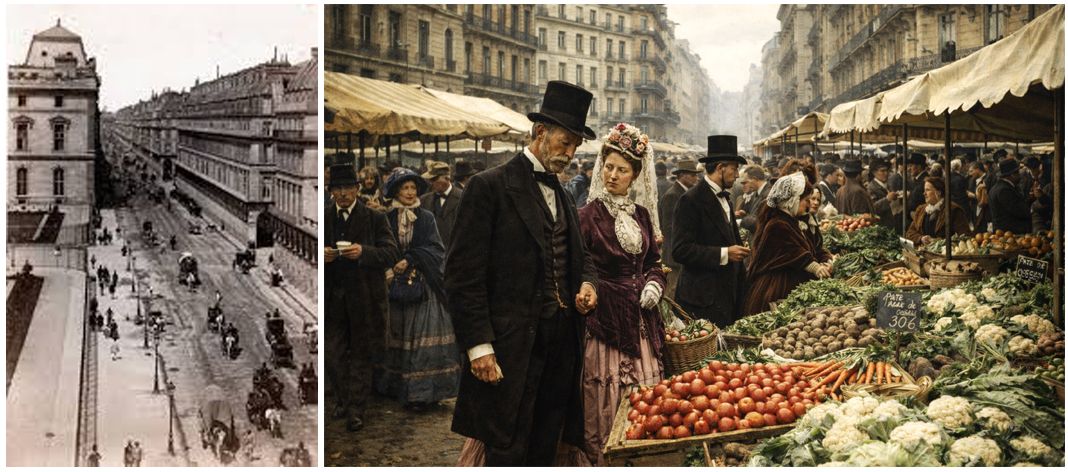
Tuesday, April 15, 1844, Louis Philippe, King of the French, and Monsieur Guizot, head of government, presided over a session in the Chamber of Peers. The Prince of Moskowa, Joseph Nay, expressed his astonishment that France had yielded to England by recalling Rear Admiral Dupetit-Thouars from Tahiti.
Queen Pomare played the English card against the French protectorate. Monsieur Guizot lacked dignity, the newspapers said, and yet, France at that time was prosperous. There was the expansion of the railways, the improvement of the roads. Business was booming; the “Magnifiques Galeries,” one of the forerunners of our department stores, was selling new items that attracted large crowds. In Paris, the price of bread was divided into two tiers, one for the rich and another for the poor, who had to settle for a second-rate loaf.
France, and Paris in particular, was opening up to art in all its forms. The “Le Français” theater announced “Charles VII et l’Etourdi” and “Les mystères de Paris” at the Porte Saint-Martin, while music lovers flocked to Franz Liszt’s concert at the “Théâtre Italien.” Literature, for its part, was not to be outdone. The Fournier publishing house announced the release of “Cent proverbes de Grandville,” and “Le Siècle” offered its readers “Les trois mousquetaires.”
Advertisements appeared in the newspapers; Milanese water removed freckles, Circassian water dyed hair, and Raspail cigarettes were very effective against asthma.
The ladies wore bonnets, shawls, and leg-of-mutton sleeves, while the gentlemen sported top hats, multi-layered ties, and frock coats.
This whole little world indulged in its own private world. They gathered frequently and held "salons," reading Alexandre Dumas, Eugène Sue, and Balzac, who had just given his works the title "Human Comedy" for the first time. Neither the lower nor the upper middle class cared much about the appalling poverty in which the workers of the burgeoning industrial sector were plunged; it held no interest for Parisians, who were isolated in their bubble. Only Lille and Mulhouse and their surrounding areas were affected.
Far removed from this atmosphere at the beginning of 1845, Battalion Commander Vinoy, the future general of 1870, was the senior commander at Sidi-Bel-Abbès, a modest camp, lost in the countryside where troops on operations set up camp.
Some twenty years later, after a few bloody skirmishes, a town would be born, populated by 5,000 inhabitants. A century earlier, the Deraoua people and French soldiers had slaughtered each other in the same place. In 1865, a prosperous and peaceful city would rise there. The once uncultivated lands of the surrounding area would produce rich harvests.
In 1862, the French expedition to Mexico began, and the Legion was "on standby." When a soldier knows that a battle is raging somewhere, he is eager to participate. This is what happened; The Legion was weary of garrison duty, building roads, digging wells, guarding the Ben Youd and Boukanefis penitentiaries, and protecting a few isolated outposts.
It was not listed among the troops sent to Mexico, nor, for that matter, in the Cochinchina expeditionary force. The regiment's junior officers petitioned the Emperor, whose initial reaction was to punish the most senior officers of each rank. However, faced with the defeat of the French contingents before Puebla on January 19, 1863, orders arrived to mobilize a marching regiment to reinforce the expeditionary force in Mexico. Only the 3rd Battalion and the depot remained in Algeria.
The regiment embarked on February 9, 1863, and arrived at Vera Cruz on March 28, 33 days before that famous April 30 when "The French army besieged Puebla..." but that's a whole other story that was unfolding and will be the subject of a follow-up to this article.
