



The Middle East 1/3
A backdrop partly shaped by Europe
By Louis Perez y Cid
A story we prefer to forget
When a conflict erupts in the Middle East, Europe often observes with a mixture of detachment and incomprehension. Images flash by: bombed cities, columns of refugees, maps of disputed territories. Then comes almost always the same fatalistic sigh: these wars are supposedly distant, ancient, incomprehensible. They belong to a world that is not ours.
In this convenient view, the Middle East appears as a land of immemorial rivalries, riddled with religious and tribal divisions so deep that no lasting stability could ever take root. Europe, in this narrative, is merely an outside observer, sometimes worried, sometimes clumsy, but fundamentally detached from the root causes of the conflicts.
Yet history tells a different story.
The societies of the Middle East obviously have their own tensions, their own political and religious rivalries. But the political order that structures the region today did not arise naturally. It is largely the product of events that occurred at the beginning of the 20th century, when European powers redrew the map of the Near East following the collapse of the Ottoman Empire.
In just a few years, a centuries-old political world vanished.
Promises were made to peoples who hoped for their independence.
Other commitments were made, in secret, in European chancelleries.
And on maps drawn far from the desert and the cities of the Levant, new borders appeared.
Understanding the contemporary Middle East, therefore, is not about assigning blame. It is simply about looking at the facts with clear eyes. Europe did not create all the crises in the region, but it largely contributed to setting the stage for their development. The End of an Old Order
For nearly four centuries, a large part of the Middle East was part of the Ottoman Empire.
From its capital, Istanbul, the empire ruled over a vast and complex mix of peoples, languages, and religions. Arabs, Turks, Kurds, Greeks, Armenians, and Jews lived within an imperial system that, despite its tensions and inequalities, ensured a degree of political continuity.
The Ottoman sultan also held the title of caliph, that is, the symbolic leader of the Sunni Muslim world. This religious authority gave the empire a legitimacy that extended far beyond its administrative borders.
At the beginning of the 20th century, however, this edifice was already crumbling. Nationalism was on the rise, military defeats were mounting, and most of the European provinces had left the empire. The First World War dealt the final blow. An ally of Germany, the Sublime Porte was defeated in 1918.
The empire collapsed.
In 1924, the new leader of Turkey, Mustafa Kemal Atatürk, officially abolished the caliphate. This act brought an end to an institution that, for centuries, had embodied a form of political and religious unity in the Sunni world.
In the Arab world, this disappearance created a void.
A political void, but also a symbolic one.
It was in this void that the European powers would intervene.
The Promises of War
During the war, the United Kingdom sought a way to weaken the Ottoman Empire from within.
London then encouraged an Arab revolt led by the Sharif of Mecca, Hussein ibn Ali, guardian of Islam's holy sites and a respected figure in the peninsula.
Between 1915 and 1916, a correspondence developed between Hussein and the British High Commissioner in Egypt, Henry McMahon.
In these letters, the British suggested that a vast Arab kingdom could emerge after the war if the Arabs rose up against the Ottomans.
Encouraged by these promises, the Arab forces rebelled.
The revolt was led in particular by the Sharif's son, Faisal I, and supported by several British officers. Among them was T. E. Lawrence, who became famous as Lawrence of Arabia.
For many Arab leaders, the war seemed to herald the birth of a new world, one of long-awaited independence.
But while these promises were being made, other decisions were already being made elsewhere.
The Partition of the Middle East
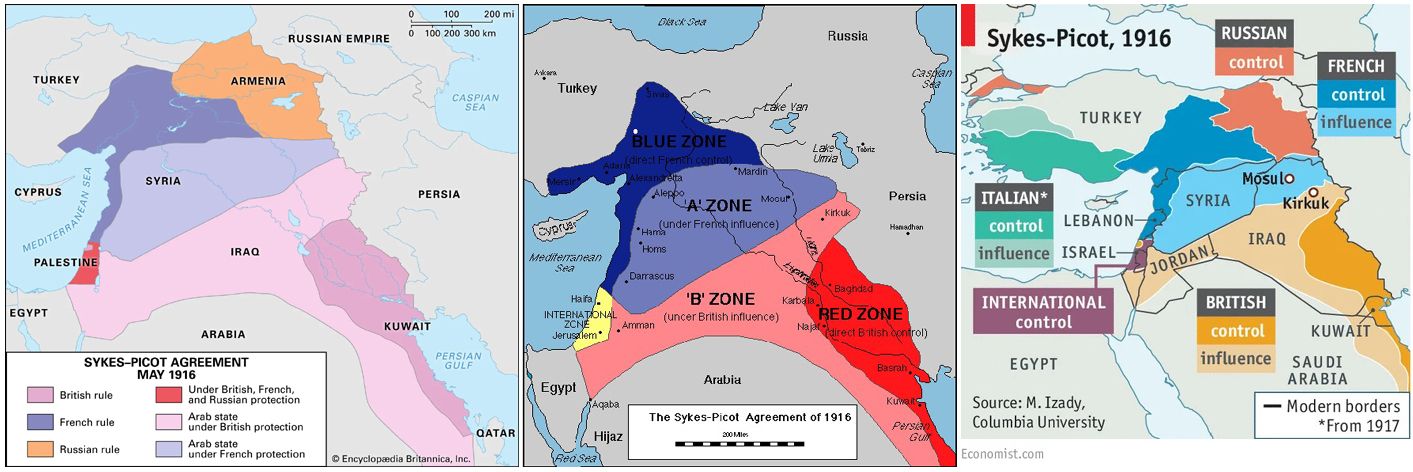
In 1916, France and Great Britain concluded the Sykes-Picot Agreement. This secret agreement stipulated the division of the Ottoman Empire's Arab territories between European spheres of influence. The negotiators were the British diplomat Mark Sykes and his French counterpart, François Georges-Picot.
The new map drawn up by these agreements divided the Levant territories between the two powers.
• French zone: Syria and Lebanon
• British zone: Iraq and Palestine
• Autonomous Arab zone: Arabia etc.
After the war, this system took the form of mandates granted by the League of Nations. Borders were often drawn without regard for local realities, creating states with fragile internal balances.
A story we prefer to forget
When a conflict erupts in the Middle East, Europe often observes with a mixture of detachment and incomprehension. Images flash by: bombed cities, columns of refugees, maps of disputed territories. Then comes almost always the same fatalistic sigh: these wars are supposedly distant, ancient, incomprehensible. They belong to a world that is not ours.
In this convenient view, the Middle East appears as a land of immemorial rivalries, riddled with religious and tribal divisions so deep that no lasting stability could ever take root. Europe, in this narrative, is merely an outside observer, sometimes worried, sometimes clumsy, but fundamentally detached from the root causes of the conflicts.
Yet history tells a different story.
The societies of the Middle East obviously have their own tensions, their own political and religious rivalries. But the political order that structures the region today did not arise naturally. It is largely the product of events that occurred at the beginning of the 20th century, when European powers redrew the map of the Near East following the collapse of the Ottoman Empire.
In just a few years, a centuries-old political world vanished.
Promises were made to peoples who hoped for their independence.
Other commitments were made, in secret, in European chancelleries.
And on maps drawn far from the desert and the cities of the Levant, new borders appeared.
Understanding the contemporary Middle East, therefore, is not about assigning blame. It is simply about looking at the facts with clear eyes. Europe did not create all the crises in the region, but it largely contributed to setting the stage for their development. The End of an Old Order
For nearly four centuries, a large part of the Middle East was part of the Ottoman Empire.
From its capital, Istanbul, the empire ruled over a vast and complex mix of peoples, languages, and religions. Arabs, Turks, Kurds, Greeks, Armenians, and Jews lived within an imperial system that, despite its tensions and inequalities, ensured a degree of political continuity.
The Ottoman sultan also held the title of caliph, that is, the symbolic leader of the Sunni Muslim world. This religious authority gave the empire a legitimacy that extended far beyond its administrative borders.
At the beginning of the 20th century, however, this edifice was already crumbling. Nationalism was on the rise, military defeats were mounting, and most of the European provinces had left the empire. The First World War dealt the final blow. An ally of Germany, the Sublime Porte was defeated in 1918.
The empire collapsed.
In 1924, the new leader of Turkey, Mustafa Kemal Atatürk, officially abolished the caliphate. This act brought an end to an institution that, for centuries, had embodied a form of political and religious unity in the Sunni world.
In the Arab world, this disappearance created a void.
A political void, but also a symbolic one.
It was in this void that the European powers would intervene.
The Promises of War
During the war, the United Kingdom sought a way to weaken the Ottoman Empire from within.
London then encouraged an Arab revolt led by the Sharif of Mecca, Hussein ibn Ali, guardian of Islam's holy sites and a respected figure in the peninsula.
Between 1915 and 1916, a correspondence developed between Hussein and the British High Commissioner in Egypt, Henry McMahon.
In these letters, the British suggested that a vast Arab kingdom could emerge after the war if the Arabs rose up against the Ottomans.
Encouraged by these promises, the Arab forces rebelled.
The revolt was led in particular by the Sharif's son, Faisal I, and supported by several British officers. Among them was T. E. Lawrence, who became famous as Lawrence of Arabia.
For many Arab leaders, the war seemed to herald the birth of a new world, one of long-awaited independence.
But while these promises were being made, other decisions were already being made elsewhere.
The Partition of the Middle East
In 1916, France and Great Britain concluded the Sykes-Picot Agreement. This secret agreement stipulated the division of the Ottoman Empire's Arab territories between European spheres of influence. The negotiators were the British diplomat Mark Sykes and his French counterpart, François Georges-Picot.
The new map drawn up by these agreements divided the Levant territories between the two powers.
• French zone: Syria and Lebanon
• British zone: Iraq and Palestine
• Autonomous Arab zone: Arabia etc.
After the war, this system took the form of mandates granted by the League of Nations. Borders were often drawn without regard for local realities, creating states with fragile internal balances.
In 1917, the British government published the Balfour Declaration, supporting the establishment in Palestine of a national home for the Jewish people.
After the Second World War and the horror of the Holocaust, international pressure for the creation of a Jewish state intensified. In 1947, the United Nations proposed a partition plan for Palestine. On May 14, 1948, the State of Israel was proclaimed.
War broke out immediately with neighboring Arab countries. For the Israelis, it was the birth of a state; for the Palestinians, the Nakba, an exodus, and a lasting territorial loss.
De Gaulle's Warning
After the Six-Day War, this statement by General de Gaulle at a press conference in November 1967 demonstrates his clear-sighted, even prescient, understanding of the political consequences of the situation and how Israel might be perceived in the future:
"Certainly, despite your numerical inferiority, given that you are far better organized and armed than the Arabs, I have no doubt that you will achieve military successes; but then you would find yourselves embroiled, both on the ground and internationally, in growing difficulties... so much so that you, having become conquerors, would gradually be blamed for the drawbacks. Now, Israel is organizing an occupation in the territories it has seized, an occupation that inevitably involves oppression, repression, and expulsions, and resistance is emerging against it, which it, in turn, labels terrorism." “Opening to the 21st Century: Echoes of the Past.
A century later, the borders of Iraq, Syria, and Lebanon remain those imposed by the European mandates. Internal divisions partly reflect these arbitrary decisions.
In Iraq, the fragility of the post-Saddam state and the rise of jihadist movements serve as reminders that the political balance there remains precarious.
In Syria, the civil war and the collapse of institutions illustrate how an artificial territory, constructed by distant diplomacy, can become a battleground of protracted conflicts.
Even Lebanon, long perceived as an example of coexistence, is beset by tensions rooted in border arrangements inherited from the mandate period.
To observe these conflicts with clear eyes is to understand that the past is ever-present, that borders drawn by pens of ink continue to shape the destinies of individuals and nations, and that contemporary crises are never entirely detached from the history that preceded them.” Today, the United States and Israel are striking Iran.
History continues to be written amidst the clash of arms.
In 1961, upon leaving the White House, Dwight D. Eisenhower warned his country about the growing influence of the "military-industrial complex." He feared that one day the military, having become an economic pillar, would itself dictate strategic choices. When the tool becomes central, the temptation is great to use force before exhausting diplomacy. "Peace through strength"—isn't that the slogan of this US administration?
Since the beginning of the 21st century, particularly after the 2003 Iraq War, many have observed that this logic has taken hold; the military response often appears as the quickest, the simplest, sometimes the most natural.
Facing them is Iran, heir to ancient Persia.
Three millennia of history have shaped a patient and strategic political culture among the Persians. They are credited with inventing chess: an art where each move prepares the next, where victory often belongs to the one who knows how to wait.
The United States, on the other hand, is barely two and a half centuries old. Its economic and military power is immense, but its diplomacy can sometimes resemble a game of checkers: you strike at whatever comes your way, quickly and forcefully.
Meanwhile, China observes and advances its pieces according to yet another logic: that of Go, a game where victory is achieved less through direct confrontation than through patient encirclement.
Such is the way of the world:
some play checkers,
others chess,
and some Go.
But in this vast game we call history, the crucial question always remains the same:
who, ultimately, sees the whole board, and who only sees the next move?
The End
After the Second World War and the horror of the Holocaust, international pressure for the creation of a Jewish state intensified. In 1947, the United Nations proposed a partition plan for Palestine. On May 14, 1948, the State of Israel was proclaimed.
War broke out immediately with neighboring Arab countries. For the Israelis, it was the birth of a state; for the Palestinians, the Nakba, an exodus, and a lasting territorial loss.
De Gaulle's Warning
After the Six-Day War, this statement by General de Gaulle at a press conference in November 1967 demonstrates his clear-sighted, even prescient, understanding of the political consequences of the situation and how Israel might be perceived in the future:
"Certainly, despite your numerical inferiority, given that you are far better organized and armed than the Arabs, I have no doubt that you will achieve military successes; but then you would find yourselves embroiled, both on the ground and internationally, in growing difficulties... so much so that you, having become conquerors, would gradually be blamed for the drawbacks. Now, Israel is organizing an occupation in the territories it has seized, an occupation that inevitably involves oppression, repression, and expulsions, and resistance is emerging against it, which it, in turn, labels terrorism." “Opening to the 21st Century: Echoes of the Past.
A century later, the borders of Iraq, Syria, and Lebanon remain those imposed by the European mandates. Internal divisions partly reflect these arbitrary decisions.
In Iraq, the fragility of the post-Saddam state and the rise of jihadist movements serve as reminders that the political balance there remains precarious.
In Syria, the civil war and the collapse of institutions illustrate how an artificial territory, constructed by distant diplomacy, can become a battleground of protracted conflicts.
Even Lebanon, long perceived as an example of coexistence, is beset by tensions rooted in border arrangements inherited from the mandate period.
To observe these conflicts with clear eyes is to understand that the past is ever-present, that borders drawn by pens of ink continue to shape the destinies of individuals and nations, and that contemporary crises are never entirely detached from the history that preceded them.” Today, the United States and Israel are striking Iran.
History continues to be written amidst the clash of arms.
In 1961, upon leaving the White House, Dwight D. Eisenhower warned his country about the growing influence of the "military-industrial complex." He feared that one day the military, having become an economic pillar, would itself dictate strategic choices. When the tool becomes central, the temptation is great to use force before exhausting diplomacy. "Peace through strength"—isn't that the slogan of this US administration?
Since the beginning of the 21st century, particularly after the 2003 Iraq War, many have observed that this logic has taken hold; the military response often appears as the quickest, the simplest, sometimes the most natural.
Facing them is Iran, heir to ancient Persia.
Three millennia of history have shaped a patient and strategic political culture among the Persians. They are credited with inventing chess: an art where each move prepares the next, where victory often belongs to the one who knows how to wait.
The United States, on the other hand, is barely two and a half centuries old. Its economic and military power is immense, but its diplomacy can sometimes resemble a game of checkers: you strike at whatever comes your way, quickly and forcefully.
Meanwhile, China observes and advances its pieces according to yet another logic: that of Go, a game where victory is achieved less through direct confrontation than through patient encirclement.
Such is the way of the world:
some play checkers,
others chess,
and some Go.
But in this vast game we call history, the crucial question always remains the same:
who, ultimately, sees the whole board, and who only sees the next move?
The End