





Response to Marshal Philippe Pétain's article
Michel's response is a profoundly valuable testimony for foreign legionnaires who choose to integrate into French society. For many, the history of their adopted country begins the very day they set foot there; Pétain, Agincourt… all of this blends into a distant past that they gradually discover.
Not all of them are history buffs, but they are sincere men, ready to build their new lives based on the stories and emotions they share.
Your testimony, so spontaneous and authentic, brings genuine human warmth. It helps us to understand more deeply this historical moment, so painful for so many French families, and it will allow these new French citizens to better grasp the soul of the country that is now theirs.
And for us, native-born French or simply French for longer, it reminds us of our responsibility: the words we speak, the stories we pass on, contribute to shaping the understanding and love that these future French citizens will have for our country. Through our words, we participate in the construction of their French identity.
Louis Perez y Cid
Marshal Pétain
By Michel Gravereau
Hello Louis,
I would like to respond quickly to your article published this morning about Marshal Pétain.
I was born just after the war, and throughout my childhood, I heard people in my family, at various houses, talking about Pétain. The Marshal for some, the collaborator for others. Depending on whether you were powerful or destitute…
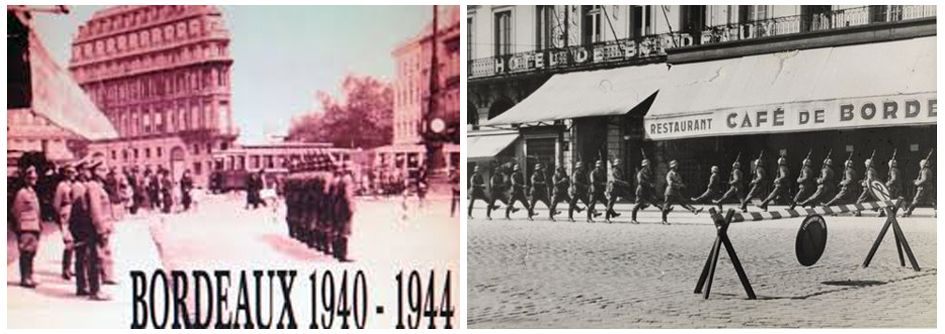
The subject was a hot topic. What I have always remembered is that I lived among ordinary French people who were suffering under the German occupation. My mother often told me: "We saw the Germans marching across the stone bridge in Bordeaux. Is that a troop encountering resistance?"
We could, unfortunately, recall the tragic fate of glorious Legion regiments, the 11th and 12th REI, to name just two. Crushed despite their bravery.
Where were the politicians to offer resistance?
Hello Louis,
I would like to respond quickly to your article published this morning about Marshal Pétain.
I was born just after the war, and throughout my childhood, I heard people in my family, at various houses, talking about Pétain. The Marshal for some, the collaborator for others. Depending on whether you were powerful or destitute…
The subject was a hot topic. What I have always remembered is that I lived among ordinary French people who were suffering under the German occupation. My mother often told me: "We saw the Germans marching across the stone bridge in Bordeaux. Is that a troop encountering resistance?"
We could, unfortunately, recall the tragic fate of glorious Legion regiments, the 11th and 12th REI, to name just two. Crushed despite their bravery.
Where were the politicians to offer resistance?
Indeed, Louis, an 84-year-old man, the victor of Verdun, was placed in a defensive position and could do nothing but sign the armistice.
At the time, no one challenged him.
Colonel Rémy, in his memoirs—and who could accuse him of being a Vichy supporter?—said that fortunately, Pétain was in France to calm the Germans' fervor, and de Gaulle was in London to organize the Resistance.
How many times have I heard: "What did you expect him to do?" "Nobody wanted power at that time." "They all ran away like cowards."
I sincerely believe that this is where the truth lies.
My father, the town clerk, was taken hostage and forced to provide service personnel to the German army at the Kommandantur in Blaye, Gironde. Otherwise, it was a firing squad. Was he accused of being a collaborator?
This term, by the way, only refers, in the minds of young people today, to that period of the war. I'm afraid we'll open a can of worms if we bring up the subject. Doesn't any country that, by force, whether acknowledged or not, subjugates another country through its intrusion, de facto create collaborators among the civilians of that country?
How did the Viet Cong view the Vietnamese auxiliaries?
Do you want to talk about the populations of North Africa, Iraq, or elsewhere, who, under pressure, were forced to "collaborate"?
Let's get back to Pétain. My father collected newspaper front pages. For a long time, I continued the trend with major headlines: the end of the Indochina War, de Gaulle's return, '68, the moon landing, etc.
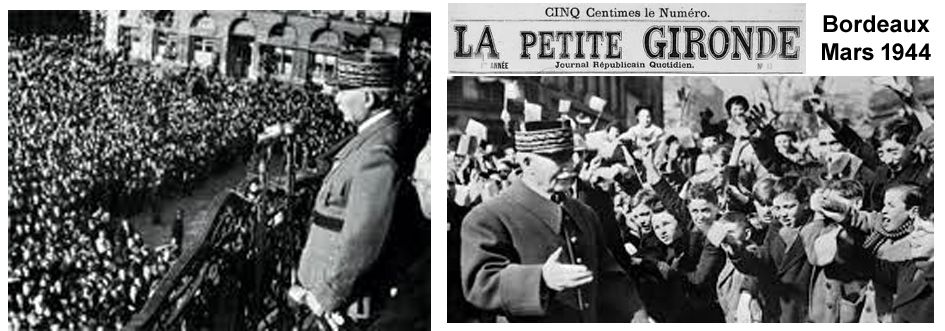
Among these newspapers was La Petite Gironde. In the Place du Théâtre in Bordeaux, Pétain had arrived, and the crowd cheering him was so large that the article said, "You couldn't have slipped a needle through the crowd." He was adored. He was the victor of Verdun. But what is extraordinary is that this event took place in March 1944!
How could the people of France have changed so completely in such a short time, once the war had ended? The expression "rushing to the aid of victory" takes on its full meaning.
Victor Hugo wrote in L'Expiation about Waterloo: "Hope changed sides, the battle changed its soul."
It's truly sad, but even today, we can observe the same phenomenon with elections. The French are capable of voting for a man they will despise a few months later and swear they didn't vote for him. Something's not right here. We're capable of burning today what we adored yesterday.
We'll never escape this cycle because those who talk about history didn't live it, but interpret it.
In short, I congratulate you on bringing up this still-sensitive subject, especially since we no longer have people old enough to have known Pétain as adults. It must be emphasized with the great bell, we must remember History as it was written, without ever distorting it or trying to interpret it by saying, "If I had lived in that era." No one is capable of doing that.
We still have in our ranks, in our associations, veterans who had to take a stand in the face of historical moments. They did so by "putting their lives on the line," as Captain Pierre Sergent would have said. They did so because they were convinced it was the best thing for France.
History, nothing but History. The rest is just talk.
Congratulations again on your text.
Michel