





All this is happening above our heads
Red Sun.
By Michel Gravereau
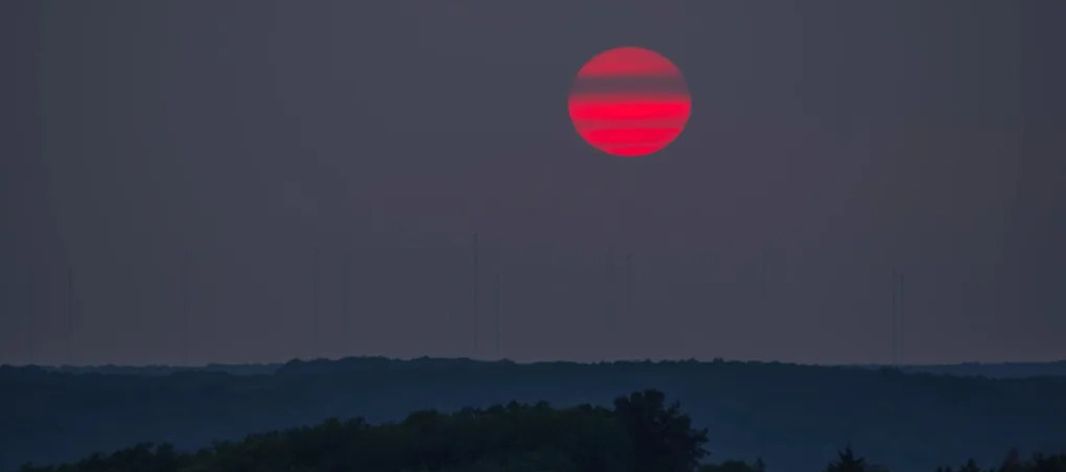
Who hasn't marveled at a magnificent sunset at the end of the day, alone, as a couple, or with friends? This breathtaking spectacle, which illuminates the horizon with its coppery hue, gives the sun a red tint, almost visible to the naked eye, whereas just a few minutes earlier, the sunlight was simply unbearable.
Who hasn't marveled at a magnificent sunset at the end of the day, alone, as a couple, or with friends? This breathtaking spectacle, which illuminates the horizon with its coppery hue, gives the sun a red tint, almost visible to the naked eye, whereas just a few minutes earlier, the sunlight was simply unbearable.

What causes this change in brightness?
When the sun reaches the lowest point of the horizon, its light passes through ten times more atmosphere than when it is high in the sky. Let's not forget, once again, that the Earth is round and that for the same thickness of atmosphere, the tangent from your observation point will pass through more atmospheric gas than a vertical line.
I've already had occasion to tell you that our atmosphere acts as a filter and a prism. While they are not blocked by the Sun high in the sky, the blue rays of sunlight are stopped by the large amount of dust present in the Earth's atmosphere.
Conversely, the yellow and red rays reach our eyes, giving the Sun the red color that tints it at sunset or dawn.
Poets believe that the Sun changes color throughout the day. This is not the case, and at all times of day, it bathes our planet in the same white-yellow hue. It is the Earth, and more specifically its atmosphere, that produces the effect of the "red ball" on the horizon.
Despite its transparent appearance, our atmosphere is "populated" with dust and molecules that tend to slow down and scatter the sun's rays. The sorting of wavelengths is such that some are more scattered than others.
Remember that sunlight is a mixture of all the colors of the rainbow: violet, indigo, blue, green, yellow, orange, and red. This corresponds to different wavelengths, with shorter wavelengths in violet and blue, and longer wavelengths in red.
When sunlight reaches our atmosphere, like through a prism, the light is refracted and scattered. Shorter wavelengths are refracted much more than longer wavelengths, which are practically unaffected. Blue light is refracted strongly, which is why our sky appears blue during the day. Our atmosphere is saturated with these blue rays.
Conversely, when the Sun approaches the horizon, the distance of the atmospheric layers it has to traverse is significant. Shorter wavelengths of light are blocked, while longer wavelengths of orange and red light pass through and color our Sun.
When the sun reaches the lowest point of the horizon, its light passes through ten times more atmosphere than when it is high in the sky. Let's not forget, once again, that the Earth is round and that for the same thickness of atmosphere, the tangent from your observation point will pass through more atmospheric gas than a vertical line.
I've already had occasion to tell you that our atmosphere acts as a filter and a prism. While they are not blocked by the Sun high in the sky, the blue rays of sunlight are stopped by the large amount of dust present in the Earth's atmosphere.
Conversely, the yellow and red rays reach our eyes, giving the Sun the red color that tints it at sunset or dawn.
Poets believe that the Sun changes color throughout the day. This is not the case, and at all times of day, it bathes our planet in the same white-yellow hue. It is the Earth, and more specifically its atmosphere, that produces the effect of the "red ball" on the horizon.
Despite its transparent appearance, our atmosphere is "populated" with dust and molecules that tend to slow down and scatter the sun's rays. The sorting of wavelengths is such that some are more scattered than others.
Remember that sunlight is a mixture of all the colors of the rainbow: violet, indigo, blue, green, yellow, orange, and red. This corresponds to different wavelengths, with shorter wavelengths in violet and blue, and longer wavelengths in red.
When sunlight reaches our atmosphere, like through a prism, the light is refracted and scattered. Shorter wavelengths are refracted much more than longer wavelengths, which are practically unaffected. Blue light is refracted strongly, which is why our sky appears blue during the day. Our atmosphere is saturated with these blue rays.
Conversely, when the Sun approaches the horizon, the distance of the atmospheric layers it has to traverse is significant. Shorter wavelengths of light are blocked, while longer wavelengths of orange and red light pass through and color our Sun.
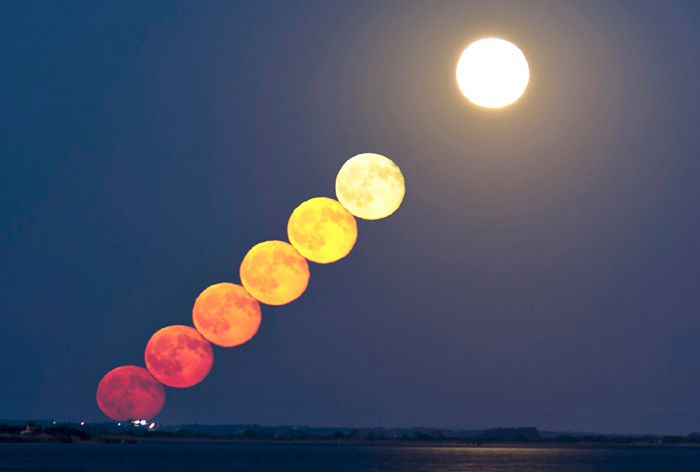
The Sun isn't the only celestial body to turn red when it reaches the horizon: everyone has likely observed the same phenomenon affecting the Moon. Of course, there is a difference: the Moon doesn't shine on its own; it only reflects sunlight.
But when it's low in the sky, the same cause produces the same effect: of the sunlight it reflects back to us, only the red rays manage to penetrate the hundreds of kilometers of atmosphere. The warmer days have returned, and the evenings and nights are perfect for walks and stargazing. Don't hesitate to watch the sunrises and sunsets of these celestial bodies that surround us.
But when it's low in the sky, the same cause produces the same effect: of the sunlight it reflects back to us, only the red rays manage to penetrate the hundreds of kilometers of atmosphere. The warmer days have returned, and the evenings and nights are perfect for walks and stargazing. Don't hesitate to watch the sunrises and sunsets of these celestial bodies that surround us.