




All this is happening above our heads
French Astronauts
By Michel Gravereau
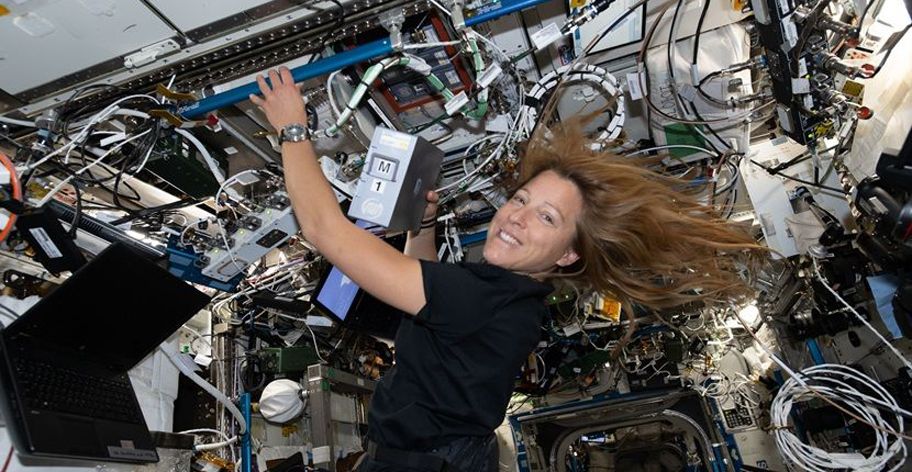
Now that we have welcomed back Sophie Adenot, who returned from an 8-month stay on the International Space Station (ISS), it would be appropriate to remember her predecessors, in addition to the one who remains the most well-known among the French: Thomas Pesquet.
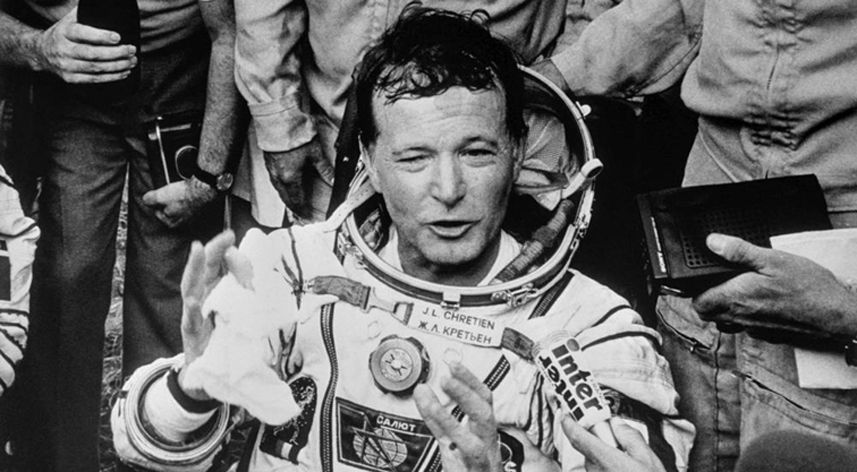
The first Frenchman to experience the joys of weightlessness was Jean-Loup Chrétien.
At the time, the Russians had installed a platform in orbit around the Earth: Salyut. Aboard a Soyuz spacecraft, Jean-Loup Chrétien reached Salyut, and during his stay, he inaugurated scientific experiments in space for the first time. Twelve experiments by the CNES (French National Centre for Space Studies) were carried out.
He returned a second time in 1988, this time to a different setting, as he settled into the new Soviet space station: Mir. He will be the first European to "walk in space" during an EVA (extravehicular activity).
For his third stay up there, he returned to Mir in 1999, but this time aboard the American space shuttle Atlantis.
With his extensive knowledge in the field, he will participate in the design of the International Space Station for NASA, which he will join.
Like Jean-Loup Chrétien, Patrick Baudry was recruited by CNES in 1980. They underwent the same two-year training program in Russia. On June 17, 1985, Patrick Baudry left Cape Canaveral aboard the space shuttle Discovery. He remained on board for seven days as the onboard experiments manager.
Later, he would be the test pilot for the future European space shuttle Hermes. But the project was abandoned in 1992.
In 1985, CNES recruited six men and one woman to prepare for upcoming missions with the Europeans, the Soviets, and the Americans. Two would never fly: Frédéric Patat and Michel Viso.
The first of this group to reach for the stars was Michel Tognini, on July 27, 1992. Destination: Mir. For about two weeks, he conducted technological and life science experiments.
He would have to wait until 1999 for his second stay in space. With the American space shuttle, he would deploy and put the Chandra X-ray Observatory into orbit.
Jean-Pierre Haigneré would be the fourth French astronaut. In 1993, he went to Mir to continue Tognini's experiments. He too would have to wait, as it wasn't until 1999 that he would return to Mir (during the spectacular solar eclipse of August 11). It was worth the wait, as he became the first non-Russian to spend six months on the station.
They had to wait for their second flight because their classmates were already in line.
Thus, DGA (Directorate General of Armaments) engineer Jean-François Clervoy completed three flights: in 1994 and 1997 aboard the Space Shuttle Atlantis to Mir, and in 1999 with Discovery. For his final flight, an extraordinary mission awaited him. With the Space Shuttle, he would approach the Hubble Space Telescope, which had been put into hibernation due to malfunctions. He would be at the controls of the robotic arm to capture Hubble, repair it, and allow the astronauts who had performed the repairs to move around. He thus became the Frenchman to have traveled the furthest from Earth: 609 km.
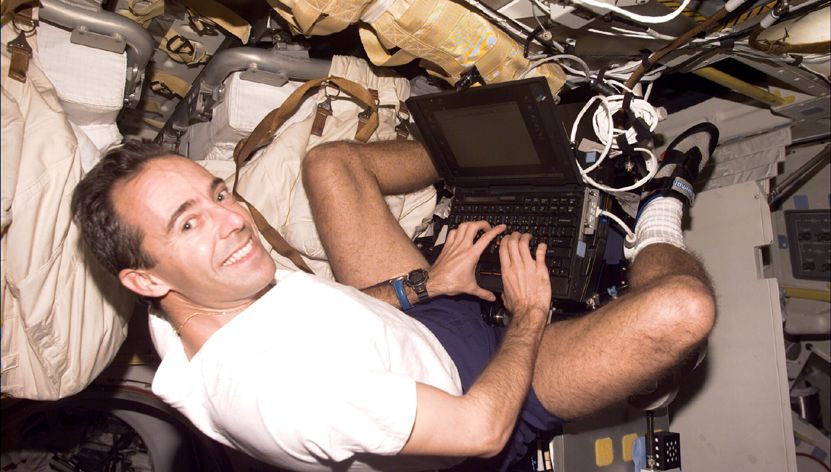
The sixth Frenchman to go into space was Jean-Jacques Favier. From June 20 to July 7, 1996, this engineer experimented with the effects of microgravity on the human body.
These studies would allow for a better understanding of the conditions for the future assembly of the ISS. Jean-Jacques Favier died on March 19, 2023.
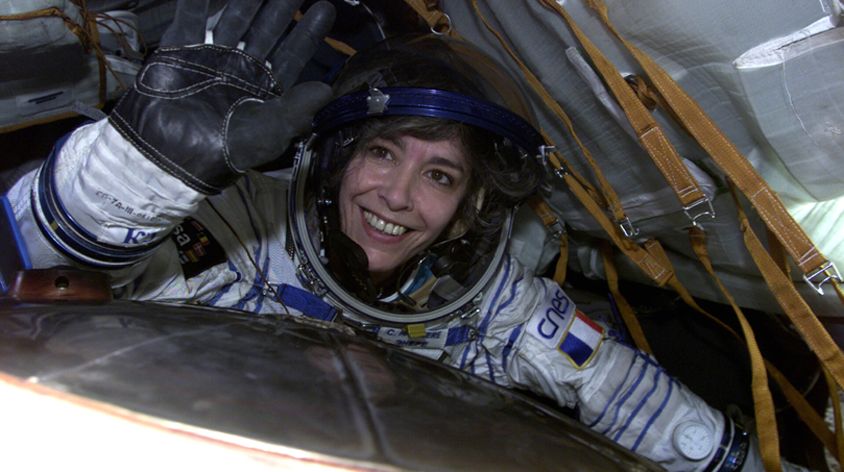
The first European woman to reach space was Claudie André Deshays, who would later become Haigneré after her marriage to Jean-Pierre Haigneré.
She made two flights. The first was aboard Mir, starting on August 17, 1996. For 16 days, she conducted a series of experiments in life sciences and physical sciences. I remember the birth of all those little salamanders she brought to the Mir space station. They were floating around everywhere.
Her second mission was to the ISS, where she served as Flight Engineer Number 1.
In 2002, Philippe Perrin, a pilot-engineer, completed a single 14-day spaceflight during which he performed three spacewalks to participate in the assembly of the ISS. He holds the record for the longest EVA at 7 hours and 17 minutes.
Air Force pilot Léopold Eyharts, from the Basque Country, spent 20 days aboard Mir from January 29 to February 19, 1998.
In 2008, he replaced Philippe Perrin in the construction of this giant space assembly: the ISS. He will be the one to dock the European Columbus laboratory to the ISS and be the first to enter it.
Recruited and trained by the European Space Agency in 2009, Thomas Pesquet will carry out two missions aboard the ISS: Proxima, from November 17, 2016 to June 2, 2017, and then Alpha, from April 23 to 9 november 2021.
His accomplishments include over a hundred spacewalks and six spacewalks to maintain the ISS and replace solar panels.
During his second mission in 2021, he will become the first French astronaut to command the ISS.
Sophie Adenot is a helicopter test pilot who has just completed her first spacewalk. It will undoubtedly not be her last. The Moon awaits her.
The twelfth French astronaut is expected to be Arnaud Prost. A fighter jet test pilot, he could be a pioneer by the end of 2027. A private space station, Haven-1, developed by the company VAST, is under construction, and he could be the first to board it. A mission to prepare for the post-ISS era, as the ISS reaches the end of its lifespan and is scheduled to be deorbited around 2030.
Thus, French astronauts orbited our beloved Earth, contemplating it from above and finding it so beautiful. Soon, they will soar into lunar orbit before setting foot on the surface of our natural satellite. To see them, it's high time to acquire a large telescope.