






All this is happening above our heads
Venus Passes Ahead of the Sun
By Michel Gravereau
Even before night spreads its black velvet cloak over us, a firefly appears above the point where the Sun has retreated for the night, towards the western horizon. It is Venus, the second planet from the Sun in our solar system.
When this article is published on June 9th, Jupiter will deign to show itself, right next to Venus, also in the constellation of Gemini. Then, day after day, the two planets will seem to move further apart. On the 17th, you will be able to admire Venus flirting with the Sun in the form of a thin crescent moon. No doubt that with Jupiter below, the spectacle will be well worth a few moments of attention and reverie before the beauty of the celestial vault.
Even before night spreads its black velvet cloak over us, a firefly appears above the point where the Sun has retreated for the night, towards the western horizon. It is Venus, the second planet from the Sun in our solar system.
When this article is published on June 9th, Jupiter will deign to show itself, right next to Venus, also in the constellation of Gemini. Then, day after day, the two planets will seem to move further apart. On the 17th, you will be able to admire Venus flirting with the Sun in the form of a thin crescent moon. No doubt that with Jupiter below, the spectacle will be well worth a few moments of attention and reverie before the beauty of the celestial vault.

Your eyes will only see a very bright point, but binoculars or a telescope will reveal Venus as a half-moon. This is easily explained by considering that Venus is an "inner" planet, meaning its orbit is closer to the Sun (100 million km) than Earth's (150 million km). It will therefore pass between Earth and the Sun soon: on October 24th to be precise.
It is at this moment that, just as the Moon can obscure the Sun during its journey around Earth (solar eclipse, like the one on August 12th), Venus can pass in front of the Sun. This is called a "Transit of Venus."
Venus and Earth, in their relentless orbit around the Sun, align—Sun-Venus-Earth—every 584 days. This is the inferior conjunction. But alas, a transit is a very rare phenomenon: only twice a century. We witnessed the two transits of the 21st century on June 8, 2004, and June 6, 2012. The next one is in December 2117. Stay healthy, friends, or pray that science makes progress if you want to witness it. The mechanics are perfectly calibrated: 105 years for the first transit, then 8 years later for the second.
Why this rarity when Venus returns to pass between the Sun and the Earth in less than two years?
Simply because Venus's orbit is tilted relative to Earth's, and for a transit to occur, the orbital planes must align.
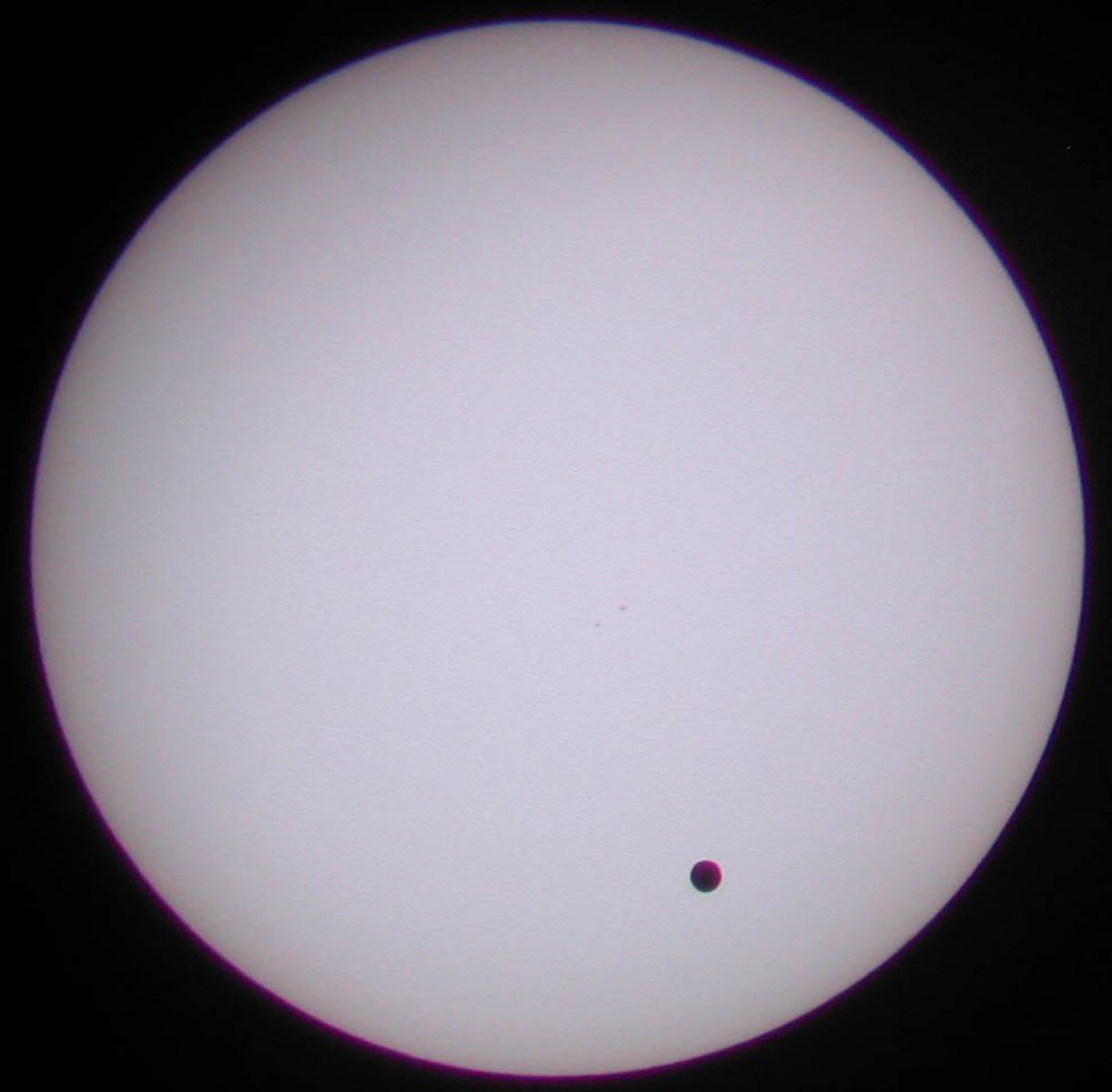
The photo, taken on June 8, 2004, in front of the Montpellier planetarium, shows only a tiny point moving across the face of the Sun. Indeed, it cannot completely obscure the solar disk as the Moon does, for example. With a diameter 120 times smaller than that of the Sun, Venus, when it transits, appears 30 times smaller than the Sun. Virtually nothing.
It is at this moment that, just as the Moon can obscure the Sun during its journey around Earth (solar eclipse, like the one on August 12th), Venus can pass in front of the Sun. This is called a "Transit of Venus."
Venus and Earth, in their relentless orbit around the Sun, align—Sun-Venus-Earth—every 584 days. This is the inferior conjunction. But alas, a transit is a very rare phenomenon: only twice a century. We witnessed the two transits of the 21st century on June 8, 2004, and June 6, 2012. The next one is in December 2117. Stay healthy, friends, or pray that science makes progress if you want to witness it. The mechanics are perfectly calibrated: 105 years for the first transit, then 8 years later for the second.
Why this rarity when Venus returns to pass between the Sun and the Earth in less than two years?
Simply because Venus's orbit is tilted relative to Earth's, and for a transit to occur, the orbital planes must align.
The photo, taken on June 8, 2004, in front of the Montpellier planetarium, shows only a tiny point moving across the face of the Sun. Indeed, it cannot completely obscure the solar disk as the Moon does, for example. With a diameter 120 times smaller than that of the Sun, Venus, when it transits, appears 30 times smaller than the Sun. Virtually nothing.
Yet, in the past, transits of Venus have attracted the full attention of scientists. Twenty-two centuries separate us from the first human observations of planetary orbits. The brightest object in the night sky after the Moon, Venus has been the subject of much attention. It is never very far from the Sun, hence its presence either shortly before sunrise or shortly after sunset. This is why it is nicknamed the Morning Star.
Venus is the goddess of Love for the Romans. But for astronomers, even though some consider it Earth's twin sister, it's a hellish place given its temperature, atmosphere, and the gases we breathe there. In a future article, I'll come back to present this very bright planet in our evening sky.
Bright, I said. "Venus casts a shadow." A well-known expression among astronomers. Also, during my stay in Mayotte, I had the chance to experience this twice. On a dreamy night, with no other light than that of Venus, I passed my hand in front of a sheet of white paper and I could see that the shadow of my hand was projected onto the paper. Venus had enough light to illuminate, albeit faintly, the Mahoran night.
Venus is the goddess of Love for the Romans. But for astronomers, even though some consider it Earth's twin sister, it's a hellish place given its temperature, atmosphere, and the gases we breathe there. In a future article, I'll come back to present this very bright planet in our evening sky.
Bright, I said. "Venus casts a shadow." A well-known expression among astronomers. Also, during my stay in Mayotte, I had the chance to experience this twice. On a dreamy night, with no other light than that of Venus, I passed my hand in front of a sheet of white paper and I could see that the shadow of my hand was projected onto the paper. Venus had enough light to illuminate, albeit faintly, the Mahoran night.

To conclude, and return to the transit of Venus, as early as the 18th century, scientists launched expeditions to the ends of the earth to observe these transits. A transit was planned for 1769. The British Admiralty, in its quest for new islands in the South Pacific, sent James Cook to an island discovered in 1767 by Samuel Wallis, Otaheite. It would later be named Tahiti. Initially called King George Island and then "New Cythera" by Bougainville, it was the focus of an expedition led by Cook and the astronomer Charles Green. They established an observatory at Point Venus, from where they could observe the "black drop," a visual contact between the Sun and Venus.
The expedition's ship, the Endeavour (meaning "the attempt"), was a 29-meter three-masted vessel with a crew of 90. Departing from Plymouth in 1768, it returned to Dover in 1771, having lost 34 men to dysentery, including Charles Green.
The adventures of the Frenchman Le Gentil remain famous.
He set sail for Pondicherry, in India, in order to observe the transit of Venus across the Sun in 1761, he was unable to disembark because the city had fallen to the British. He therefore observed the transit from his ship, but without being able to make any measurements. Undaunted, he decided to wait eight years to observe the next transit in June 1769. Alas, clouds thwarted this second attempt. Returning home in 1772, he discovered that, believing him dead, his wife had remarried and that his heirs had divided his estate. What a tough job being an astronomer!
The expedition's ship, the Endeavour (meaning "the attempt"), was a 29-meter three-masted vessel with a crew of 90. Departing from Plymouth in 1768, it returned to Dover in 1771, having lost 34 men to dysentery, including Charles Green.
The adventures of the Frenchman Le Gentil remain famous.
He set sail for Pondicherry, in India, in order to observe the transit of Venus across the Sun in 1761, he was unable to disembark because the city had fallen to the British. He therefore observed the transit from his ship, but without being able to make any measurements. Undaunted, he decided to wait eight years to observe the next transit in June 1769. Alas, clouds thwarted this second attempt. Returning home in 1772, he discovered that, believing him dead, his wife had remarried and that his heirs had divided his estate. What a tough job being an astronomer!

480°
Pressure
It's raining
Pressure
It's raining