
LÉGION'ARTS






Comics, the Meaning of Life
Unlike many politicians, our friend Christian keeps his promises. The second post on comics is still fresh off the press. He doesn't do this half-heartedly; there are no half measures. You can tell he's a comic book addict; he knows his stuff… Many years ago, he took me through the streets of Aix-en-Provence to show me a bookstore specializing in them. He probably doesn't remember it anymore, but I remember it very well, so astonished was I by the owners' passion for the world of comics, as if surprised by the glee in Christian's eyes. These comics aren't for kids; they're very adult and very serious.
I humbly confess that I never thought I could elevate my mind to such a degree—like on Jacob's Ladder, which he mentions—thanks to comics. But come to think of it… who knows!
Today he's talking about Calvin, complete with his tiger and his famous box. He feels literally hypnotized by the box's contents. As he himself says, it's a veritable Pandora's box where you find everything that can affect us in life.
A marvelous world where you can dive headfirst without being mistaken for an old man having a midlife crisis.
Our friend Christian has more in store for us…
Antoine Marquet.
Comics. Calvin and Hobbes
By Christian Morisot
Following my friend Antoine's interesting contribution, I'd like to clarify something:
My point concerns all forms of comics, not just one category, whether classic or modern. Passion cannot be reasoned with, something I find difficult to explain or convey, and it is thus, as I clumsily put it, that the absurd and the “nonsense,” through the power of infinite metamorphoses, allow drawing to offer a kind of Jacob’s ladder oriented directly toward our existential anxieties. As the philosopher Sven Ortoli so aptly puts it in an article devoted to comics: “But…look at Charlie Brown,” suggests the philosopher Julian Baggini, “he is not a realistic portrait of an American boy, and yet he represents any one of them. It is by abandoning all realistic connotations that this medium becomes the best way to do philosophy.”
Following my friend Antoine's interesting contribution, I'd like to clarify something:
My point concerns all forms of comics, not just one category, whether classic or modern. Passion cannot be reasoned with, something I find difficult to explain or convey, and it is thus, as I clumsily put it, that the absurd and the “nonsense,” through the power of infinite metamorphoses, allow drawing to offer a kind of Jacob’s ladder oriented directly toward our existential anxieties. As the philosopher Sven Ortoli so aptly puts it in an article devoted to comics: “But…look at Charlie Brown,” suggests the philosopher Julian Baggini, “he is not a realistic portrait of an American boy, and yet he represents any one of them. It is by abandoning all realistic connotations that this medium becomes the best way to do philosophy.”
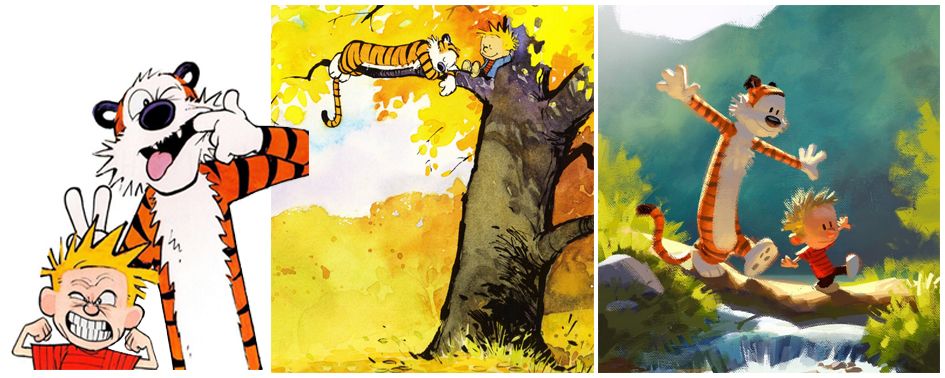
To continue, I would like to introduce you—for some of you—and above all remain faithful to the guiding thread explained above: “Calvin and Hobbes,” a reference, a cult figure in the history of comics.
It is said that a pinch of Calvin and a dash of Hobbes and we are off to a world where man is a tiger to man and tuna sandwiches are the last resort to face the absurdity of life. All of this is underpinned by a philosophy: exploring reality, but what better way to do so than with a good dose of distortion? Calvin is a kid too smart for his age, Hobbes a jovial, anthropomorphic tiger (*) capable of standing upright and holding a conversation, while the outside world stubbornly insists on seeing him as nothing more than a cuddly toy. This comic book comprises some three thousand pages published in just ten years, between 1985 and 1995. Author Bill Watterson addresses everything: the conformism of absurd customs, the pitfalls of domestic discipline, everyday meanness in schools, the wave of unease gnawing at a materialistic world given over to the cynicism of profit and the mediocrity of mass culture, and the anxiety and boredom that grip children on Sunday afternoons. Phew, all that in a comic book!
I have a truly hypnotic fascination with Calvin's cardboard box. This box is legendary; in my opinion, it's the best way to explore one's own world. Thanks to it, Calvin, with or without Hobbes, takes many journeys. This box, which he can pull out or put away in his closet at will, possesses a reality far more concrete than a flying saucer or the silhouette of a T. Rex.
It represents everything we fill and empty in our lives: the boxes of Christmas presents, those of toys we no longer use, books, notebooks, objects from the past, photo albums, clothes, outdated documents we're afraid to throw away. Calvin's box is a treasure, the Pandora's box of our lives. It contains our past images, our dreams of the future, our forgotten hopes. I just opened it up with my very recent move… It’s a bit like a skull containing our brains; it holds an ever-expanding inner universe that reality can never equal or reproduce.
Ah! The cardboard boxes in my great-grandmother’s attic, those formidable magnets that pulled me out of the pre-recorded boredom of Sunday afternoons!
It is said that a pinch of Calvin and a dash of Hobbes and we are off to a world where man is a tiger to man and tuna sandwiches are the last resort to face the absurdity of life. All of this is underpinned by a philosophy: exploring reality, but what better way to do so than with a good dose of distortion? Calvin is a kid too smart for his age, Hobbes a jovial, anthropomorphic tiger (*) capable of standing upright and holding a conversation, while the outside world stubbornly insists on seeing him as nothing more than a cuddly toy. This comic book comprises some three thousand pages published in just ten years, between 1985 and 1995. Author Bill Watterson addresses everything: the conformism of absurd customs, the pitfalls of domestic discipline, everyday meanness in schools, the wave of unease gnawing at a materialistic world given over to the cynicism of profit and the mediocrity of mass culture, and the anxiety and boredom that grip children on Sunday afternoons. Phew, all that in a comic book!
I have a truly hypnotic fascination with Calvin's cardboard box. This box is legendary; in my opinion, it's the best way to explore one's own world. Thanks to it, Calvin, with or without Hobbes, takes many journeys. This box, which he can pull out or put away in his closet at will, possesses a reality far more concrete than a flying saucer or the silhouette of a T. Rex.
It represents everything we fill and empty in our lives: the boxes of Christmas presents, those of toys we no longer use, books, notebooks, objects from the past, photo albums, clothes, outdated documents we're afraid to throw away. Calvin's box is a treasure, the Pandora's box of our lives. It contains our past images, our dreams of the future, our forgotten hopes. I just opened it up with my very recent move… It’s a bit like a skull containing our brains; it holds an ever-expanding inner universe that reality can never equal or reproduce.
Ah! The cardboard boxes in my great-grandmother’s attic, those formidable magnets that pulled me out of the pre-recorded boredom of Sunday afternoons!