




From the seven-flamed grenade to the Legion logo,
the journey of an unwitting designer
1/3
Short stories about some creations that have made their mark… sometimes even further than their creator!
In the twilight of life, a brief inventory
At the end of our lives, we sometimes look back on the path we've traveled and wonder what we've left behind. On a human scale, our time on Earth is like a shooting star, a brief flash, then everyone goes their separate ways.
Looking more closely at my own journey, a question came to me after nearly thirty years in the French Foreign Legion: what tangible legacy have I left to this noble institution?
I served in the "O.O." branch, as a legionnaire, non-commissioned officer, and then officer. I feel I did my part, like many of my comrades, nothing more, nothing less. In military terms, we simply say, "I did the job." “
I am neither a hero of Camerone, nor of the Somme, nor of Bir Hakeim, nor of Dien Bien Phu, the Legion’s last major battle. My career unfolded during the Cold War, the infamous overseas deployments, and a few external operations. But make no mistake, the preparation for combat was intense and constant. The Legion’s very purpose is to be ready to fight. The quieter periods were therefore not exactly vacations at Club Med!
Yet, in compiling this inventory, I realized that the most tangible traces I left behind didn’t really stem from my military training. They had a much older origin: my artistic training. Which goes to show, you can join the Legion with a certain background and one day discover that it’s the pencils that will prove most useful!”
White Kepi. When the Pencil Becomes a Weapon of Service
In the army, fate sometimes has a very particular way of guiding you.
When Warrant Officer Rudy Burda, illustrator and layout artist for Képi Blanc magazine, was posted overseas, a replacement had to be found. The command turned to me and immediately assigned me to the 1st Foreign Regiment.
The logic seemed clear: non-commissioned officers in the Operations branch were easy to find, but layout artists were another story!
Off to Aubagne, to the Képi Blanc magazine. I would end up spending three tours there, without the slightest regret. It was during these postings that I created several pieces for the Legion: badges, posters, illustrations, and, unbeknownst to me at the time, an image destined for a special fate.
But let's start from the beginning.
1973. A Grenade for the Comoros
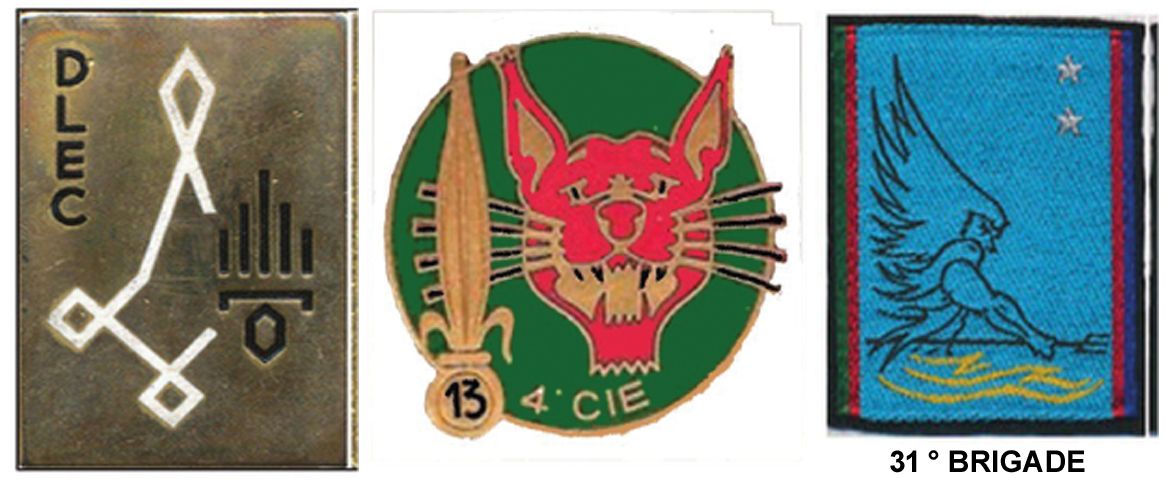
That year, the 3rd Foreign Infantry Regiment (3e REI) permanently left Madagascar for French Guiana. The 2nd Company, placed outside the regular regimental structure, remained in the Comoros. Formed into a cohesive unit, it took the name of the Comoros Foreign Legion Detachment (DLEC).
Its commander, Captain F. Grandjean, contacted me while I was at Képi Blanc to propose a design for the insignia. His specifications were concise.
"It must retain the rectangular shape of the 3rd REI's insignia and feature the Southern Cross somewhere."
That certainly had the merit of being clear! No twelve-meeting brainstorming sessions or thirty-two-slide PowerPoint presentations. One shape, one symbol, and the designer was left to figure it out!
Having already worked with rectilinear shapes, I looked for a solution that preserved the graphic spirit of the regiment's insignia. I opted for a seven-flame grenade, designed in the same style, drawing inspiration in particular from the one worn by the CICS/GILE at the Corte flour mill.
The captain approved the design.
The matter was settled. Well, almost, because insignia sometimes outlive the units that wear them. The DLEC would later become the DLEM. The Southern Cross would then give way to the outline of the island of Mayotte.
The grenade, for its part, would have done its job, accompanying the unit's evolution without needing to request a new assignment!
1975. At Holl-Holl, the bridge won't go anywhere!
Change of scenery: we are now at the Brunet de Sairigné post, in Holl-Holl, Djibouti. This time, I'm no longer in the White Kepi, but a squad leader in the 3rd section of the 4th company of the 13th DBLE.
All the company insignia are circular, with one exception: the 4th Company's rectangular insignia depicts the Holl-Holl Bridge, a crossing on the railway line connecting Djibouti to Addis Ababa.
Captain Terrasson, the unit commander, asked me to propose a new insignia. The commanding officer, Colonel Lardry, wanted to standardize the designs. But the captain had another idea.
"The commanding officer wants uniform insignia. I don't want a bridge, but a caracal. There's a pair of lynxes living at the post. The Legion's green and red colors should be included, but the company's green should be dominant."
The message was received.
Fortunately, the company already has a sports T-shirt featuring a caracal. I'm using this as inspiration for the new insignia, taking care to maintain graphic consistency across all the different materials. In military terms, we'd call it uniformity; in everyday language, everyone needs to look like they're from the same place.
The project is quickly adopted. The caracal replaces the bridge, the color green takes its place, and the 4th Company's insignia joins the ranks of official insignia.
As for the Holl-Holl bridge, it continues to allow trains to pass. We're not going to remove all the infrastructure in the name of aesthetics!
Share your writing
Elders of the Legion: about the Legion and other topics
Supporters: about the Legion