





All this is happening above our heads
Managing the Passing Days
By Michel Gravereau
Marignan: 1515.
How many times have you been asked your date of birth?
Do you know anyone born on February 29th who only celebrates their birthday every four years?
We could go on with these kinds of questions for a long time, questions that relate to the passage of time inscribed on our calendars.
Speaking of which, our 28, 29, 30, or 31-day calendar, where does it come from, and isn't it the result of humanity's perpetual concern with knowing how to measure time?
The Romans.
More than 2,000 years ago, in 46 BC, Julius Caesar commissioned the Greek astronomer Sosigenes of Alexandria to invent a calendar that would put an end to the enormous imperfections of the previous one, which, depending on the year, had 12 or 13 months. Indeed, it was based on the phases of the Moon, which renew themselves every 29.5 days. Thus, we had months of 29 and months of 30 days, totaling 354 days in the year.
To correspond with the seasons, it was necessary to add a thirteenth month every three years.
To achieve this, Sosigenes took the solar year, 365.25 days, and had the idea of dividing it into 12, alternating months of 30 and 31 days. Since February was the first month of the year for the Romans, it would only have 28 months. To reach 0.25 and align with the Sun, it was necessary to add a day every 4 years, hence the famous leap year.
This was clearly better than before. But Caesar's calendar also had a flaw: it advanced by one day every 128 years. Over a millennium and a half, calculations became more precise, and it wasn't a year of 365.25 days, but 365.2422 days that had to be taken into account. 11 minutes and 14 seconds. So much so that by the end of the 16th century, the Julian calendar (from Julius Caesar via Sosigenes) was more than 12 days ahead of the seasons. Pope Gregory XIII, from 1572 to 1585, decided to reform the calendar and create another, the Gregorian, much more precise than the previous one. This was in February 1582.
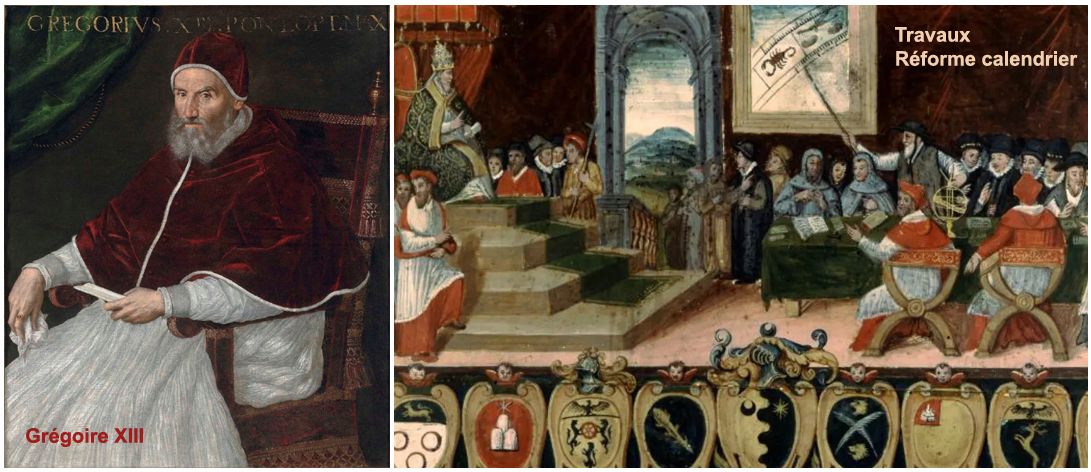
This precision was established as follows: all years ending in 00 and not multiples of 400 (1700, 1800, 1900, 2100, etc.) would not be leap years. We thus arrived at a calendar year of 365.2425 days.
To be thorough on the subject, let's not forget that this calendar advances by 26 seconds per year, which will necessitate a reform around the year 4000. I will discuss this further at that time.
How was the transition from one calendar to the other adjusted?
In March 1582, the Pope promulgated the bull Inter gravissimas, according to which Thursday, October 4, 1582, should be immediately followed by Friday, October 15.
In France, this resolution was implemented by Henry III, who moved the date from December 9 to December 20, 1582.
Other, non-Catholic countries implemented the shift much later. As a reminder, Russia will only be in the lunar calendar from January 31st to February 14th in 1918.
Upcoming Events
This section informs you about foreseeable events in the fields of pure astronomy and space exploration.
Artemis 2 Launch to the Moon:
Normally, by the time this article is published, Artemis 2 will have returned from its orbit around the Moon.
Astronomical Events
May 7th and 8th: Sunset under the Arc de Triomphe from the Place de la Concorde.
May 9th, 10th, and 11th: Sunset under the Arc de Triomphe from the Champs-Élysées roundabout.
June 21st: Summer Solstice.
July 31, August 1, 2, and 3: Sunset under the Arc de Triomphe from the Champs-Élysées roundabout.
August 3, 4, and 5: Sunset under the Arc de Triomphe from the Place de la Concorde.
August 12: Total solar eclipse, visible in its partial phase in mainland France.
Perseid meteor shower.
August 28: Partial lunar eclipse in mainland France.
September 14: Venus appears behind the Moon.
September 23: Autumnal equinox.
December 21: Winter solstice.
Ursidae meteor shower.
Space exploration
ISS: French astronaut Sophie Adenot has joined the crew aboard the ISS. She thus became the 11th French astronaut and the 2nd woman, the 1st being Claudie Aigneré.
To be thorough on the subject, let's not forget that this calendar advances by 26 seconds per year, which will necessitate a reform around the year 4000. I will discuss this further at that time.
How was the transition from one calendar to the other adjusted?
In March 1582, the Pope promulgated the bull Inter gravissimas, according to which Thursday, October 4, 1582, should be immediately followed by Friday, October 15.
In France, this resolution was implemented by Henry III, who moved the date from December 9 to December 20, 1582.
Other, non-Catholic countries implemented the shift much later. As a reminder, Russia will only be in the lunar calendar from January 31st to February 14th in 1918.
Upcoming Events
This section informs you about foreseeable events in the fields of pure astronomy and space exploration.
Artemis 2 Launch to the Moon:
Normally, by the time this article is published, Artemis 2 will have returned from its orbit around the Moon.
Astronomical Events
May 7th and 8th: Sunset under the Arc de Triomphe from the Place de la Concorde.
May 9th, 10th, and 11th: Sunset under the Arc de Triomphe from the Champs-Élysées roundabout.
June 21st: Summer Solstice.
July 31, August 1, 2, and 3: Sunset under the Arc de Triomphe from the Champs-Élysées roundabout.
August 3, 4, and 5: Sunset under the Arc de Triomphe from the Place de la Concorde.
August 12: Total solar eclipse, visible in its partial phase in mainland France.
Perseid meteor shower.
August 28: Partial lunar eclipse in mainland France.
September 14: Venus appears behind the Moon.
September 23: Autumnal equinox.
December 21: Winter solstice.
Ursidae meteor shower.
Space exploration
ISS: French astronaut Sophie Adenot has joined the crew aboard the ISS. She thus became the 11th French astronaut and the 2nd woman, the 1st being Claudie Aigneré.