
LÉGION'ARTS






The spirit of defense cannot be improvised,
it must be passed on!
By Louis Perez y Cid
From Djibouti to Ukraine, from the experience of the legionnaire to the classroom, why former military personnel still have a role to play with young people.
We often hear that young people no longer know their army and that the bond between the Nation and those who defend it has weakened. But do we really know what is happening in our schools? And what role can we, as former military personnel, still play in passing on the spirit of defense?
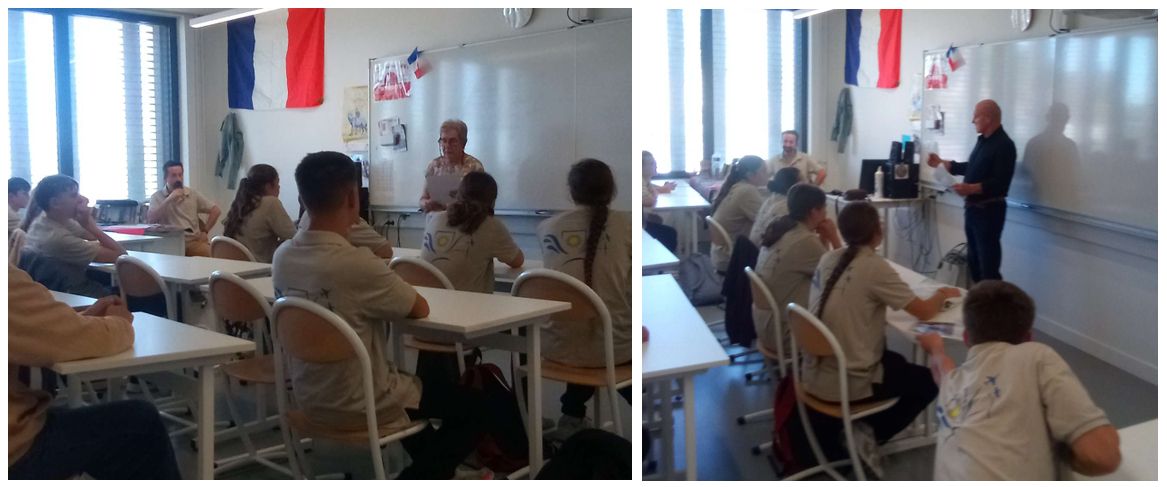
A presentation at the Caroline Aigle middle school in Lançon-Provence, organized with the ALMOPEX association for a class of ninth-grade defense students, allowed me to reflect on this in a concrete way.
"What if tomorrow morning, France came to a standstill?"
“On September 13th, prior to the commemoration of the Drakkar bombing in Lebanon, Simone Sarrazin, president of ALMOPEX, spoke about overseas operations and this tragedy that marked our military history. I then asked the students a question.
“Imagine that tomorrow morning, France is plunged into a serious crisis: no water, no electricity, no internet, disrupted transportation, and hospitals in difficulty. What is essential for the country to continue functioning?”
The answers were: water, electricity, hospitals, emergency services… “You’ve grasped the concept of defense,” I replied, then I explained to them that defending a country is not just a matter for soldiers; it concerns the entire society.
Drawing on my experience as a legionnaire, I developed four themes: the individual, the team, the country, and their own role as citizens.”
Courage is not about not being afraid.
In 1976, in Djibouti, as the territory approached independence, two demonstrations, one Afar, the other Issa, threatened to clash. Our company from the 13th DBLE was deployed between the two crowds, armed with sticks, iron bars, and machetes. Women and children were also caught in the middle.
I asked the students if the legionnaires were afraid. They answered yes.
They were right. But our greatest fear was having to fire into that crowd. Our mission was to prevent a confrontation, and if we had had to open fire, we would have had to face the consequences.
I wanted them to understand that courage is not about never being afraid, but about taking responsibility despite fear. A sense of mission, training, discipline, and trust in one's comrades are what allow one to persevere. These qualities are just as valuable in civilian life.
Teamwork: Learning to Trust Each Other
No operation relies solely on individual qualities. Cohesion is built through work, preparation, and respecting commitments. Everyone must know their role and be able to count on others.
These principles apply to sports, associations, businesses, and everyday life. We all need each other to achieve a common goal.
Defense: A Nation's Business
I mentioned the story of Iryna Terekh, a Ukrainian entrepreneur who dedicated her skills to the defense industry after the 2022 Russian aggression.
Her commitment illustrates a crucial reality: a country's defense does not depend solely on its military. Industry, technology, emergency services, government agencies, and citizens all contribute, each at their own level, to national resilience.
It's not about turning everyone into a soldier, but about understanding that a country's ability to face a crisis depends on the entire society.
“And you, at your age, what can you do?”
At fourteen, you can’t command a unit, but you can already learn to exercise your judgment, take an interest in history, understand institutions, respect others, and participate in community life.
You also need to learn how to deal with information warfare. Fake news, manipulated images, and content taken out of context can deceive, divide, and influence opinions. Checking sources, cross-referencing information, and thinking before sharing have become essential civic reflexes.
The Ministry of Education is already mobilized. Defense education has been integrated into the curriculum since the 1997 reform of national service. The comprehensive defense and security classes, created in 2005, allow students to work with units of the defense and security forces. According to data published by Éduscol in September 2026, they now involve more than 32,000 students in over 1,200 classes.
Everything isn't perfect, and partnerships remain unequal. But to claim that nothing is being done would be unfair. The school's purpose isn't to train soldiers, but citizens capable of understanding defense issues and their responsibilities. We, former military personnel, can contribute to this effort, without replacing the teachers.
Former military personnel, let us continue to serve in other ways.
What struck me at Caroline Aigle Middle School was the students' participation and their interest in the anecdotes shared. Testimonies give substance to ideas, provided we also know how to listen, answer questions, and allow young people to reflect for themselves.
Our experience should not be a model to be replicated, but rather an insight to be shared. We can explain what a mission means, cohesion, responsibility in the face of danger, and defense beyond the actions of the armed forces.
A one-off presentation, like the one organized with ALMOPEX, can already be useful. Defense classes offer other possibilities. However, our associations still need to raise their profile and we need to dare to offer our support to schools.
We have left active service, but we are not necessarily finished serving.
In Djibouti, in 1976, I learned what it meant to hold a position when fear and responsibility were inseparable. Years later, speaking to middle school students, I tried to pass on some of this knowledge. Not to ask them to become soldiers, but to help them understand that defense relies on women and men, skills, institutions, and citizens capable of discernment.
Young people are not only the future of the nation, they are already an integral part of it. A spirit of defense cannot be improvised the day a crisis arises. It is built through education, knowledge, and the passing on of that knowledge.
So, former members of the Foreign Legion, veterans, former soldiers, before saying that young people no longer know, let's go and meet them. Let's listen to them. Let's tell them what we experienced, with humility and without embellishment. Let's help them understand what we learned.
We served in uniform. We can continue to serve in other ways.
The torch has been passed. It is up to us to pass it on.
Note: I would like to sincerely thank Simone Sarrazin and her husband Jean-Claude, who concluded the session, for allowing me to have this enriching experience. This meeting with the students of Caroline Aigle Middle School will remain a wonderful moment of sharing and knowledge transfer.