






All this is happening above our heads
The Light-Year
By Michel Gravereau
Elementary school teaches us that our beloved France measures approximately 1,000 km from north to south and that the Earth's circumference is around 40,000 km.
The Sun is already 150 million kilometers away from us, and the closest star to our solar system, Proxima Centauri in the constellation Centaurus, is no less than 40 trillion kilometers away—enough to make your head spin and, above all, to make mistakes when writing down its distance.
The same is true for every object in the sky: stars, planets, asteroids, star clusters, nebulae, and galaxies.
Therefore, we had to adopt another unit of measurement: the light-year. At the current stage of our knowledge, nothing can travel faster than light. It propagates at 300,000 km per second. A light-year (or LY) is the distance that light travels in one year. It may seem paradoxical at first to express a distance by what appears to be a time, but that's how it is. Our Sun ejects particles of light, photons, which take a little over 8 minutes to reach us. 8 light-minutes.
As for stars, Proxima Centauri is therefore located 4 light-years away, and the Andromeda Galaxy is 2.3 million light-years away.
Consider that if we had to express the distance in kilometers, we would have written 2.3 billion km for Andromeda. Quite unrealistic.
In our summer sky, just above our heads, shine three stars in an isosceles triangle: Vega in Lyra, Altair in Aquila, and Deneb in Cygnus.
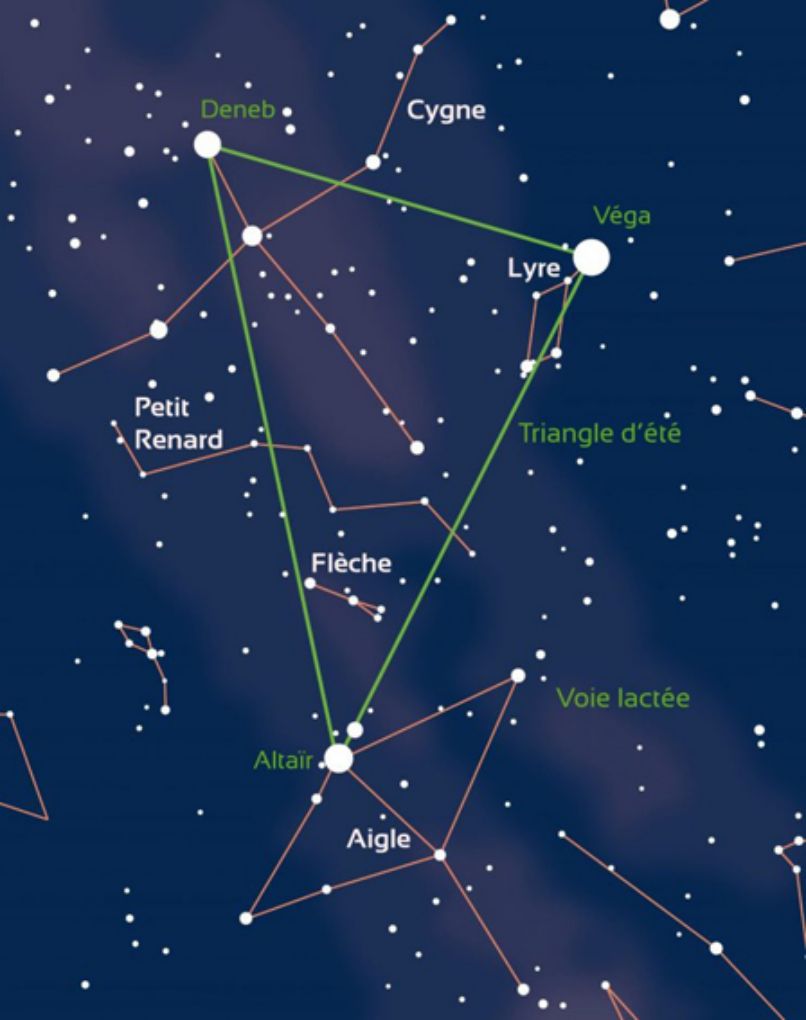
They are respectively 27 light-years, 17 light-years, and 3,200 light-years away, making Deneb the most distant star our eyes can see; yet, it is not so far from our solar system. Let's not forget that our galaxy, the Milky Way, has a diameter of about 100,000 light-years.
The boundaries of the Universe are set at 13.5 billion light-years; this is at least the distance at which the Hubble Space Telescope has photographed the most distant galaxies.
If we want to return to more "human" distances, I've just looked at the case of the Voyager 1 and 2 probes launched in September 1977. The farthest and fastest is Voyager 1. With a speed of nearly 17 km per second, it is located at 170.5 astronomical units. One AU is the distance between the Earth and the Sun, or 150 million km. Voyager 1 is 25.575 billion km from Earth. Converted to a light-year, this is 26.64 light-hours. Let's reflect on this case and enrich our knowledge for the long conversation by the fireside next winter about the existence of extraterrestrials. We Earthlings have launched a probe that seeks to leave our solar system. In 49 years of travel, it has covered barely a light-day, and I remind you that the nearest star is 4.3 light-years away. I'll let you do the math to figure out how long it will take for it to get closer. Leave the answering machine on.
This probe is still active, and it takes almost a day to receive its radio messages.
Of course, we must also address what's on the minds of most of us. The stars are so far away that one might think their light takes so long to reach us that, in the meantime, they've died. In theory, this might be true, but in reality, because of the proximity of stars visible to the naked eye, it's false, and all the stars we see on our summer nights are very much alive. We need a very large telescope to peer into the deep sky and imagine that we're admiring the ghosts of the past.
Besides the solar eclipse on August 12th, I invite you to visit your deckchair in an open spot and feast your eyes on the myriad tiny points of light that will enchant your summer nights.
The boundaries of the Universe are set at 13.5 billion light-years; this is at least the distance at which the Hubble Space Telescope has photographed the most distant galaxies.
If we want to return to more "human" distances, I've just looked at the case of the Voyager 1 and 2 probes launched in September 1977. The farthest and fastest is Voyager 1. With a speed of nearly 17 km per second, it is located at 170.5 astronomical units. One AU is the distance between the Earth and the Sun, or 150 million km. Voyager 1 is 25.575 billion km from Earth. Converted to a light-year, this is 26.64 light-hours. Let's reflect on this case and enrich our knowledge for the long conversation by the fireside next winter about the existence of extraterrestrials. We Earthlings have launched a probe that seeks to leave our solar system. In 49 years of travel, it has covered barely a light-day, and I remind you that the nearest star is 4.3 light-years away. I'll let you do the math to figure out how long it will take for it to get closer. Leave the answering machine on.
This probe is still active, and it takes almost a day to receive its radio messages.
Of course, we must also address what's on the minds of most of us. The stars are so far away that one might think their light takes so long to reach us that, in the meantime, they've died. In theory, this might be true, but in reality, because of the proximity of stars visible to the naked eye, it's false, and all the stars we see on our summer nights are very much alive. We need a very large telescope to peer into the deep sky and imagine that we're admiring the ghosts of the past.
Besides the solar eclipse on August 12th, I invite you to visit your deckchair in an open spot and feast your eyes on the myriad tiny points of light that will enchant your summer nights.
