






All this is happening above our heads
The Sun Shines
By Michel Gravereau
On these sweltering days, when presenting the Sun to the public, the inevitable question arises: is the Sun responsible for this heat we are experiencing?
Of course, it would be completely foolish to answer that it has nothing to do with it, since we have been living thanks to the Sun and the heat it has been radiating for nearly 5 billion years.
But it must be strongly stated that these changes observed in the various climates of planet Earth and their resulting consequences are, so to speak, the product of human activities and their influence on the atmospheric layers that are supposed to protect us, but which will kill us in the long term if we continue to alter their composition. See the articles published on this site concerning the greenhouse effect.
Once again, it is absolutely essential not to systematically link solar activity and global warming.
The Sun shines brightly and bathes us in a thousand lights because it has at its center an immense nuclear power plant which, from matter, produces energy in the form of light and heat.

This process takes place only in its core, where its temperature is around 15 to 16 million degrees.
It then takes 2 million years for this light to travel through the Sun's interior and reach its surface. This is called convection. Imagine a pot of water you've placed on the stove to cook noodles. Many tiny bubbles form on the bottom of the pot, which then detach and rise to the surface. That's convection. The same principle applies to the Sun as to heat.
This core of the Sun, estimated by scientists to be a sphere 347,000 km in diameter, generates heat of nearly 15 million degrees, while the Sun's surface barely reaches 6,000 degrees.
I remind you that the Sun's diameter is approximately 1.4 million km, while the Earth's is 12,700 km. We could fit 109 Earths side by side within the Sun's diameter.
Let's return to sunlight, composed primarily of the two most common chemical elements in the universe: hydrogen and helium. The pressure and high temperature at its core generate four hydrogen atoms that fuse a helium atom, producing light, heat, and radiation in the process…
It then takes 2 million years for this light to travel through the Sun's interior and reach its surface. This is called convection. Imagine a pot of water you've placed on the stove to cook noodles. Many tiny bubbles form on the bottom of the pot, which then detach and rise to the surface. That's convection. The same principle applies to the Sun as to heat.
This core of the Sun, estimated by scientists to be a sphere 347,000 km in diameter, generates heat of nearly 15 million degrees, while the Sun's surface barely reaches 6,000 degrees.
I remind you that the Sun's diameter is approximately 1.4 million km, while the Earth's is 12,700 km. We could fit 109 Earths side by side within the Sun's diameter.
Let's return to sunlight, composed primarily of the two most common chemical elements in the universe: hydrogen and helium. The pressure and high temperature at its core generate four hydrogen atoms that fuse a helium atom, producing light, heat, and radiation in the process…

When humankind wanted to create the atomic bomb, it simply observed what the Sun had been doing for 5 billion years and copied it: the fusion of hydrogen into helium.
Although it is considered a small star, our Sun has imposing dimensions compared to the Earth. The Sun could hold 1,310,000 Earths. It has been shining for 5 billion years, and scientists estimate its lifespan at another 5 billion years. It is halfway through its life. And yet, it transforms no less than 600 million tons of hydrogen every second. Our minds cannot comprehend such a furnace.
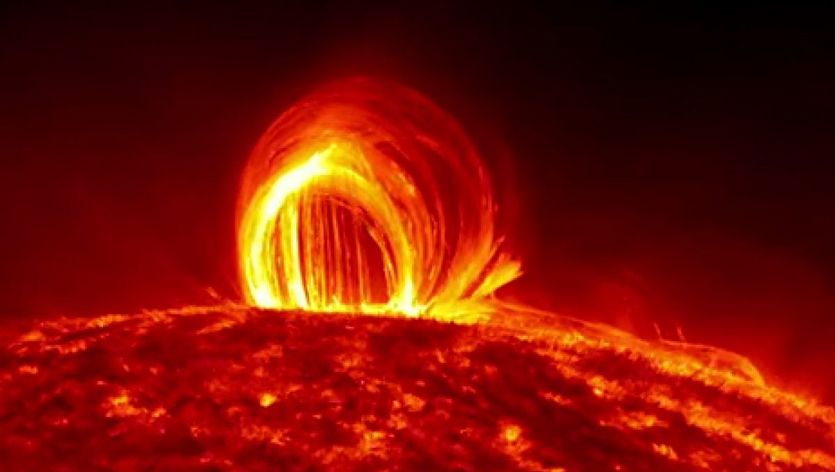
When I said that the light produced at its core takes 2 million years to reach its surface, I meant that its internal path is fraught with all sorts of obstacles, sometimes even temporarily depriving the Sun of the partial and temporary heating of a portion of its surface. For us, as observers of the Sun, this translates into the appearance of sunspots. These are areas slightly cooler than the rest of the Sun.
Although it is considered a small star, our Sun has imposing dimensions compared to the Earth. The Sun could hold 1,310,000 Earths. It has been shining for 5 billion years, and scientists estimate its lifespan at another 5 billion years. It is halfway through its life. And yet, it transforms no less than 600 million tons of hydrogen every second. Our minds cannot comprehend such a furnace.
When I said that the light produced at its core takes 2 million years to reach its surface, I meant that its internal path is fraught with all sorts of obstacles, sometimes even temporarily depriving the Sun of the partial and temporary heating of a portion of its surface. For us, as observers of the Sun, this translates into the appearance of sunspots. These are areas slightly cooler than the rest of the Sun.
I often compare the passage of time for us humans with the time it takes for light to travel, which seems instantaneous to us, but is actually limited to 300,000 km per second.
We see the Sun with an 8-minute delay. When our gaze falls upon the star Proxima Centauri, we see it 4 years in the past. If we admire one of the three summer stars, Deneb, its light reaches us with a 3,200-year delay. When the photons, particles of light, left this star, Ramses II was causing trouble for Moses.
If, with binoculars or a telescope, we contemplate the Andromeda Galaxy, the closest galaxy to our own, the Milky Way, it is an image that was created before humankind even existed on our good Earth.
The sunlight that warms us and sustains us, which we are receiving right now, is energy created within us when Homo Habilis was just learning to master its first tool.
We can observe our star, the Sun, safely shielded from its harmful radiation thanks to the natural filter of Earth's atmosphere. But let's consider the astronauts who "inhabit" the International Space Station, like Sophie Adenot, for example. They receive the cosmic radiation emitted by the Sun, and this radiation can penetrate the protective suits and even reach them inside the spacecraft. Hence their limited time in space and the monitoring of accumulated doses.
Let's continue to enjoy the benefits of the Sun…and drink cold drinks.
We see the Sun with an 8-minute delay. When our gaze falls upon the star Proxima Centauri, we see it 4 years in the past. If we admire one of the three summer stars, Deneb, its light reaches us with a 3,200-year delay. When the photons, particles of light, left this star, Ramses II was causing trouble for Moses.
If, with binoculars or a telescope, we contemplate the Andromeda Galaxy, the closest galaxy to our own, the Milky Way, it is an image that was created before humankind even existed on our good Earth.
The sunlight that warms us and sustains us, which we are receiving right now, is energy created within us when Homo Habilis was just learning to master its first tool.
We can observe our star, the Sun, safely shielded from its harmful radiation thanks to the natural filter of Earth's atmosphere. But let's consider the astronauts who "inhabit" the International Space Station, like Sophie Adenot, for example. They receive the cosmic radiation emitted by the Sun, and this radiation can penetrate the protective suits and even reach them inside the spacecraft. Hence their limited time in space and the monitoring of accumulated doses.
Let's continue to enjoy the benefits of the Sun…and drink cold drinks.