







Lili Marlène, a Tale from History.
By Louis Perez y Cid
One evening in 1915, in a world that had just plunged into the Great War, a young German soldier named Hans Leip* was preparing to leave the city to join the front.
He was a poet, enlisted out of a sense of duty.
He walked slowly toward the exit of the barracks, his heart heavy.
Under a lantern, at a street corner, a young woman was waiting for him.
The light cast a trembling halo around her, like a promise.
They said goodbye, simply, without knowing if they would ever see each other again.
That evening, Hans engraved this image in his heart.
From this emotion was born a poem, "Lied eines jungen Wachpostens," in English, Song of a Young Sentry. A few lines about a soldier on duty, thinking of the one he loved under the lantern. He gives it a name: Lili Marleen, a blend of two first names, two memories, two women who were important to him. But, out of superstition, he doesn't write the last stanza. Fate will choose it.
Then the war sweeps everything away. Nine million dead and missing. Twenty-one million wounded. And, as if that weren't enough, the Spanish flu claims forty million more lives, five percent of humanity.
The poem, however, remains in a drawer, forgotten like a secret of the soul.
The years pass.
The Weimar Republic arrives, the Roaring Twenties, the cabarets, the fever of rediscovered life. Hans Leip has survived the apocalypse. He writes songs, poems, dreams. But the scars of war never truly heal.
And already, the world threatens to begin again.
One evening in 1915, in a world that had just plunged into the Great War, a young German soldier named Hans Leip* was preparing to leave the city to join the front.
He was a poet, enlisted out of a sense of duty.
He walked slowly toward the exit of the barracks, his heart heavy.
Under a lantern, at a street corner, a young woman was waiting for him.
The light cast a trembling halo around her, like a promise.
They said goodbye, simply, without knowing if they would ever see each other again.
That evening, Hans engraved this image in his heart.
From this emotion was born a poem, "Lied eines jungen Wachpostens," in English, Song of a Young Sentry. A few lines about a soldier on duty, thinking of the one he loved under the lantern. He gives it a name: Lili Marleen, a blend of two first names, two memories, two women who were important to him. But, out of superstition, he doesn't write the last stanza. Fate will choose it.
Then the war sweeps everything away. Nine million dead and missing. Twenty-one million wounded. And, as if that weren't enough, the Spanish flu claims forty million more lives, five percent of humanity.
The poem, however, remains in a drawer, forgotten like a secret of the soul.
The years pass.
The Weimar Republic arrives, the Roaring Twenties, the cabarets, the fever of rediscovered life. Hans Leip has survived the apocalypse. He writes songs, poems, dreams. But the scars of war never truly heal.
And already, the world threatens to begin again.
.jpg?t=aeb8a500_42ca_451a_ab7f_8e5528b4f20b)
In 1937, before the thunder rumbled again, Hans finally wrote the last stanza of his poem. The following year, a musician, Norbert Schultze, offered him a simple melody, a slow march, like a heartbeat.
A Berlin singer, Lale Andersen, lent her voice to the song, a voice that trembled just enough to be authentic. She sang for the absent, for lovers separated, for those who waited for the light in the night. But in 1938, Germany no longer wanted tenderness. It wanted to be proud, tough, invincible. This love song seemed out of place.
The record was released, then disappeared. Lale Andersen refused the advances of a high-ranking SS officer.
So her records were banned, she was threatened, her name was erased. Lili Marleen fell silent again, she was ostracized, and attempted suicide.
A Berlin singer, Lale Andersen, lent her voice to the song, a voice that trembled just enough to be authentic. She sang for the absent, for lovers separated, for those who waited for the light in the night. But in 1938, Germany no longer wanted tenderness. It wanted to be proud, tough, invincible. This love song seemed out of place.
The record was released, then disappeared. Lale Andersen refused the advances of a high-ranking SS officer.
So her records were banned, she was threatened, her name was erased. Lili Marleen fell silent again, she was ostracized, and attempted suicide.
.jpg?t=aeb8a500_42ca_451a_ab7f_8e5528b4f20b)
Until one evening in 1941, at a German military radio station in Belgrade, independent of Berlin, a technician was looking for a record to fill the end of a broadcast. At random, he pulled an old 78 rpm record from the pile: Lili Marleen.
He placed the needle… and Lale Andersen's voice rose into the night. Clear, melancholic, carried by a breath of nostalgia.
A soldier, a lantern, a moment of waiting.
Nothing more.
But everything was there.
The German soldiers, scattered across the African fronts, listened, moved and silent.
In that voice, they recognized their own thoughts.
Little by little, Lili Marleen became their companion in solitude. Every evening, Radio Belgrade ended its broadcasts with this song, reminding everyone that beyond the war, someone might be waiting for them, somewhere.
But what's most astonishing is that the enemy listens to it too. British soldiers, stationed in the desert, also pick up on this voice. They don't understand all the words, but they grasp its tenderness and adopt it.
Thus, on all the southern fronts, both sides listen to the same song,
at the same time, under the same moon. At 9:57 p.m. every evening, Lili Marleen rings out.
And in the trenches, the shelters, the dunes, the war pauses for a moment.
A breath of humanity passes.
He placed the needle… and Lale Andersen's voice rose into the night. Clear, melancholic, carried by a breath of nostalgia.
A soldier, a lantern, a moment of waiting.
Nothing more.
But everything was there.
The German soldiers, scattered across the African fronts, listened, moved and silent.
In that voice, they recognized their own thoughts.
Little by little, Lili Marleen became their companion in solitude. Every evening, Radio Belgrade ended its broadcasts with this song, reminding everyone that beyond the war, someone might be waiting for them, somewhere.
But what's most astonishing is that the enemy listens to it too. British soldiers, stationed in the desert, also pick up on this voice. They don't understand all the words, but they grasp its tenderness and adopt it.
Thus, on all the southern fronts, both sides listen to the same song,
at the same time, under the same moon. At 9:57 p.m. every evening, Lili Marleen rings out.
And in the trenches, the shelters, the dunes, the war pauses for a moment.
A breath of humanity passes.
.jpg?t=aeb8a500_42ca_451a_ab7f_8e5528b4f20b)
It is no longer a German song. Nor even a war song.
It is the song of men. For the Germans, Lale Andersen, a survivor of a shattered era, continues to sing it.
She keeps that flickering light, like the flame of a lantern buffeted by the wind.
And every time she whispers Lili Marleen, you can feel the breath of an era when even hearts at war still knew how to weep.
For the Allies, Marlene Dietrich, back from exile, sang it in turn, as a symbol of rediscovered humanity.
It is the song of men. For the Germans, Lale Andersen, a survivor of a shattered era, continues to sing it.
She keeps that flickering light, like the flame of a lantern buffeted by the wind.
And every time she whispers Lili Marleen, you can feel the breath of an era when even hearts at war still knew how to weep.
For the Allies, Marlene Dietrich, back from exile, sang it in turn, as a symbol of rediscovered humanity.

It was translated, covered, and loved. In English, in French, in Italian.
Ironically, the Allies entered Germany humming Lili Marleen (not Marleen) as a victory anthem.
Then the cannons fell silent, the flags changed, but the song remained.
It crossed borders, languages, and wounds. It became the universal voice of tenderness in the heart of horror.
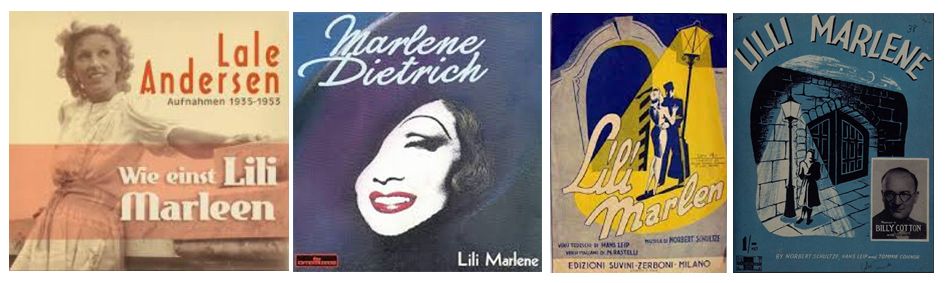
Even today, when we listen to Lili Marleen, we hear more than just a song.
We hear the echo of a world that suffered, but that had not forgotten how to love. We can imagine the sale beneath the lantern, on the wet cobblestones, the shadow of a woman waits.
And in this fragile yet eternal image shines what wars have never been able to extinguish: humanity.
Thus ends the tale of Lili Marleen, born from a farewell poem, which became the voice of both sides, and much more, the song of all hearts that hope to find each other again,
one evening, under the light of a lantern.
* Hans Leip (1893–1983) wrote the lyrics to this poem before leaving for the Russian front in April 1915. He was then assigned to the Coccinelles barracks in Berlin with the Imperial Guard as a cadet officer (standing at two meters tall). Having fallen from a bridge with a broken vertebra, he was demobilized in December 1915. He did not publish his poem until 1937, having practiced popular arts (poetry and literature) in the meantime.
Lale Andersen (1905–1972).
Norbert Schultze (1911–2002)
3 videos
Lale Andersen (original version, 1938) - https://www.youtube.com/watch?v=Qk2ge4H-o5g
Marlene Dietrich - https://www.youtube.com/watch?v=xz5GtOprh9E
Marie Laforêt (1972) - https://www.youtube.com/watch?v=Qk2ge4H-o5g
We hear the echo of a world that suffered, but that had not forgotten how to love. We can imagine the sale beneath the lantern, on the wet cobblestones, the shadow of a woman waits.
And in this fragile yet eternal image shines what wars have never been able to extinguish: humanity.
Thus ends the tale of Lili Marleen, born from a farewell poem, which became the voice of both sides, and much more, the song of all hearts that hope to find each other again,
one evening, under the light of a lantern.
* Hans Leip (1893–1983) wrote the lyrics to this poem before leaving for the Russian front in April 1915. He was then assigned to the Coccinelles barracks in Berlin with the Imperial Guard as a cadet officer (standing at two meters tall). Having fallen from a bridge with a broken vertebra, he was demobilized in December 1915. He did not publish his poem until 1937, having practiced popular arts (poetry and literature) in the meantime.
Lale Andersen (1905–1972).
Norbert Schultze (1911–2002)
3 videos
Lale Andersen (original version, 1938) - https://www.youtube.com/watch?v=Qk2ge4H-o5g
Marlene Dietrich - https://www.youtube.com/watch?v=xz5GtOprh9E
Marie Laforêt (1972) - https://www.youtube.com/watch?v=Qk2ge4H-o5g