





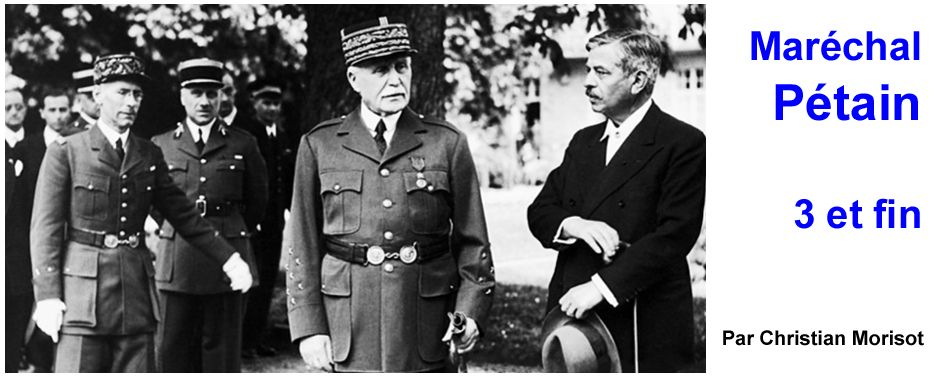
Marshal Pétain 3 and end
By Christian Morisot
In response to my friends Louis and Michel.
First and foremost, a question arises: "What would become of our feelings if the Marshal's trial did not take place…?" This question, posed in this way, leads to another: "Why should this be of serious interest to a foreigner serving France?"
Nevertheless, the subject is fascinating for some of us and extends far beyond the intimate thoughts that each of us keeps deep within our memories. Michel's reaction is bold but uncompromising, to the point of concluding that: "History, nothing but history. The rest is just talk." In fact, Michel's response raises a completely different point: that one day you are an adored hero and the next the worst of villains! Hope in 1940 had not changed sides, however, the struggle itself had changed its very essence, embodied by a resistance whose numbers were particularly impressive at the time of the liberation of the free world…
The “Pétain” affair was initially what we call a “reason of state,” a concept in political philosophy that allows states to justify their actions, however illegal they may be, in the name of the public good and in the logic of preserving and exercising political power: “Everyone sees what you appear to be, few feel what you are, and this small number do not dare to oppose the opinion of a majority who have the majesty of the state to defend them and in the actions of all men and especially of princes for whom there is no tribunal to which to protest to ensure that a prince does everything to conquer and maintain the State and the means will always be judged honorable and will be praised by everyone. To say that our "veterans" risked their lives for their ideals, they unfortunately had no choice, as Victor Hugo wrote in his poem "For Six Thousand Years, War": "And all this for Highnesses, Who, barely buried, Will exchange pleasantries, While you rot." They risked their lives for their ideals, especially for certain leaders who used foreigners who had sworn to serve France faithfully and led them into an adventure with fatal consequences for the Foreign Legion, had Pierre Messmer not intervened.
Reflection: France was quickly defeated in June 1940 by German troops. Faced with this situation, Marshal Pétain seized power and signed the armistice with Germany. The terms of the armistice were difficult for France. The Germans occupied a large part of the territory. Pétain, at the head of the French State, established a mandatory dictatorship and undertook collaboration with Germany, notably by arresting and handing over Jews and Roma to the Germans without their request. To fight against the German occupation and the Vichy regime, the internal and external resistance was organized under the leadership of General de Gaulle.
In short: Everyone is entitled to their own opinion. However, nothing is simple, and a question arises: how to interpret a (fictional) account of what France would have become if the Marshal, at 84 years old, had not accepted this "mission" at the end of his life? He had everything to lose and nothing to gain.
Nevertheless… Subtle measures introduced (or finalized) by the legislators of the Vichy regime survive to this day. This is also true of the Category IV license, which regulates the sale of alcoholic beverages in bars: introduced on September 24, 1941, it was part of the anti-alcohol crusade championed by the occupying forces. Aimed at the "regeneration of the race" through sport and health, the fate of sports federations owes much to the patronage of the French state at the time, which considered effort and discipline the driving forces of the nation. From this period, we inherited the addition of a sports component to the baccalaureate exam in 1941, which became mandatory in 1959. The siren that sounds every first Wednesday of the month? An invention of the period designed to strengthen civil defense. The "no entry" sign? Introduced by the Germans to replace a French-language sign that the occupying forces didn't understand. Mandatory price displays in stores? The pay-as-you-go pension system? Sports as a baccalaureate component? More concrete examples of the Vichy regime's policies.
In the absence of the Chamber of Deputies and the Senate, silenced by the occupying forces, Philippe Pétain's dictatorship proved particularly effective at introducing new legislation. Where months of negotiations were usually required for a decree to be finalized, a few days were now sufficient. This resulted in a veritable legislative frenzy: 16,786 laws and decrees were promulgated under the Vichy regime between July 1940 and August 1944, more than eleven new laws per day! After the Liberation, rather than simply scrapping all of these measures the Provisional Government of the French Republic (June 1944 - October 1946) reserved the right to repeal the measures put in place during the Occupation on a case-by-case basis. The ordinance known as the "Reestablishment of Republican Legality" decree, published on August 9, 1944, did not completely erase the Vichy regime's legacy, as not everything in the laws and decrees promulgated since July 1940 was without merit. Indeed, some measures continued the projects initiated during the Third Republic (1870-1940) and affected areas far removed from any particular ideology: agriculture, urban planning, infrastructure, etc. The business world also bore the imprint of the Vichy regime. It was during the Occupation that the role of CEO (Chief Executive Officer) was invented, along with works councils, which have since become company committees, with the aim of strengthening collaboration between unions and management. Company canteens are also a legacy of this era, as are meal vouchers, a corporatist version of the rationing system in place during the Second World War.
Some measures are less subtle in their ideological underpinnings, which hasn't prevented them from remaining in the law to this day. Take, for example, the offense of failing to assist a person in danger, introduced on October 25, 1941. Philippe Pétain's dictatorship used it to force citizens to report "terrorist" attacks of which they were aware. While it may seem a noble act today, who could have imagined that it once rewarded denunciation of the Resistance?
Indeed, national security was one of the imperatives guiding the Vichy bureaucrats. Thus, the creation of the National Police (April 23, 1941) allowed the collaborationist regime to become a coordinated instrument of repression, which carried out the Vel' d'Hiv Roundup on July 16 and 17, 1942. Meanwhile, the mandatory possession of an identity card (law of October 27, 1940) distinguished Jews from other citizens and facilitated their persecution administratively. Stamped with a national number, unique to each individual, this number has become our Social Security number… Furthermore, it was during this same period that the infamous "S file" (for "State Security") was established, listing individuals targeted by the authorities.
Thus, in some respects, postwar France was still somewhat under the influence of Vichy and, therefore, Berlin. It was under Marshal Pétain's rule that French clocks were synchronized with those of the Third Reich, even though France and Germany are not actually on the same longitude. The ultimate illustration of this legacy, now a daily reality, is that French clock hands remain on the clocks to this day, whereas they were once aligned with the Greenwich Meridian, London time.
In response to my friends Louis and Michel.
First and foremost, a question arises: "What would become of our feelings if the Marshal's trial did not take place…?" This question, posed in this way, leads to another: "Why should this be of serious interest to a foreigner serving France?"
Nevertheless, the subject is fascinating for some of us and extends far beyond the intimate thoughts that each of us keeps deep within our memories. Michel's reaction is bold but uncompromising, to the point of concluding that: "History, nothing but history. The rest is just talk." In fact, Michel's response raises a completely different point: that one day you are an adored hero and the next the worst of villains! Hope in 1940 had not changed sides, however, the struggle itself had changed its very essence, embodied by a resistance whose numbers were particularly impressive at the time of the liberation of the free world…
The “Pétain” affair was initially what we call a “reason of state,” a concept in political philosophy that allows states to justify their actions, however illegal they may be, in the name of the public good and in the logic of preserving and exercising political power: “Everyone sees what you appear to be, few feel what you are, and this small number do not dare to oppose the opinion of a majority who have the majesty of the state to defend them and in the actions of all men and especially of princes for whom there is no tribunal to which to protest to ensure that a prince does everything to conquer and maintain the State and the means will always be judged honorable and will be praised by everyone. To say that our "veterans" risked their lives for their ideals, they unfortunately had no choice, as Victor Hugo wrote in his poem "For Six Thousand Years, War": "And all this for Highnesses, Who, barely buried, Will exchange pleasantries, While you rot." They risked their lives for their ideals, especially for certain leaders who used foreigners who had sworn to serve France faithfully and led them into an adventure with fatal consequences for the Foreign Legion, had Pierre Messmer not intervened.
Reflection: France was quickly defeated in June 1940 by German troops. Faced with this situation, Marshal Pétain seized power and signed the armistice with Germany. The terms of the armistice were difficult for France. The Germans occupied a large part of the territory. Pétain, at the head of the French State, established a mandatory dictatorship and undertook collaboration with Germany, notably by arresting and handing over Jews and Roma to the Germans without their request. To fight against the German occupation and the Vichy regime, the internal and external resistance was organized under the leadership of General de Gaulle.
In short: Everyone is entitled to their own opinion. However, nothing is simple, and a question arises: how to interpret a (fictional) account of what France would have become if the Marshal, at 84 years old, had not accepted this "mission" at the end of his life? He had everything to lose and nothing to gain.
Nevertheless… Subtle measures introduced (or finalized) by the legislators of the Vichy regime survive to this day. This is also true of the Category IV license, which regulates the sale of alcoholic beverages in bars: introduced on September 24, 1941, it was part of the anti-alcohol crusade championed by the occupying forces. Aimed at the "regeneration of the race" through sport and health, the fate of sports federations owes much to the patronage of the French state at the time, which considered effort and discipline the driving forces of the nation. From this period, we inherited the addition of a sports component to the baccalaureate exam in 1941, which became mandatory in 1959. The siren that sounds every first Wednesday of the month? An invention of the period designed to strengthen civil defense. The "no entry" sign? Introduced by the Germans to replace a French-language sign that the occupying forces didn't understand. Mandatory price displays in stores? The pay-as-you-go pension system? Sports as a baccalaureate component? More concrete examples of the Vichy regime's policies.
In the absence of the Chamber of Deputies and the Senate, silenced by the occupying forces, Philippe Pétain's dictatorship proved particularly effective at introducing new legislation. Where months of negotiations were usually required for a decree to be finalized, a few days were now sufficient. This resulted in a veritable legislative frenzy: 16,786 laws and decrees were promulgated under the Vichy regime between July 1940 and August 1944, more than eleven new laws per day! After the Liberation, rather than simply scrapping all of these measures the Provisional Government of the French Republic (June 1944 - October 1946) reserved the right to repeal the measures put in place during the Occupation on a case-by-case basis. The ordinance known as the "Reestablishment of Republican Legality" decree, published on August 9, 1944, did not completely erase the Vichy regime's legacy, as not everything in the laws and decrees promulgated since July 1940 was without merit. Indeed, some measures continued the projects initiated during the Third Republic (1870-1940) and affected areas far removed from any particular ideology: agriculture, urban planning, infrastructure, etc. The business world also bore the imprint of the Vichy regime. It was during the Occupation that the role of CEO (Chief Executive Officer) was invented, along with works councils, which have since become company committees, with the aim of strengthening collaboration between unions and management. Company canteens are also a legacy of this era, as are meal vouchers, a corporatist version of the rationing system in place during the Second World War.
Some measures are less subtle in their ideological underpinnings, which hasn't prevented them from remaining in the law to this day. Take, for example, the offense of failing to assist a person in danger, introduced on October 25, 1941. Philippe Pétain's dictatorship used it to force citizens to report "terrorist" attacks of which they were aware. While it may seem a noble act today, who could have imagined that it once rewarded denunciation of the Resistance?
Indeed, national security was one of the imperatives guiding the Vichy bureaucrats. Thus, the creation of the National Police (April 23, 1941) allowed the collaborationist regime to become a coordinated instrument of repression, which carried out the Vel' d'Hiv Roundup on July 16 and 17, 1942. Meanwhile, the mandatory possession of an identity card (law of October 27, 1940) distinguished Jews from other citizens and facilitated their persecution administratively. Stamped with a national number, unique to each individual, this number has become our Social Security number… Furthermore, it was during this same period that the infamous "S file" (for "State Security") was established, listing individuals targeted by the authorities.
Thus, in some respects, postwar France was still somewhat under the influence of Vichy and, therefore, Berlin. It was under Marshal Pétain's rule that French clocks were synchronized with those of the Third Reich, even though France and Germany are not actually on the same longitude. The ultimate illustration of this legacy, now a daily reality, is that French clock hands remain on the clocks to this day, whereas they were once aligned with the Greenwich Meridian, London time.