





All this is happening above our heads
Pluto, Dwarf Planet
By Michel Gravereau
We all learned that the solar system had nine planets. A single sentence could even help us place them in order of distance from the Sun: Me (Mercury) Here (Venus) All (Earth) Cute (Mars), I (Jupiter) Am (Saturn) One (Uranus) New (Neptune) Planet (Pluto).
Today, in schools, our children are learning that our large family, the solar system, has shrunk to eight. What happened? Who stole the ninth?
Let's find out.
In January 1930, a young American astronomer, Clyde Tombaugh, took two photos of the same part of the sky, a week apart. Comparing the two images, he declared victory: he had found what he was looking for. A tiny dot had shifted in the space of a week. It can only be a planet.
And he didn't point to that part of the sky by chance. Building on the work of Percival Lowell, another American who had proposed the existence of a ninth planet in 1903, 27 years earlier, he was thereby confirming Lowell's remarkable calculations. A mathematician and businessman, Lowell had also argued for the existence of "canals" on Mars, thus supporting the presence of living beings, the Martians.
Pluto was added to the family of planets but didn't satisfy the astronomical scientific community. Indeed, while the first four planets—Mercury, Venus, Earth, and Mars—are solid, rocky, and terrestrial, we then find four gas giants: Jupiter, Saturn, Uranus, and Neptune.
Pluto came next, bearing no resemblance to the first eight: rocky, very small, with a completely different orbit.
For a long time, I had subscribed to the theory of certain astronomers who considered Pluto a trans-Neptunian object and not a planet formed in the primordial protoplanetary cloud 5 billion years ago. As a science communicator at the Montpellier planetarium, I was regularly reprimanded during my lectures when I claimed that Pluto wasn't a true planet, but a "wart," which appeared there long after the planets had formed.
And I remember perfectly that evening, when, during a lecture on August 24, 2006, one of the planetarium directors slipped this little note onto my lectern: "Now you can assert that Pluto isn't a planet, since the International Astronomical Union, meeting in Prague, has just declassified it."

Why was it declassified?
All planets orbit the Sun in an almost circular path. Almost, because a slight ellipse animates them. Pluto approaches within 5 billion km of the Sun and moves away to 8.4 billion km. Its orbit is roughly the size of a rugby ball. Even better: while it orbits the Sun in 249 years, for 21 years it is closer to the Sun than Neptune. And we, the ancients, lived through this period, which occurred between 1979 and 2000. The planet farthest from the Sun was then Neptune, not Pluto.
Pluto's second anomaly: while the eight planets orbit in the same plane as the Sun's equator, the ecliptic, Pluto is tilted by about 20 degrees.
Third peculiarity: Pluto has an enormous moon compared to itself. It's called Charon. Almost as big as Pluto. So much so that its mass attracts Pluto, and its center of gravity is deflected. The barycenter of the two planets is therefore well outside Pluto's sphere. It is strongly perturbed by its moon.
All planets orbit the Sun in an almost circular path. Almost, because a slight ellipse animates them. Pluto approaches within 5 billion km of the Sun and moves away to 8.4 billion km. Its orbit is roughly the size of a rugby ball. Even better: while it orbits the Sun in 249 years, for 21 years it is closer to the Sun than Neptune. And we, the ancients, lived through this period, which occurred between 1979 and 2000. The planet farthest from the Sun was then Neptune, not Pluto.
Pluto's second anomaly: while the eight planets orbit in the same plane as the Sun's equator, the ecliptic, Pluto is tilted by about 20 degrees.
Third peculiarity: Pluto has an enormous moon compared to itself. It's called Charon. Almost as big as Pluto. So much so that its mass attracts Pluto, and its center of gravity is deflected. The barycenter of the two planets is therefore well outside Pluto's sphere. It is strongly perturbed by its moon.
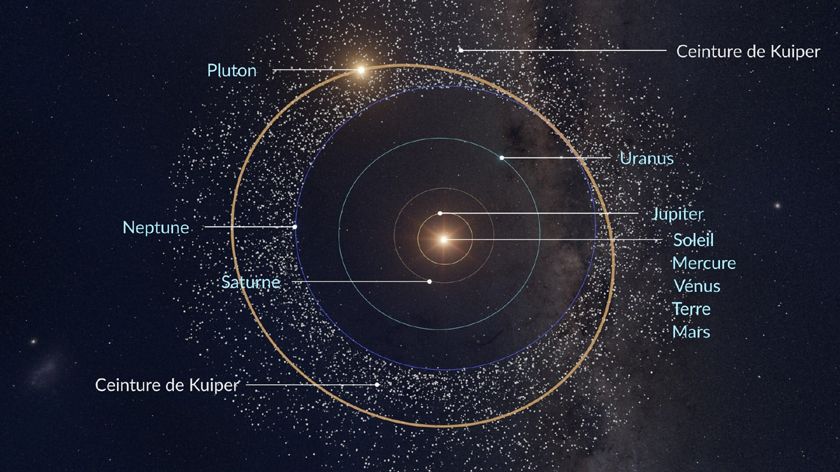
These three reasons led astronomers worldwide to downgrade Pluto from its status as a major planet. But what to do with it? Where to put it?
Pluto is not a star, not a comet, not an asteroid, and no longer a planet. It therefore had to be classified somewhere. On the same day, the category of dwarf planets was created, and presto, Pluto joined Sedna, Orcus, Makemake, Eris, Ceres (the largest asteroid), Haumea, and others.
So it wasn't a question of size, as is often heard, that led to Pluto's downgrading. This should be clearly explained to children, who unfortunately learn something else entirely in school.
Pluto was the subject of a large-scale space mission, which I personally followed with great pleasure.
Pluto is not a star, not a comet, not an asteroid, and no longer a planet. It therefore had to be classified somewhere. On the same day, the category of dwarf planets was created, and presto, Pluto joined Sedna, Orcus, Makemake, Eris, Ceres (the largest asteroid), Haumea, and others.
So it wasn't a question of size, as is often heard, that led to Pluto's downgrading. This should be clearly explained to children, who unfortunately learn something else entirely in school.
Pluto was the subject of a large-scale space mission, which I personally followed with great pleasure.
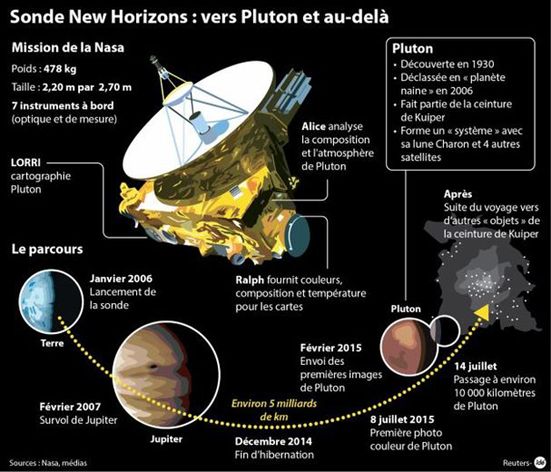
From Cape Canaveral, on January 19, 2006, the New Horizons probe launched toward Pluto.
Initially directed toward Jupiter, it reached the largest planet a year later, on February 28, 2007. There, benefiting from Jupiter's gravitational pull, it gained 4 km/s, saving it 5 years on the journey to Pluto, which it reached on July 14, 2017.
The close-up images of Pluto were sensational. The Plutonian system was discovered on this occasion, and five moons are now known to orbit Pluto.
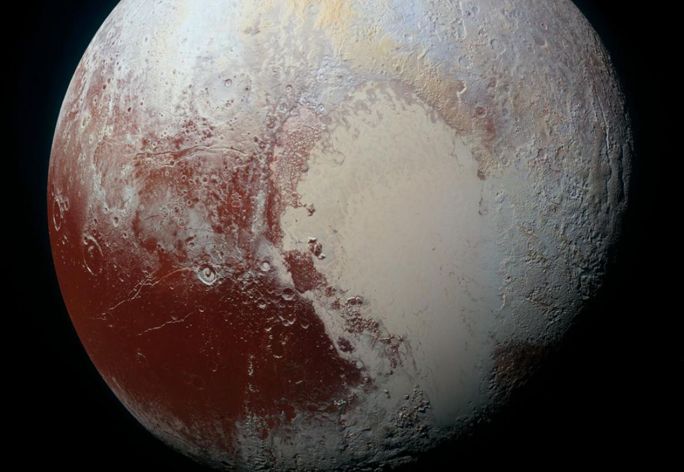
Among all these images, the most famous is this one region of Pluto that resembles an enormous heart. The Americans quickly dubbed it: the Heart of Clyde Tombaugh.
Initially directed toward Jupiter, it reached the largest planet a year later, on February 28, 2007. There, benefiting from Jupiter's gravitational pull, it gained 4 km/s, saving it 5 years on the journey to Pluto, which it reached on July 14, 2017.
The close-up images of Pluto were sensational. The Plutonian system was discovered on this occasion, and five moons are now known to orbit Pluto.
Among all these images, the most famous is this one region of Pluto that resembles an enormous heart. The Americans quickly dubbed it: the Heart of Clyde Tombaugh.