





All this is happening above our heads
Saturn, the ringed planet
By Michel Gravereau
The summer sky is gradually arriving, and all amateur astronomers and astronomy enthusiasts are eagerly awaiting the appearance of the celestial marvel: Saturn.
It still rises a little late, around 2:00 a.m., but day by day, its rising time is advancing by four minutes, which means that in August, it will deign to appear before us at convenient hours and enchant all our autumn and winter nights.
A marvel of celestial marvels, I said. But only with a telescope, because to the naked eye, nothing distinguishes it from an ordinary star.
Far from being as bright as Venus or Jupiter, it is currently located in the constellation Pisces.
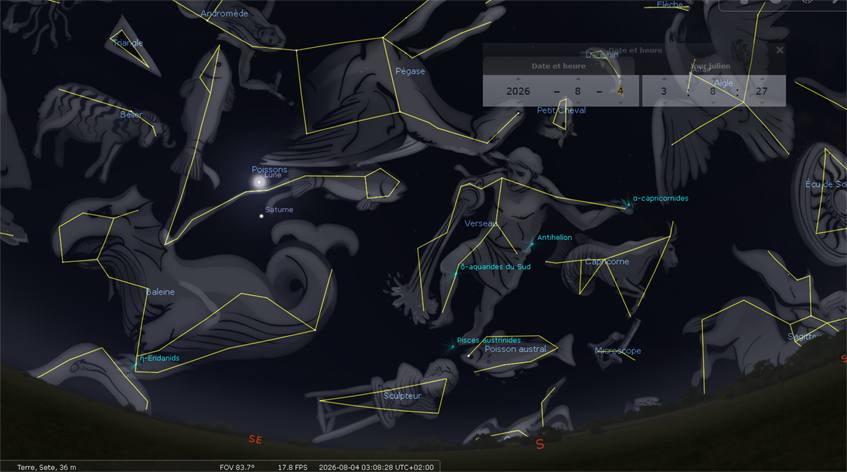
To find it, around the beginning of August, look towards the southeastern horizon and, with a star chart, locate the Great Square of Pegasus, unmistakable. Extending from the two stars on the left, Alpheratz at the top and Algenib at the bottom, slightly to the left, is a point brighter than the few stars. That's Saturn. I've attached a screenshot from the Stellarium software on August 4th. Saturn will be just below the Moon.
To find it, around the beginning of August, look towards the southeastern horizon and, with a star chart, locate the Great Square of Pegasus, unmistakable. Extending from the two stars on the left, Alpheratz at the top and Algenib at the bottom, slightly to the left, is a point brighter than the few stars. That's Saturn. I've attached a screenshot from the Stellarium software on August 4th. Saturn will be just below the Moon.
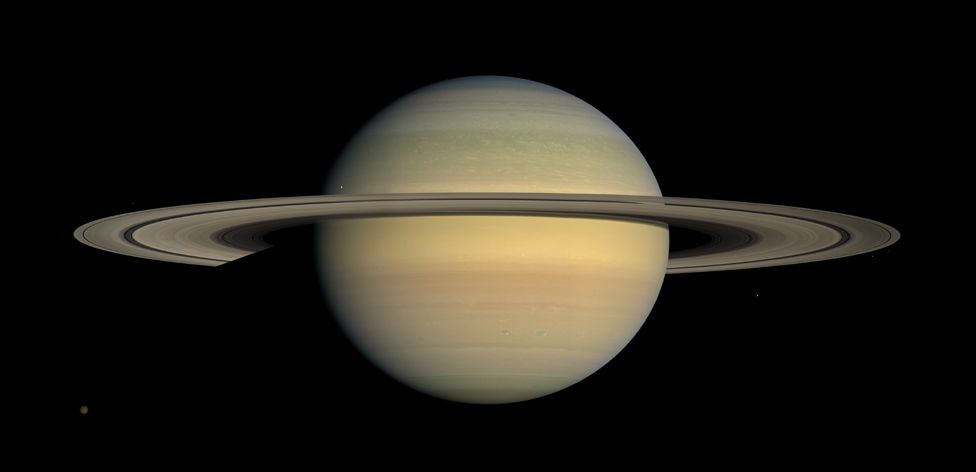
Saturn is 10 times farther from the Sun than Earth is: 1.5 billion km, and its diameter is 9 times larger than that of our planet. We could fit 770 Earths inside Saturn. It is the second largest planet after Jupiter.
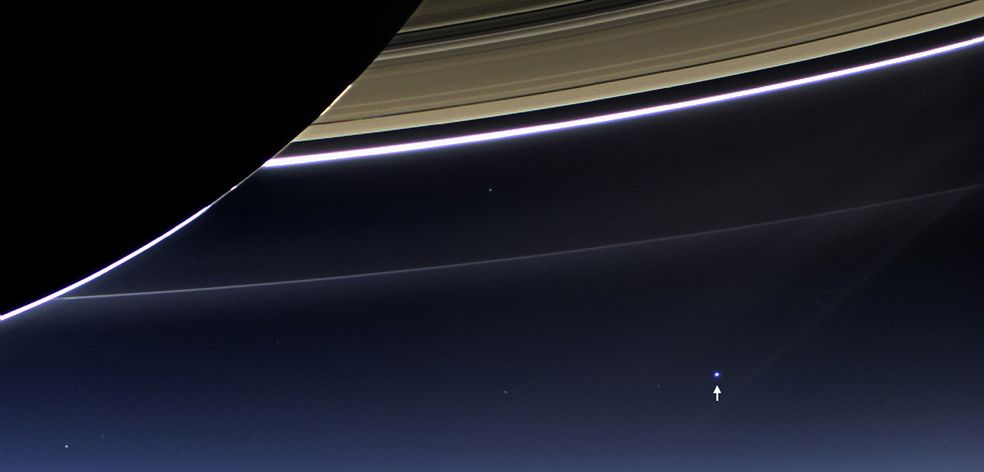
However, its rings are 22 times the diameter of Earth, with a thickness varying from 10 to 100 meters. Consider that they are proportionally thinner than a DVD.
It would seem, according to studies conducted by the Cassini probe, that these rings were created by a comet or asteroid that entered Saturn's gravitational field and was gradually crushed by gravitational tides.
Saturn, like Jupiter, Uranus, and Neptune, is a ball of gas, making it impossible to land any kind of spacecraft on it.
It takes 29 years to orbit the Sun, while Earth takes only one year to complete its orbit. But like Jupiter, it spins like a top, rotating on its axis in just 10 hours and 53 minutes. Compare that to Earth: one rotation in a day.
While only one natural satellite orbits us, the Moon, a multitude of small objects orbit Saturn—274 have been identified to date. A record.
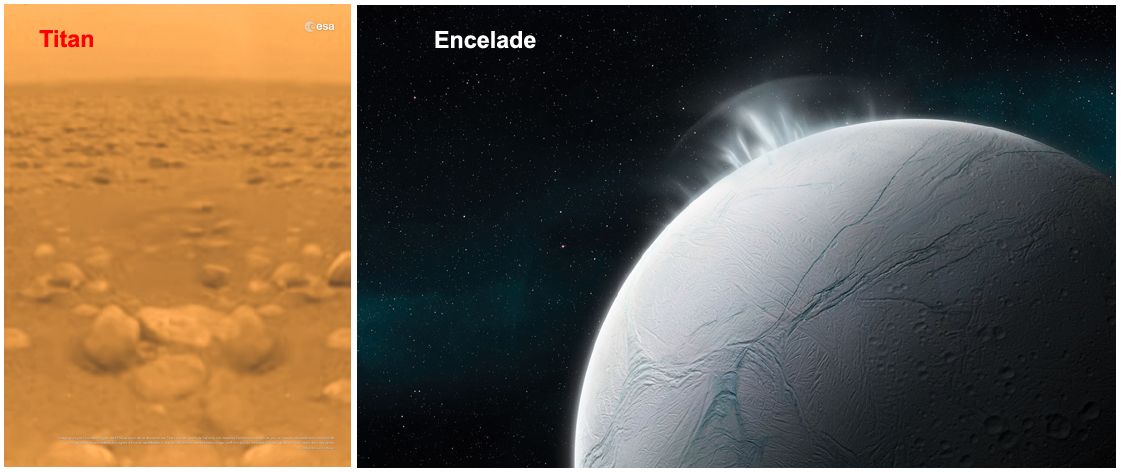
The largest, Titan, is the only moon with an atmosphere. It is larger than Mercury, as is Ganymede, a moon of Jupiter.
Taking advantage of the Cassini probe's journey, the ESA accompanied it with a lander that touched down on Titan in January 2004: Huygens. To this day, it remains the most distant place in the solar system where humans have landed a robot. This interest in Titan stems from its methane atmosphere, which puzzles scientists, especially given the temperatures that hover around -200°C. Hydrocarbons are found there. Don't get me wrong, Total is exploring the possibility of extracting them via pipeline.
Another moon of Saturn is attracting the attention of scientists who are preparing to send a probe to it: Enceladus. Why? Simply because it has powerful ice geysers and could be a potential habitat for microbial life. Sadly, I won't be around to see the day this probe explores the ocean beneath this icy layer, which, like Europa, a moon of Jupiter, could harbor traces of life.
If we can hope to find biological life in our solar system, it is unfortunately now only on these two moons.
However, its rings are 22 times the diameter of Earth, with a thickness varying from 10 to 100 meters. Consider that they are proportionally thinner than a DVD.
It would seem, according to studies conducted by the Cassini probe, that these rings were created by a comet or asteroid that entered Saturn's gravitational field and was gradually crushed by gravitational tides.
Saturn, like Jupiter, Uranus, and Neptune, is a ball of gas, making it impossible to land any kind of spacecraft on it.
It takes 29 years to orbit the Sun, while Earth takes only one year to complete its orbit. But like Jupiter, it spins like a top, rotating on its axis in just 10 hours and 53 minutes. Compare that to Earth: one rotation in a day.
While only one natural satellite orbits us, the Moon, a multitude of small objects orbit Saturn—274 have been identified to date. A record.
The largest, Titan, is the only moon with an atmosphere. It is larger than Mercury, as is Ganymede, a moon of Jupiter.
Taking advantage of the Cassini probe's journey, the ESA accompanied it with a lander that touched down on Titan in January 2004: Huygens. To this day, it remains the most distant place in the solar system where humans have landed a robot. This interest in Titan stems from its methane atmosphere, which puzzles scientists, especially given the temperatures that hover around -200°C. Hydrocarbons are found there. Don't get me wrong, Total is exploring the possibility of extracting them via pipeline.
Another moon of Saturn is attracting the attention of scientists who are preparing to send a probe to it: Enceladus. Why? Simply because it has powerful ice geysers and could be a potential habitat for microbial life. Sadly, I won't be around to see the day this probe explores the ocean beneath this icy layer, which, like Europa, a moon of Jupiter, could harbor traces of life.
If we can hope to find biological life in our solar system, it is unfortunately now only on these two moons.
Four interplanetary probes have approached it, such as Pioneer 11, Voyager 1 and 2 in 1979, and Cassini-Huygens in 2004.
Its gaseous atmosphere experiences incredibly violent winds: 1,800 km/h. Slightly less than those that sweep across Neptune.
Saturn's rings.
While the three other gas giants, Jupiter, Uranus, and Neptune, also have rings, only Saturn's ring is visible from Earth. Billions of tiny bodies, ranging from micrometers to several meters in size, orbit around Saturn. It's water ice, and even though we see a continuous disk from Earth, these bodies are separate and each has its own orbital velocity. The Cassini probe passed through these rings during its mission around Saturn.
In 1609, Galileo, with his telescope, observed Saturn and saw two protrusions on either side of the planet's surface.
But it wasn't until 1655 that Huygens, a Dutch astronomer, with a more powerful telescope, perceived the reality of the rings. These rings sway over time, on a 15-year cycle. Currently, they are opening up, whereas previously they were only visible edge-on. In a few years, Saturn will be a true delight to observe.
Its gaseous atmosphere experiences incredibly violent winds: 1,800 km/h. Slightly less than those that sweep across Neptune.
Saturn's rings.
While the three other gas giants, Jupiter, Uranus, and Neptune, also have rings, only Saturn's ring is visible from Earth. Billions of tiny bodies, ranging from micrometers to several meters in size, orbit around Saturn. It's water ice, and even though we see a continuous disk from Earth, these bodies are separate and each has its own orbital velocity. The Cassini probe passed through these rings during its mission around Saturn.
In 1609, Galileo, with his telescope, observed Saturn and saw two protrusions on either side of the planet's surface.
But it wasn't until 1655 that Huygens, a Dutch astronomer, with a more powerful telescope, perceived the reality of the rings. These rings sway over time, on a 15-year cycle. Currently, they are opening up, whereas previously they were only visible edge-on. In a few years, Saturn will be a true delight to observe.

A marvel of marvels in the sky, Saturn is truly worth a visit, and this sixth planet of the solar system leaves an indelible mark on those lucky enough to have glimpsed it through a telescope.
Throughout this summer and the following autumn, it will preside over the celestial vault, and various astronomy clubs will undoubtedly turn their instruments towards it to share its wonders with all those curious about the Universe. Join the crowd!
Throughout this summer and the following autumn, it will preside over the celestial vault, and various astronomy clubs will undoubtedly turn their instruments towards it to share its wonders with all those curious about the Universe. Join the crowd!