LÉGION'ARTS






Soldiers and Builders
By Antoine Marquet (Lt-Colonel TE-er)
“The Legion exists only to fight.” The quotation marks surrounding this title of the editorial by the general commanding the Foreign Legion, published in issue 901 of Képi Blanc in October 2026, caught my attention… but not for long. An older formulation, according to my research, would have been: “The Legion is made only to wage war.” In these times, the word “war” has become too harsh for a headline.
This expression originates in the political and parliamentary debates of the late 19th century, and not from the mouth of a military leader haranguing his troops.
In the aftermath of the defeat of 1870, France questioned the organization of its army, the role of conscription, and the place of foreigners in its ranks. In this context, the formula encapsulates a strict conception of the Legion's mission: a unit destined to be deployed wherever military needs demand it, while preserving the lives of French soldiers.
But can an institution be reduced to its sole purpose? And can its history be reduced to just one of its missions? Even acknowledging that its history and traditions are not forgotten.
The stone inscriptions attributed to the legionaries of ancient Rome recall another dimension of the soldier: "Gessimus gladium in altera manu, palam in altera," in other words: "We marched with a sword in one hand and a shovel in the other." This formula, of which I have preserved the transmitted version, admirably expresses the dual vocation of the legionary builder.
Who is unaware of what the Legion has accomplished with the sword during its nearly two centuries of existence? His battles, his sacrifices, and his deaths are etched in our memory. His glory is ours, inscribed in gold on our flags and banners. But it is essential to revive the memory of the other facet of his history, less celebrated and too often forgotten: that of the legionnaires as builders.
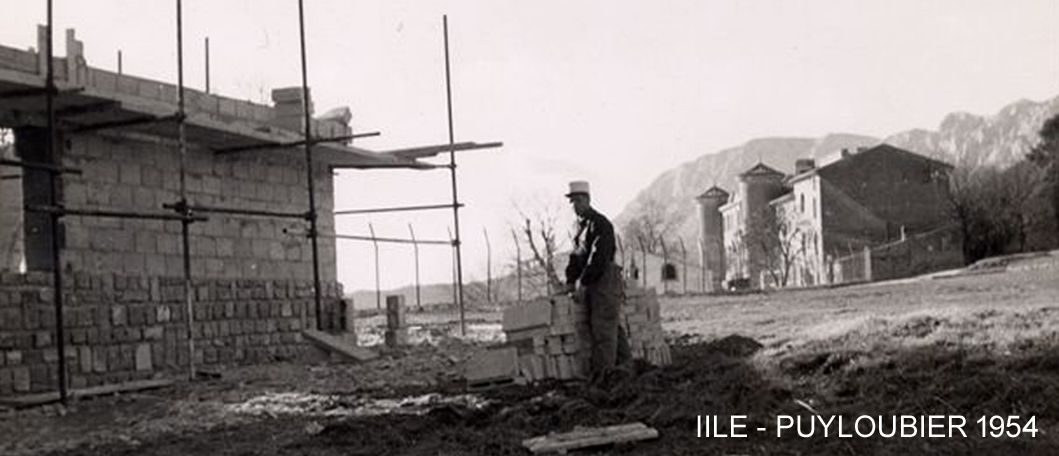
After the battles, the conquests, and the military installations, the legionnaires were often employed in developing the territories where they were stationed. They built roads, bridges, camps, fortifications, and civilian and military buildings. Their selflessness, endurance, and ingenuity made them workers and pioneers capable of facing the most difficult conditions.
"Form the bundles!" No sooner are the weapons gathered than the tools can take over. The same men who have just fought seize shovels and picks to clear a path, drain a marsh, or construct a fortification. They remained soldiers, but also became laborers, masons, and builders.
From the very first years of the French presence in Algeria, between 1831 and 1835, the legionnaires participated in road construction, the building of camps, blockhouses, redoubts, and bridges, as well as the draining of marshy land. Building a road through marshes where men sank up to their knees reportedly required two months of effort. This road, long known as the "Legion Causeway," bears witness to the arduous conditions under which these pioneers carried out their work.
The 1st Foreign Regiment spared no effort around Sidi-Bel-Abbès. Starting with the first military establishments in the 1840s, the legionnaires participated in the construction of the fortified camp and then in the development of the town. Initially housed in tents, they helped build the facilities that would gradually transform the camp into a veritable urban settlement. The hospital infrastructure also reflected needs that extended beyond those of the troops alone.
After the Crimean War, work resumed in Algeria, both in the north and the south. Then, from 1907 onward, Morocco became a new field of operation for the legionary builders.
General Catroux recounts a particularly revealing episode in "Lyautey the Moroccan."
In 1907, during the campaign that led French troops to Oujda, Captain Catroux served in the 3rd Battalion of the 1st Foreign Regiment. The legionnaires were eager to march and fight. But Lyautey, who commanded the operation, had another mission in mind for them. He didn't want any gunfire: he needed a road passable by vehicles between Oujda and Marnia. He is counting on the legionnaires, whom he knows are capable of completing this task quickly.
In the dialogue reported by Catroux, the general firmly reminds them that bayonets are not always the most useful tool. He needs men armed with shovels and picks.
This anecdote is worth pondering. It in no way diminishes the Legion's fighting spirit; it demonstrates that a leader also knows how to employ his men in the task that best meets the needs of the moment. In certain circumstances, a road can prove more useful than gunfire.
In Morocco, as in Algeria and southern Oran, legionnaires participated in opening communication routes and building infrastructure. Testimonies of their presence are multiplying. The seven-flamed grenade, engraved in stone and sometimes accompanied by the unit's name, still identifies many structures today.
The sapper-pioneer companies of the foreign regiments became specialized units, equipped with increasingly substantial resources. Legionnaires served as site managers, foremen, or supervisors. Some companies employed hundreds of workers and managed large-scale construction projects.
The 1st Foreign Regiment, in particular, participated in the restoration of railway lines and in work in the Viénot district. In 1929, at Sidi-Hamza, a site with a large onyx quarry, legionnaires undertook road construction to connect the quarry to the Tlemcen road. A team specializing in stone and marble work extracted and shaped the onyx destined for the Legion's war memorial, erected for its centenary. Under the direction of Adjutant Salini, assisted by Corporal Glass, the men extracted, cut, and polished the blocks on site before they were transported to the construction site. The monument, combining onyx and bronze, was inaugurated in 1931.
Another emblematic achievement was the Foum Zabel tunnel, bored in six months by a unit of the 3rd Foreign Infantry Regiment. The stone still bears witness to these men who opened up the mountain after having built roads.
Then came Madagascar, Lebanon, Syria, and the Far East. Everywhere, the history of the Legion remains one of battles, but also one of tracks, roads, camps, and fortifications built under often extreme conditions.
One might think that this work belongs to a bygone era, linked to the conquest and pacification of overseas territories. However, contemporary history demonstrates that this tradition has not died out.
After leaving Algeria in October 1962, the Legion's headquarters was established at Camp de la Demande in Aubagne. Legionnaires participated in the development of the new Viénot barracks. The temporary facilities were gradually replaced by permanent buildings, to which men temporarily stationed at the common depot contributed. The Legion thus continued to build the places where it lived and worked.
In 1963, the creation of the 5th Mixed Pacific Regiment opened a new chapter. After the technical training of its personnel, the regiment moved to French Polynesia, where it built the infrastructure necessary for the Pacific Test Center. Significant work was undertaken in Tahiti, then on various islands and atolls, notably Hao and Mururoa. Becoming the 5th Foreign Regiment in 1984, the regiment contributed to the center's infrastructure support until 1997. This history must also be considered within the context of nuclear testing, but it undeniably demonstrates the scale of the Legion's construction capabilities.
In 1968, the Foreign Legion Pioneer Company was created within the 1st Foreign Regiment to participate in clearing and developing the Canjuers camp in the Var region. The work took place at high altitude, under challenging conditions. The unit later evolved into the 61st Mixed Engineer-Legion Battalion.
The 3rd Foreign Infantry Regiment (3e REI) left Madagascar in 1973. Arriving in French Guiana, the legionnaires began clearing trails through the equatorial forest in November, using rudimentary equipment and at the cost of considerable effort. They advanced through dense and dangerous vegetation, built base camps, and established communication routes between Cayenne, Régina, and Saint-Georges-de-l’Oyapock. The Régina camp, which became Camp Szuts, remains associated with this history and now houses the Jungle Warfare Training Center.
In Djibouti, in 1978, the reinforcement of the 3rd Squadron of the 1st Foreign Cavalry Regiment (1er REC) to the 13th Foreign Legion Demi-Brigade (13e DBLE) contributed to the construction of Camp Arta, intended in particular to house the rotating companies of the 2nd Foreign Parachute Regiment (2e REP). Between October 1981 and May 1982, the same squadron was deployed to Mururoa to participate in the atoll's defense works.
On August 2, 1978, the 1st Foreign Regiment established a new roadworks unit, the CRTRLE, responsible for the infrastructure, maintenance, and repair of the roads and tracks of the vast Canjuers training area. This company, which succeeded the 61st BMGL in its missions, represents one of the milestones in the history of the Legion's specialized works units.
In 1990, the magazine VSD published a photograph of the 2nd Company of the 6th Foreign Engineer Regiment, commanded by Captain Rittiman, perched atop a grader has just completed work to accommodate the Daguet Division at King Khalid Military Camp in Saudi Arabia. Stationing, mobility, and counter-mobility: this work falls squarely within the missions of the engineering corps and force support.
I don't mention these examples merely as episodes from a distant past. The transformations of units, the construction projects, the resources employed, and the missions entrusted to them also belong to the Legion's recent history. I witnessed and participated in all of this during my very long career in its ranks, during which I was both a combatant and a builder.
In 2026, the context is obviously no longer that of colonial conquests and pacification operations of the past. It would be anachronistic to present these missions without considering their historical context. But it would be equally reductive to forget what they reveal about the men who carried them out.
The tools have changed. The shovel and pickaxe have given way to heavy machinery, specialized equipment, and modern engineering techniques. Missions have also evolved. Yet, armies still need soldiers capable of fighting, defending themselves, clearing routes, overcoming obstacles, and building the infrastructure essential to their operations.
The French Foreign Legion is a combat unit. That much is certain. But does this mean it exists solely for fighting? Its history demonstrates that it has also been able to apply the same qualities required in combat to construction missions: discipline, endurance, courage, cohesion, ingenuity, and a commitment to quality workmanship.
This is not about pitting the soldier against the builder, nor about diminishing the importance of combat in the Legion's identity. It is about remembering that these two aspects have often been embodied in the same men. I have experienced both during my service. They do not contradict each other; they complement each other.
The seven-flamed grenade carved in stone testifies to the works accomplished, just as the flags covered in glory testify to the sacrifices made. One must not make us forget the others.
Otherwise, what would be the point of parading the axes and buffalo-hide aprons of our pioneers in the front line? Certainly not to perpetuate outdated folklore. They remind us that throughout its history, the Legion has known how to fight and build, to destroy when military necessity demanded it, to construct when duty required it.
The Legion exists to fight, certainly. But its history reminds us that it has also existed—and still exists—to build. For legionnaires, "Gessimus gladium in altera manu, in altera" (we use our swords in both hands) are two sides of the same coin. That is the nobility of service.