





All this is happening above our heads
The Planet Uranus
By Michel Gravereau
Contemplating the celestial vault, our very distant ancestors admired the beauty of the stars, using them as guides in their desire to venture beyond the horizon, to see if any life animated the landscape. Fleeting passages of comets certainly caught their attention, as did natural phenomena such as eclipses and the perpetual dance the Moon performs around our planet, sometimes hiding only to reappear, illuminating our countryside on nights of the full moon.
In this ever-present sky, they had spotted these five small celestial bodies that wandered through the nights, weeks, months, and years. Never in the same place. They called them "wandering stars." Planets in Greek.
These were the members of our family, the solar system.
In 1609, Galileo first turned a telescope toward the sky; he discovered that the Moon was covered in craters, indelible marks of our satellite's painful encounters with foreign bodies. He saw that Venus could strangely resemble the Moon depending on its position relative to the Sun. He also noted that around Jupiter, four moons danced a ballet with such regularity that he created a calendar.
Improving our vision with a piece of glass. Others took up the challenge, and that is how telescopes would revolutionize our knowledge of the sky.
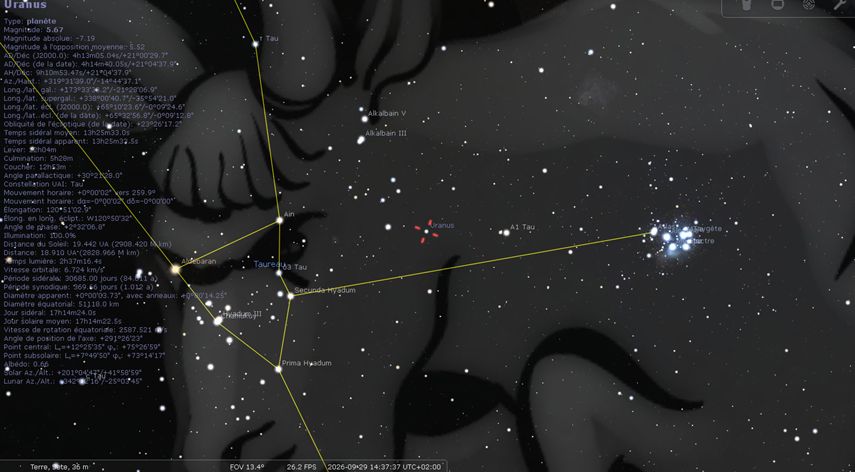
In April 1781, an English amateur astronomer named William Herschel, while searching for a comet, discovered a small blue celestial body nearly 3 billion kilometers from our star, the Sun. We already knew of Jupiter (Zeus) and its father, Saturn (Cronus). It would be named after Saturn's father: Uranus (Ouranos in Greek). The seventh planet had just been born. To be precise about the observation and discovery of Uranus, it's worth noting that Uranus was certainly seen with the naked eye in the past, but its faint brightness, at the limit of visual acuity, and its very slow movement led to it being mistaken for a star.
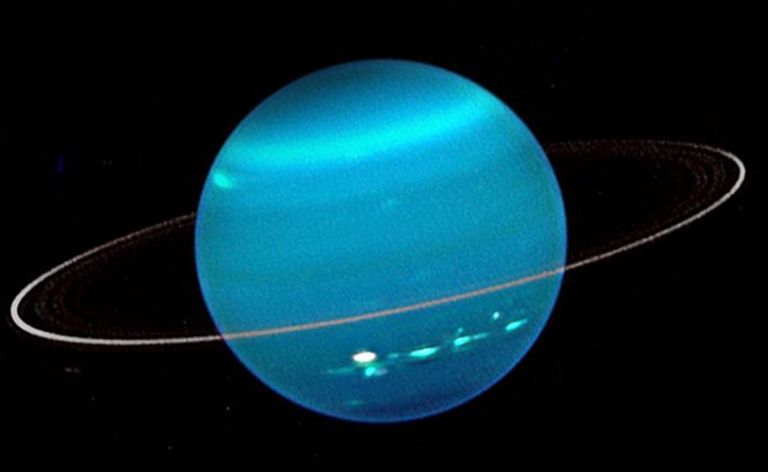
Since then, it has been the subject of observations. But its distance makes it difficult to access details of its surface, which once seemed the calmest of all the planets. We now know that violent winds, on the order of 900 km/h, sweep through its atmosphere.
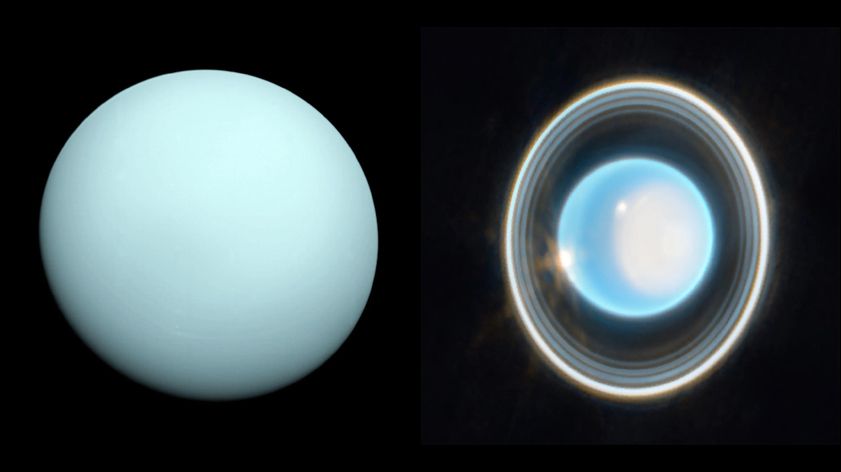
Its pale blue color (aquamarine) is due to the significant amount of methane, although it is primarily composed of hydrogen and helium.
Only one probe has visited it to date, and even then, only briefly: Voyager 2 on January 24, 1986.
Its considerable size, four times the diameter of Earth and 63 times the volume of Earth, places it among the largest planets after Jupiter and Saturn. However, it takes the gold medal for temperature, with an average of -224°C. Is this why it's called an "ice giant"?
Like the other giant gas planets, Uranus has a ring system. Its rings are quite unusual, as they are tilted at 90° to the polar axis, causing it to move in its orbit somewhat like a bicycle wheel. It's the planet lying on its side. Some scientists speculate that a terrible impact in the past could have caused its tilt. Or, it is possible that the planet was once surrounded by a very massive ring, which would have caused it to wobble on its axis, like a spinning top.
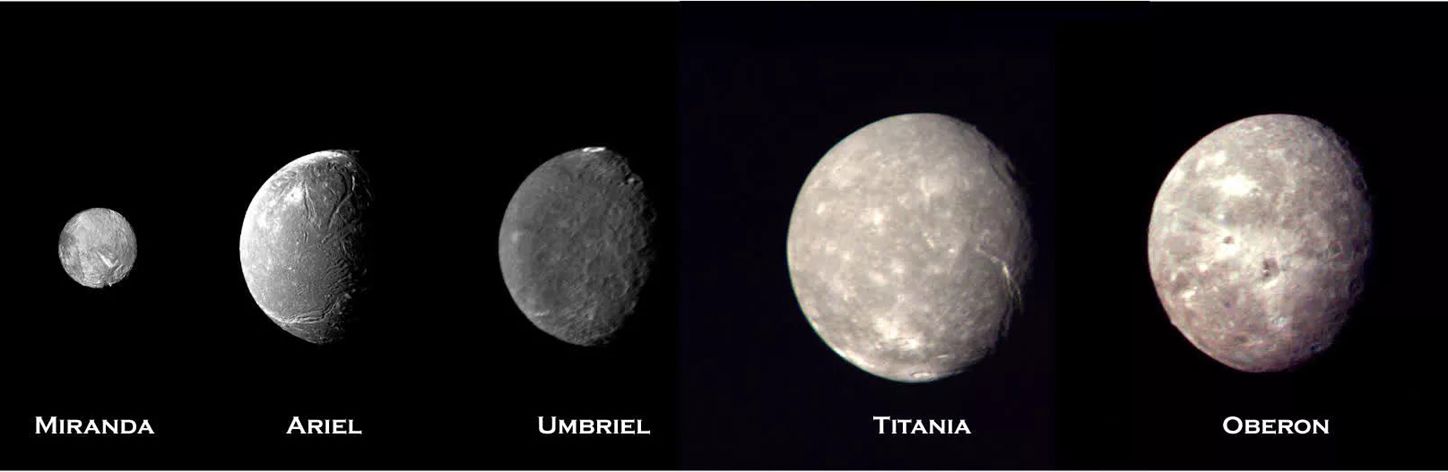
Around Uranus, Voyager and large telescopes like Hubble have discovered a retinue of moons orbiting around it.
Last week I told you that the International Astronomical Union had reserved the names of Mercury's craters for all the great figures who have graced the arts in all their disciplines: painting, philosophy, literature, and music. The moons of Uranus pay homage to the plays of William Shakespeare, the great British playwright. Among the five largest are Oberon and Titania, discovered in 1787 by Herschel, characters from "A Midsummer Night's Dream."
In 1851, William Lassell discovered Ariel (a character from "The Tempest") and Umbriel.
In 1948, Kuiper discovered Miranda (the only female moon in the Storm). Later, large telescopes discovered about twenty more moons.
Orbiting the Sun in 84 years, tilted on its axis, this planet presents its poles to the Sun every 20 years, making Uranus a very unique planet in terms of polar temperature.
Just to spark your imagination, we can imagine that in its methane mantle under intense pressure (200,000 times greater than that of our atmosphere), carbon molecules are created which, by assembling, could form diamonds that fall like rain into the planet's interior.
While waiting to be able to build your own diamonds, all you have to do is get closer to a telescope and look at Uranus. Admittedly, you won't see the same level of detail as on Jupiter or Saturn, but you'll be drawn to its beautiful blue color against the darkness of the night sky.