






All this is happening above our heads
Venus, the cursed planet.
By Michel Gravereau
You can't miss Venus in the sky right now and in the coming weeks.
Indeed, as soon as the Sun sets, a very bright point appears not very high in the sky towards the western horizon. Its brightness will far exceed that of the stars: that's Venus.
The second planet from the Sun in our solar system is there, like a beacon.
If you have the opportunity to look at it through a telescope, the view will astonish you. Every evening, when I point it out, I hear this comment: "That's the Moon." No, it's not the Moon, but it appears like a half-moon. At roughly the same distance from the Sun, it is illuminated by half, like all the planets, and we therefore see it edge-on. On the right, the sunlit side; on the left, the side in darkness.
Since it is only 100 million kilometers from the Sun, compared to Earth's 150 million, Venus will pass between Earth and the Sun in November. Traveling faster than Earth in its orbit around the Sun, it will approach us, appearing larger and larger to the naked eye, but through a telescope, it will appear as a crescent moon. It will descend to the horizon and remain visible for shorter and shorter periods each evening.

Venus is often presented in some books as Earth's twin sister. It is also sometimes called the "Planet of Love."
I'll let you be the judge.
Long ago, Venus underwent a massive volcanic eruption that released a considerable amount of carbon dioxide into its atmosphere, giving it a greenhouse effect unlike anything else we experience. This has consequences that humans should consider regarding the fate of our poor Earth, which we are mistreating.
Twice as far from the Sun as Mercury, where we record a temperature of 450 degrees Celsius, Venus reaches 480 degrees Celsius. This is solely due to the greenhouse effect. We can't help but draw a parallel with Earth.
Furthermore, Venus has an atmospheric pressure 90 times greater than Earth's. This means that the surface of Venus would experience pressure equivalent to that found 900 meters underwater. Remember that submarines rarely exceed 200 to 300 meters because of this pressure.
This was a major surprise for Soviet scientists when, in the late 1960s, they launched the Venera probes toward Venus. Upon descending into the atmosphere, they were crushed by the pressure. They needed to build something more robust.
Since then, numerous projects have emerged to better understand this nearby planet. NASA, with Mariner, the Europeans, and others are orbiting Venus, analyzing its atmosphere, and scanning its surface with radar.
It rains on Venus. But it's sulfuric acid. Not good for the lungs!
I'll let you be the judge.
Long ago, Venus underwent a massive volcanic eruption that released a considerable amount of carbon dioxide into its atmosphere, giving it a greenhouse effect unlike anything else we experience. This has consequences that humans should consider regarding the fate of our poor Earth, which we are mistreating.
Twice as far from the Sun as Mercury, where we record a temperature of 450 degrees Celsius, Venus reaches 480 degrees Celsius. This is solely due to the greenhouse effect. We can't help but draw a parallel with Earth.
Furthermore, Venus has an atmospheric pressure 90 times greater than Earth's. This means that the surface of Venus would experience pressure equivalent to that found 900 meters underwater. Remember that submarines rarely exceed 200 to 300 meters because of this pressure.
This was a major surprise for Soviet scientists when, in the late 1960s, they launched the Venera probes toward Venus. Upon descending into the atmosphere, they were crushed by the pressure. They needed to build something more robust.
Since then, numerous projects have emerged to better understand this nearby planet. NASA, with Mariner, the Europeans, and others are orbiting Venus, analyzing its atmosphere, and scanning its surface with radar.
It rains on Venus. But it's sulfuric acid. Not good for the lungs!
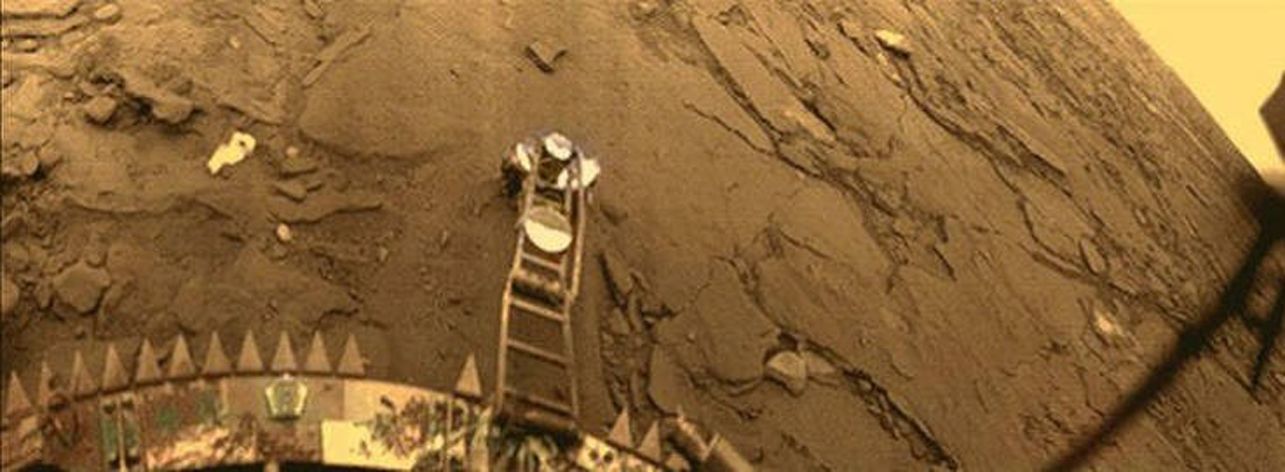
Of all the planets in our solar system, Venus is certainly the most hostile in terms of its temperature and atmosphere. It represents what Earth could become in the long term if we continue to release greenhouse gases into our atmosphere.
As a consolation, we can admire it every evening in the twilight and understand, through its beauty, why shepherds chose it as "their star." The shepherd's star is not a star; it's a planet, the third brightest object in the sky, after the Sun and the Moon.
As a consolation, we can admire it every evening in the twilight and understand, through its beauty, why shepherds chose it as "their star." The shepherd's star is not a star; it's a planet, the third brightest object in the sky, after the Sun and the Moon.