






Laotian Chronicle 1/6
By Lt. Colonel (Ret.) Antoine Marquet
It was in June 2023 that my comrade Jean-Pierre Raoul, a retired battalion commander, first told me about his discovery, through his reading*, of deadly battles in the Mouang Khoua region of northern Laos involving the 2nd Battalion of the 3rd Foreign Infantry Regiment (3e REI) under the command of Major Cabaribère, a column of the 5th Tabor under Major Vaudrey, three companies of Laotians, and a company of auxiliaries. He decided to try to shed light on this affair by visiting the site 70 years later. To do so, he compiled a very complete and solid file on the dramatic events that led to the disappearance of the 2nd Battalion of the 3rd REI, as well as significant elements of the 5th Tabor and the Laotian Chasseurs units.
This is how two lines in a book led to a journey in the footsteps of our predecessors. Joining me were my comrade Raoul (we served together in three regiments and are from the same graduating class), General Jean Baillaud (Paratrooper) (General Rollet class), with whom I completed a year of practical training at the EAI (Air Force Training School), Corporal Jacky Biaugeaud, president of the FACS Thailand (Army Veterans Association), and myself. An administrative issue prevented Jean-Luc Martin, a Colonel (General Rollet class), from joining us. They all live in Thailand and had the good sense to invite me—I live in Portugal—to participate in this commemorative expedition.
This account aims to describe this trip while recalling the historical context of the time, established thanks to the war diary of the 2nd Battalion, 3rd Foreign Infantry Regiment (II/3e REI) and the report written by Commandant Cabaribère himself. We, former legionnaires, had never heard of this affair. January 21, 2024
After a long journey, I arrived in Vientiane, the capital of Laos, at a hotel where I was waiting for my companions to arrive the next day.
January 22, 2024
In the afternoon, we met at a lovely hotel, La Seine, on the banks of the legendary Mekong River. I hadn't seen Baillaud for 43 years, Raoul for about 30, and I was meeting Jacky Baillaud for the first time.
The walk across the city between the two hotels revealed a distinctly Eastern cleanliness and the impressive electrical and telephone wiring of this capital. That alone should make it a World Heritage Site!
My first interactions with the Laotians suggested a kind, laid-back nature, which would be confirmed throughout the trip, and a very friendly attitude towards foreigners. A tuk-tuk driver unbuttoned his shirt to proudly show us his number 7 French Football Federation jersey!
After an excellent dinner on the hotel's rooftop terrace, where we could admire the sunset over the river and Thailand just a stone's throw away on the opposite bank, we explored the city center in search of bistros that had vanished and now existed only in Raoul's memory (!)... The next morning, we searched unsuccessfully for a French bakery that had also disappeared; we opted for breakfast at our hotel.
Raoul then presented us with the remarkably well-prepared file he had compiled, covering both the "military" aspects and all the logistics of the trip: reservations, trains, canoe trips... a remarkable piece of work that we all applauded.
January 23, 2024
After a night in suites upgraded by the manager, a friendly French-Chinese woman with a vague connection to Bordeaux, we took a taxi to Vientiane station, located some distance from the city, to catch a train that rivals those of our SNCF (French National Railways).
The extremely modern and functional stations were built by China, as were all the lines and trains that run on them. The security conditions for entering these stations are as strict as those required for airport boarding! This train took us to Muong Xai after a pleasant three-hour journey, monitored by a very friendly flight attendant who reminded passengers that beer consumption was prohibited on board. Speaking of which, a rather amusing incident occurred. One of us had brought two cans of beer in his backpack. At security, they were confiscated, along with a small knife he was carrying in his bag. But in the station hall, beer is freely available, and travelers can help themselves! Too preoccupied with the beer and the small knife, security overlooked the large hunting knife that was also in the bag!
Arriving in Muong Xai around 4 p.m., we took a taxi to Mouang Khoua, our destination, right in the heart of the fighting zone of the 2nd Battalion of the 3rd Foreign Infantry Regiment (3e REI). We settled into a guesthouse in this small, remote town in northern Laos. The manager, not very familiar with the internet, had received a letter sent from Thailand by Jean-Pierre to reserve towards the rooms. Not easy for the lady and not safe for us. A pleasant place where we had a balcony overlooking a tributary of the Nam Ou, the Pak Ou.
Dinner at a nearby restaurant turned out to be a disaster! Orders placed, an hour's wait, and we were forgotten in a practically empty restaurant, open to the river, terribly windy, and had to make do with a lukewarm hot soup… Mouang Khoua was off to a bad start!
It was in June 2023 that my comrade Jean-Pierre Raoul, a retired battalion commander, first told me about his discovery, through his reading*, of deadly battles in the Mouang Khoua region of northern Laos involving the 2nd Battalion of the 3rd Foreign Infantry Regiment (3e REI) under the command of Major Cabaribère, a column of the 5th Tabor under Major Vaudrey, three companies of Laotians, and a company of auxiliaries. He decided to try to shed light on this affair by visiting the site 70 years later. To do so, he compiled a very complete and solid file on the dramatic events that led to the disappearance of the 2nd Battalion of the 3rd REI, as well as significant elements of the 5th Tabor and the Laotian Chasseurs units.
This is how two lines in a book led to a journey in the footsteps of our predecessors. Joining me were my comrade Raoul (we served together in three regiments and are from the same graduating class), General Jean Baillaud (Paratrooper) (General Rollet class), with whom I completed a year of practical training at the EAI (Air Force Training School), Corporal Jacky Biaugeaud, president of the FACS Thailand (Army Veterans Association), and myself. An administrative issue prevented Jean-Luc Martin, a Colonel (General Rollet class), from joining us. They all live in Thailand and had the good sense to invite me—I live in Portugal—to participate in this commemorative expedition.
This account aims to describe this trip while recalling the historical context of the time, established thanks to the war diary of the 2nd Battalion, 3rd Foreign Infantry Regiment (II/3e REI) and the report written by Commandant Cabaribère himself. We, former legionnaires, had never heard of this affair. January 21, 2024
After a long journey, I arrived in Vientiane, the capital of Laos, at a hotel where I was waiting for my companions to arrive the next day.
January 22, 2024
In the afternoon, we met at a lovely hotel, La Seine, on the banks of the legendary Mekong River. I hadn't seen Baillaud for 43 years, Raoul for about 30, and I was meeting Jacky Baillaud for the first time.
The walk across the city between the two hotels revealed a distinctly Eastern cleanliness and the impressive electrical and telephone wiring of this capital. That alone should make it a World Heritage Site!
My first interactions with the Laotians suggested a kind, laid-back nature, which would be confirmed throughout the trip, and a very friendly attitude towards foreigners. A tuk-tuk driver unbuttoned his shirt to proudly show us his number 7 French Football Federation jersey!
After an excellent dinner on the hotel's rooftop terrace, where we could admire the sunset over the river and Thailand just a stone's throw away on the opposite bank, we explored the city center in search of bistros that had vanished and now existed only in Raoul's memory (!)... The next morning, we searched unsuccessfully for a French bakery that had also disappeared; we opted for breakfast at our hotel.
Raoul then presented us with the remarkably well-prepared file he had compiled, covering both the "military" aspects and all the logistics of the trip: reservations, trains, canoe trips... a remarkable piece of work that we all applauded.
January 23, 2024
After a night in suites upgraded by the manager, a friendly French-Chinese woman with a vague connection to Bordeaux, we took a taxi to Vientiane station, located some distance from the city, to catch a train that rivals those of our SNCF (French National Railways).
The extremely modern and functional stations were built by China, as were all the lines and trains that run on them. The security conditions for entering these stations are as strict as those required for airport boarding! This train took us to Muong Xai after a pleasant three-hour journey, monitored by a very friendly flight attendant who reminded passengers that beer consumption was prohibited on board. Speaking of which, a rather amusing incident occurred. One of us had brought two cans of beer in his backpack. At security, they were confiscated, along with a small knife he was carrying in his bag. But in the station hall, beer is freely available, and travelers can help themselves! Too preoccupied with the beer and the small knife, security overlooked the large hunting knife that was also in the bag!
Arriving in Muong Xai around 4 p.m., we took a taxi to Mouang Khoua, our destination, right in the heart of the fighting zone of the 2nd Battalion of the 3rd Foreign Infantry Regiment (3e REI). We settled into a guesthouse in this small, remote town in northern Laos. The manager, not very familiar with the internet, had received a letter sent from Thailand by Jean-Pierre to reserve towards the rooms. Not easy for the lady and not safe for us. A pleasant place where we had a balcony overlooking a tributary of the Nam Ou, the Pak Ou.
Dinner at a nearby restaurant turned out to be a disaster! Orders placed, an hour's wait, and we were forgotten in a practically empty restaurant, open to the river, terribly windy, and had to make do with a lukewarm hot soup… Mouang Khoua was off to a bad start!
The First Battle of Mouang Khoua
Early 1953
The French Command decided to maintain a chain of several isolated garrisons throughout the region, in order to buy time against Viet Minh attacks. Mouang Khoua was one of the last outposts in northern Laos. Many of these small garrisons received orders by radio to fortify themselves and fight any Viet Minh approach.
In early 1953, General Giap began his invasion of Laos. General Salan ordered these isolated outposts to resist the Viet Minh in order to buy time to fortify Luang Prabang and Vientiane. Each outpost was given a predetermined number of days to hold out. Thus, Captain Teulier, commanding the Mouang Khoua outpost, received orders on April 13, 1953, to hold out for 14 days.
The first outpost to bear the brunt of the Viet Minh offensive was the satellite outpost of Sop Nao, located 48 km east of Mouang Khoua and 32 km along the track from Dien Bien Phu. On April 3, the Viet Minh entered Laos via this track, and the lead battalion reached Sop Nao.
Surrounded by the enemy, the French, commanded by Lieutenant Grézy, resisted for six days. The survivors received authorization by radio from Captain Teulier to withdraw during the night of April 9-10.
They arrived in Mouang Khoua on the 12th, crossing the bush, and were integrated into the post's ranks. Meanwhile, a Viet Minh battalion and a 120mm mortar company arrived near Mouang Khoua. Described as a relatively small force, the two officers, the handful of non-commissioned officers, and the 300 Laotians were equipped with three 81mm mortars, two 60mm mortars, and two 12.7mm machine guns.
On April 13th, Colonel de Crèvecoeur ordered them to hold their position for 14 days and promised them air support.
At 11:00 PM that evening, the first mortar shells began to fall on the slopes of Position Alpha. The Viet Minh launched their first direct attack, which failed, leaving 22 dead in the barbed wire. From that day on, the post would be subjected to mortar fire every night. The garrison would be supported by B-26 bombers and airdrops of ammunition and supplies. This constant air support allowed the outpost to hold out, and by April 27th, it was firmly in position.
From that date onward, for two weeks, the enemy would employ its old tactic of attrition, slowly eroding the French outpost's positions.
The French Command decided to maintain a chain of several isolated garrisons throughout the region, in order to buy time against Viet Minh attacks. Mouang Khoua was one of the last outposts in northern Laos. Many of these small garrisons received orders by radio to fortify themselves and fight any Viet Minh approach.
In early 1953, General Giap began his invasion of Laos. General Salan ordered these isolated outposts to resist the Viet Minh in order to buy time to fortify Luang Prabang and Vientiane. Each outpost was given a predetermined number of days to hold out. Thus, Captain Teulier, commanding the Mouang Khoua outpost, received orders on April 13, 1953, to hold out for 14 days.
The first outpost to bear the brunt of the Viet Minh offensive was the satellite outpost of Sop Nao, located 48 km east of Mouang Khoua and 32 km along the track from Dien Bien Phu. On April 3, the Viet Minh entered Laos via this track, and the lead battalion reached Sop Nao.
Surrounded by the enemy, the French, commanded by Lieutenant Grézy, resisted for six days. The survivors received authorization by radio from Captain Teulier to withdraw during the night of April 9-10.
They arrived in Mouang Khoua on the 12th, crossing the bush, and were integrated into the post's ranks. Meanwhile, a Viet Minh battalion and a 120mm mortar company arrived near Mouang Khoua. Described as a relatively small force, the two officers, the handful of non-commissioned officers, and the 300 Laotians were equipped with three 81mm mortars, two 60mm mortars, and two 12.7mm machine guns.
On April 13th, Colonel de Crèvecoeur ordered them to hold their position for 14 days and promised them air support.
At 11:00 PM that evening, the first mortar shells began to fall on the slopes of Position Alpha. The Viet Minh launched their first direct attack, which failed, leaving 22 dead in the barbed wire. From that day on, the post would be subjected to mortar fire every night. The garrison would be supported by B-26 bombers and airdrops of ammunition and supplies. This constant air support allowed the outpost to hold out, and by April 27th, it was firmly in position.
From that date onward, for two weeks, the enemy would employ its old tactic of attrition, slowly eroding the French outpost's positions.
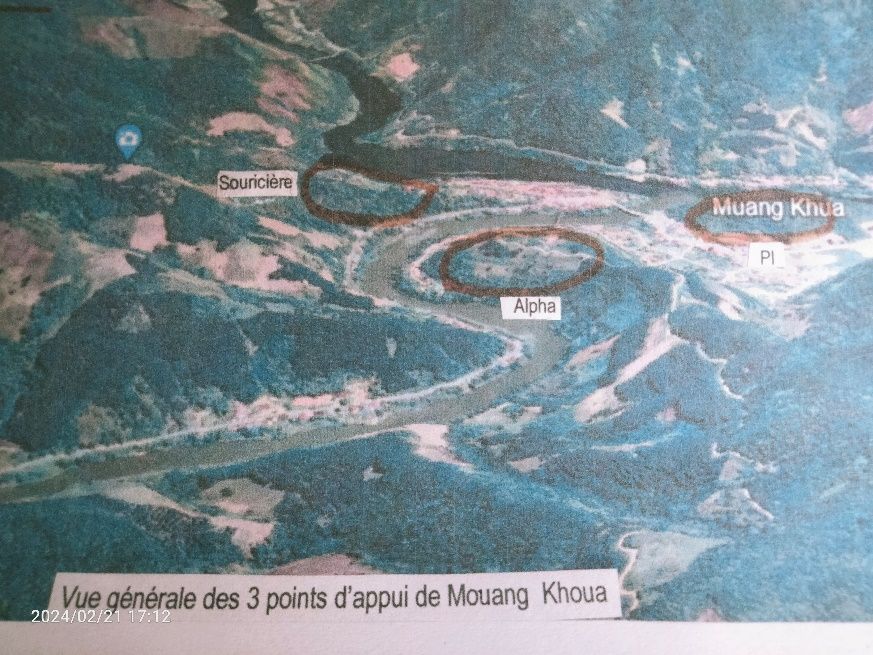
At 12:30 a.m. on May 18th, 120mm mortars, 57mm recoilless rifles, and 81mm phosphorus shells struck Position Alpha and La Souricière (The Mousetrap), but not Position Pi, where Lieutenant Grézy was supporting the two other strongpoints with his mortars. Captain Teulier radioed for the outpost to be illuminated by searchlights and for air support; however, the weather conditions were poor. At 1:00 a.m., the western flank of La Souricière fell under Viet Minh bombardment.
At 1:30 a.m., Captain Teulier received a radio message indicating that weather conditions did not permit air support.
At 2:30 a.m., the Viet Minh launched successive waves of assaults that overwhelmed Captain Teulier and his men. Thanks to the sandbanks of the Nam Pak River, the enemy was also able to launch flank attacks.
At 3:30 a.m., no further shots were fired from La Souricière (The Mousetrap).
Strong point Alpha survived the rest of the night and was spotted in the midst of combat by aircraft at 9:00 a.m.
C-47 aircraft arrived to airdrop supplies, but they could only confirm that the French and Laotian flags were no longer flying over the Pi command bunker. Instead of holding out for the requested 14 days, Captain Teulier and his 300 Laotians thus held out for 37 days before being overwhelmed by sheer numbers.
May 22, 1953
Four days after the end of the fighting, Sergeant Novak and two Laotian soldiers reached the last French outpost still held in northern Laos, Phong Saly. On May 24, Sergeant Blondeau also reached this post.
To be continued...
At 1:30 a.m., Captain Teulier received a radio message indicating that weather conditions did not permit air support.
At 2:30 a.m., the Viet Minh launched successive waves of assaults that overwhelmed Captain Teulier and his men. Thanks to the sandbanks of the Nam Pak River, the enemy was also able to launch flank attacks.
At 3:30 a.m., no further shots were fired from La Souricière (The Mousetrap).
Strong point Alpha survived the rest of the night and was spotted in the midst of combat by aircraft at 9:00 a.m.
C-47 aircraft arrived to airdrop supplies, but they could only confirm that the French and Laotian flags were no longer flying over the Pi command bunker. Instead of holding out for the requested 14 days, Captain Teulier and his 300 Laotians thus held out for 37 days before being overwhelmed by sheer numbers.
May 22, 1953
Four days after the end of the fighting, Sergeant Novak and two Laotian soldiers reached the last French outpost still held in northern Laos, Phong Saly. On May 24, Sergeant Blondeau also reached this post.
To be continued...