






All this is happening above our heads
The Moon: Creation and Hidden Side. 2/2
The Far Side of the Moon.
By Michel Gravereau
The Moon always shows the same face to Earth. This is due to its very particular motion: the Moon takes exactly the same amount of time to rotate on its axis as it does to orbit the Earth. Viewed from Earth, the Moon therefore has a visible side and an invisible side, known as the far side.
The far side remained truly unknown until October 1959. At that time, the Soviet probe Luna 3 transmitted average-resolution images of this side. Since then, the American Lunar Orbiter probes, between August 1965 and 1966, have revealed high-resolution images. The Apollo missions contributed to further understanding.
Today, the Moon is fully mapped with very high precision.
The Moon always shows the same face to Earth. This is due to its very particular motion: the Moon takes exactly the same amount of time to rotate on its axis as it does to orbit the Earth. Viewed from Earth, the Moon therefore has a visible side and an invisible side, known as the far side.
The far side remained truly unknown until October 1959. At that time, the Soviet probe Luna 3 transmitted average-resolution images of this side. Since then, the American Lunar Orbiter probes, between August 1965 and 1966, have revealed high-resolution images. The Apollo missions contributed to further understanding.
Today, the Moon is fully mapped with very high precision.
.jpg?t=aeb8a500_42ca_451a_ab7f_8e5528b4f20b)
Let's return to the reason for this far side.
Every evening, during our performances of "Heaven, My Friend," I try to explain this phenomenon. It's not easy at all.
I take a child from the audience and have them spin around. That's a rotation.
Then, taking them by the hands, I have them spin around me, always showing me their face and torso. That's a revolution.
So, the child is the Moon and I am the Earth. Nine times out of ten, when I ask them afterward if they spun around me, the answer is no. And yet...
Try this experiment with a child. First, have them spin around in the center of a room in the house. They see all four walls. That's the rotation. Then, have them spin around you, constantly looking at you. If they weren't spinning, they would only see one wall during their revolution, always the same one. But in this case, it will see the four walls. It does indeed rotate on its axis in the same amount of time it takes to orbit you.
The revolution is equal to its rotation. A little less than a month. 29 and a half days. But even with a visual demonstration, some people still can't "grasp" it, as we say nowadays.
In any case, the Moon's rotation is equal to 29 days, 12 hours, and 44 minutes on average. Why mention this?
The Earth rotates on its axis in 24 hours. At the equinoxes, we have 12 hours of daylight and 12 hours of night. On the Moon, which rotates in 29 days, we have half and half, just like on Earth.
The temperature will rise to over 130°C on the Sun for 14 and a half days, and at night, the temperature will drop to -160°C for 14 and a half days. Uninhabitable. This is why NASA and the allied countries in the Artemis program decided to build the permanent base at the Moon's South Pole, where the temperature will be suitable due to the low angle of the Sun's rays.
This phenomenon is called synchronous rotation. Several moons in the solar system exhibit this characteristic, particularly those orbiting Saturn.
The undisputed masters of this phenomenon are Pluto and its moon Charon: they orbit each other in 6.387 days and are synchronous, meaning they always present the same face to each other. Only the Chinese have succeeded in landing an automated lander, Chang 4, on the far side of the Moon on January 3, 2019, and returned 1,781 grams of lunar soil samples on December 16, 2020, using the Chang 5 probe
Every evening, during our performances of "Heaven, My Friend," I try to explain this phenomenon. It's not easy at all.
I take a child from the audience and have them spin around. That's a rotation.
Then, taking them by the hands, I have them spin around me, always showing me their face and torso. That's a revolution.
So, the child is the Moon and I am the Earth. Nine times out of ten, when I ask them afterward if they spun around me, the answer is no. And yet...
Try this experiment with a child. First, have them spin around in the center of a room in the house. They see all four walls. That's the rotation. Then, have them spin around you, constantly looking at you. If they weren't spinning, they would only see one wall during their revolution, always the same one. But in this case, it will see the four walls. It does indeed rotate on its axis in the same amount of time it takes to orbit you.
The revolution is equal to its rotation. A little less than a month. 29 and a half days. But even with a visual demonstration, some people still can't "grasp" it, as we say nowadays.
In any case, the Moon's rotation is equal to 29 days, 12 hours, and 44 minutes on average. Why mention this?
The Earth rotates on its axis in 24 hours. At the equinoxes, we have 12 hours of daylight and 12 hours of night. On the Moon, which rotates in 29 days, we have half and half, just like on Earth.
The temperature will rise to over 130°C on the Sun for 14 and a half days, and at night, the temperature will drop to -160°C for 14 and a half days. Uninhabitable. This is why NASA and the allied countries in the Artemis program decided to build the permanent base at the Moon's South Pole, where the temperature will be suitable due to the low angle of the Sun's rays.
This phenomenon is called synchronous rotation. Several moons in the solar system exhibit this characteristic, particularly those orbiting Saturn.
The undisputed masters of this phenomenon are Pluto and its moon Charon: they orbit each other in 6.387 days and are synchronous, meaning they always present the same face to each other. Only the Chinese have succeeded in landing an automated lander, Chang 4, on the far side of the Moon on January 3, 2019, and returned 1,781 grams of lunar soil samples on December 16, 2020, using the Chang 5 probe

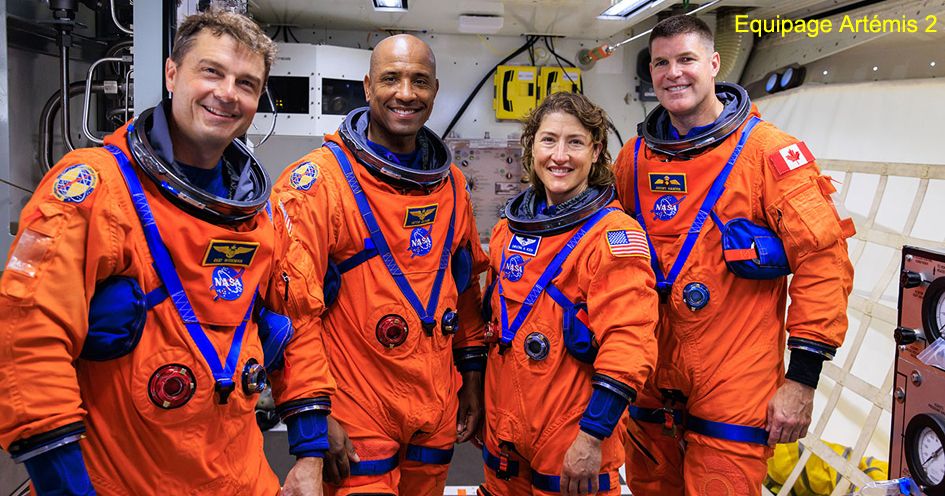
There's no doubt that the Artemis mission will treat us to sensational images of this world within rocket reach. The Moon still has some beautiful images in store for us, starting with these four space travelers—a Canadian and three Americans—who will likely launch on February 7. Get ready to watch! Better yet! Go outside at night and look at the Moon, imagining that human beings are skimming the lunar surface, dazzled by its brightness. You're allowed to dream.
Upcoming Events
This section informs you about upcoming events in the fields of pure astronomy and space exploration.
Astronomical Events
February 17: Annular solar eclipse, not visible from mainland France.
March 3: Total lunar eclipse, not visible from mainland France.
March 20: Spring equinox.
May 7 and 8: Sunset under the Arc de Triomphe from the Place de la Concorde.
May 9, 10, and 11: Sunset under the Arc de Triomphe from the Champs-Élysées roundabout.
June 21: Summer solstice.
July 31, August 1, 2, and 3: Sunset under the Arc de Triomphe from the Champs-Élysées roundabout.
August 3, 4, and 5: Sunset under the Arc de Triomphe from the Place de la Concorde.
August 12: Total solar eclipse, visible in its partial phase in mainland France.
Perseid meteor shower.
August 28: Partial lunar eclipsein metropolitan France.
September 14: Venus emerges behind the Moon.
September 23: Autumnal Equinox.
December 21: Winter Solstice.
Bear Meteor Shower.
Space Exploration
ISS Passage: From January 21 to 31, it is visible in the evening sky.
ISS: Due to the Crew Dragon's premature return for medical reasons, French astronaut Sophie Adenot will join the crew that will launch to the ISS from Baikonur aboard a Soyuz spacecraft.
She will thus become the 11th French astronaut and the 2nd woman, the first being Claudie Aigneré.
Artemis 2 Launch to the Moon: Date set: February 7.