






All this is happening above our heads
Orion, a magnificent constellation.
I've often had the opportunity to talk to you about the constellations that populate our sky, and I've mentioned one of the most beautiful: Orion.
Around mid-May, it will disappear from view as the Sun moves into the neighboring constellations of Aries, Taurus, and then Gemini. So, while there's still time to observe it, a few words about this constellation.
According to legend, Orion was a hunter who roamed the celestial expanses.
From the end of December, in the early evening, this magnificent constellation begins to rise above the horizon. It is then visible in the early evening during the long winter nights. It offers the observer one of the most beautiful celestial jewels: the Great Orion Nebula, one of the few deep-sky objects visible to the naked eye. Certainly, after the Moon, it is also the most photographed object by amateur astronomers.
Around mid-May, it will disappear from view as the Sun moves into the neighboring constellations of Aries, Taurus, and then Gemini. So, while there's still time to observe it, a few words about this constellation.
According to legend, Orion was a hunter who roamed the celestial expanses.
From the end of December, in the early evening, this magnificent constellation begins to rise above the horizon. It is then visible in the early evening during the long winter nights. It offers the observer one of the most beautiful celestial jewels: the Great Orion Nebula, one of the few deep-sky objects visible to the naked eye. Certainly, after the Moon, it is also the most photographed object by amateur astronomers.

In the upper left, a red supergiant sets the standard for defining stellar magnitudes. It represents zero. Its name is Betelgeuse. Astronomers believe its diameter is 500 to 900 times larger than that of the Sun. Its Arabic name means "the shoulder."
In the lower right, another magnificent star: Rigel. Its name evokes the "leg" of the giant Orion. Its bluish-white color is striking when viewed through a telescope. To the naked eye, the colors of Betelgeuse and Rigel are easily comparable.
Next to it, to the right, is Bellatrix.
The fourth star is less bright than the others: Saiph.
Orion is located on both sides of the celestial equator, making it observable from all points on Earth.
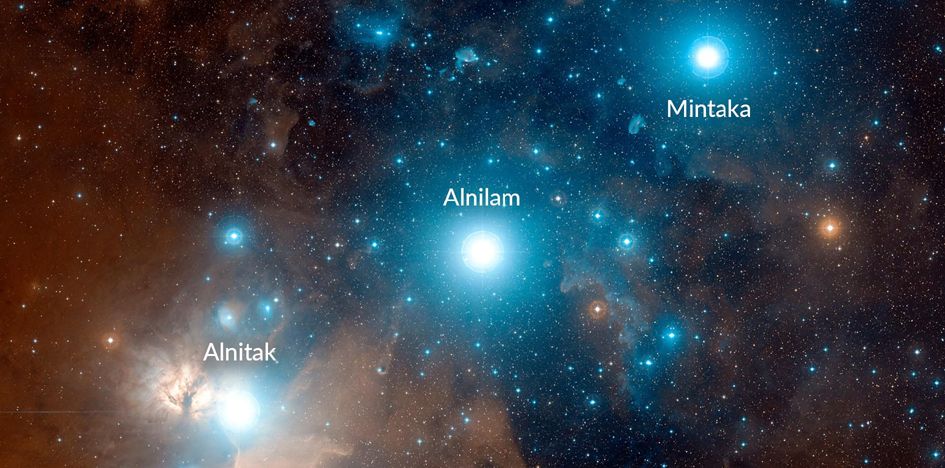
At the center of the constellation, above the nebula, are three stars named Alnitak, Alnilam, and Mintaka, nicknamed the "Three Wise Men." They form what is known as Orion's Belt.
In the lower right, another magnificent star: Rigel. Its name evokes the "leg" of the giant Orion. Its bluish-white color is striking when viewed through a telescope. To the naked eye, the colors of Betelgeuse and Rigel are easily comparable.
Next to it, to the right, is Bellatrix.
The fourth star is less bright than the others: Saiph.
Orion is located on both sides of the celestial equator, making it observable from all points on Earth.
At the center of the constellation, above the nebula, are three stars named Alnitak, Alnilam, and Mintaka, nicknamed the "Three Wise Men." They form what is known as Orion's Belt.
Below the nebula, extending from it, the dagger hanging from this belt is easily visible.
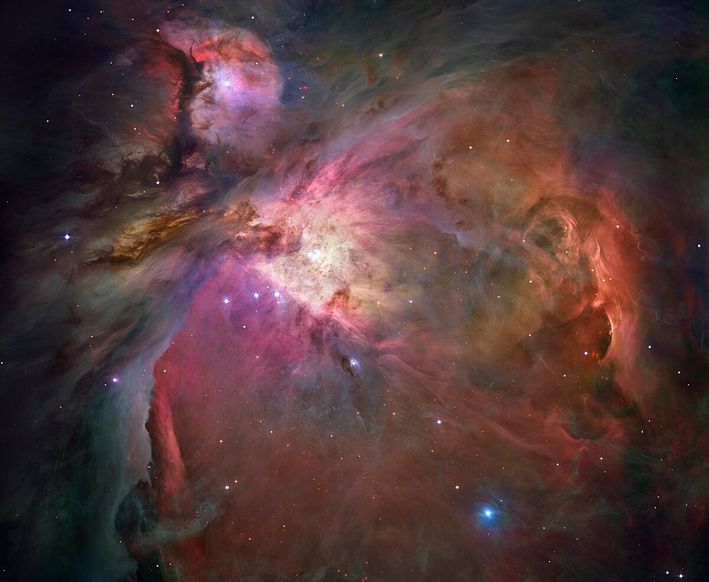
It is composed of three closely spaced stars, also aligned. Under a truly dark sky, one notices that, unlike its two companions, the middle star has a somewhat diffuse appearance: it is in fact a gigantic nebula harboring a multitude of stars in the process of being born.
With a simple pair of binoculars, one can begin to admire this marvelous stellar cradle, located approximately 1,500 light-years from us, known as the "Great Orion Nebula." Astronomers call it a "star nursery."
It is composed of three closely spaced stars, also aligned. Under a truly dark sky, one notices that, unlike its two companions, the middle star has a somewhat diffuse appearance: it is in fact a gigantic nebula harboring a multitude of stars in the process of being born.
With a simple pair of binoculars, one can begin to admire this marvelous stellar cradle, located approximately 1,500 light-years from us, known as the "Great Orion Nebula." Astronomers call it a "star nursery."
In this chaotic world, let's once again connect the sky with gentle legends.
In Greek mythology, Orion was a hunter of great beauty, son of Poseidon, the god of the sea. Artemis, goddess of the hunt and the moon, fell in love with him, which angered her brother, Apollo. One day, while Artemis and Apollo were strolling by the ocean, Apollo challenged his sister to hit a small black dot floating in the distance with one of her arrows. Artemis complied, unaware that it was Orion swimming in the sea. Having killed her beloved, Artemis was inconsolable. She begged Zeus to send Orion to the heavens and transform him into a constellation.
In Greek mythology, Orion was a hunter of great beauty, son of Poseidon, the god of the sea. Artemis, goddess of the hunt and the moon, fell in love with him, which angered her brother, Apollo. One day, while Artemis and Apollo were strolling by the ocean, Apollo challenged his sister to hit a small black dot floating in the distance with one of her arrows. Artemis complied, unaware that it was Orion swimming in the sea. Having killed her beloved, Artemis was inconsolable. She begged Zeus to send Orion to the heavens and transform him into a constellation.

Upcoming Events
This section informs you about upcoming events in the fields of pure astronomy and space exploration.
Astronomical Events
March 20: Spring Equinox.
May 7 and 8: Sunset under the Arc de Triomphe from the Place de la Concorde.
May 9, 10, and 11: Sunset under the Arc de Triomphe from the Champs-Élysées roundabout.
June 21: Summer Solstice.
July 31, August 1, 2, and 3: Sunset under the Arc de Triomphe from the Champs-Élysées roundabout.
August 3, 4, and 5: Sunset under the Arc de Triomphe from the Place de la Concorde.
August 12: Total solar eclipse, visible in its partial phase in mainland France. Photo 10 Solar Eclipse
Perseid meteor shower.
August 28: Partial lunar eclipse, visible in mainland France.
September 14: Venus appears behind the Moon.
September 23: Autumnal equinox.
December 21: Winter solstice.
Ursidae meteor shower.
Space exploration
ISS: French astronaut Sophie Adenot joined the crew aboard the ISS.
She became the 11th French astronaut and the 2nd woman, the first being Claudie Aigneré.
Artemis 2 launch to the Moon: Date set: April 1. To be continued.
This section informs you about upcoming events in the fields of pure astronomy and space exploration.
Astronomical Events
March 20: Spring Equinox.
May 7 and 8: Sunset under the Arc de Triomphe from the Place de la Concorde.
May 9, 10, and 11: Sunset under the Arc de Triomphe from the Champs-Élysées roundabout.
June 21: Summer Solstice.
July 31, August 1, 2, and 3: Sunset under the Arc de Triomphe from the Champs-Élysées roundabout.
August 3, 4, and 5: Sunset under the Arc de Triomphe from the Place de la Concorde.
August 12: Total solar eclipse, visible in its partial phase in mainland France. Photo 10 Solar Eclipse
Perseid meteor shower.
August 28: Partial lunar eclipse, visible in mainland France.
September 14: Venus appears behind the Moon.
September 23: Autumnal equinox.
December 21: Winter solstice.
Ursidae meteor shower.
Space exploration
ISS: French astronaut Sophie Adenot joined the crew aboard the ISS.
She became the 11th French astronaut and the 2nd woman, the first being Claudie Aigneré.
Artemis 2 launch to the Moon: Date set: April 1. To be continued.