





All this is happening above our heads
Geostationary Satellites
By Michel Gravereau
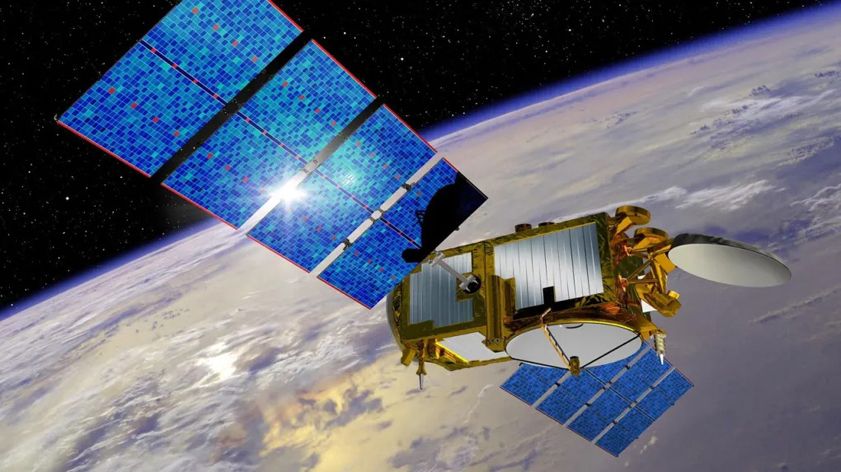
How many times, during our evenings, while admiring the satellites streaking across our sky, have I heard it said that geostationary satellites don't move in the sky, that they are motionless. A fundamental error.
Placed into orbit for specific purposes, such as weather forecasting (Meteosat satellites for Europe), telecommunications and television (Eutelsat for European coverage), or specific area monitoring (agriculture, military situation, urban planning, GPS), these satellites occupy a well-defined position relative to Earth.
The Earth rotates on its axis in 23 hours, 56 minutes, and 4 seconds. Therefore, the satellite must rotate at the same speed to always appear in the same position in the sky, as seen from Earth.
How many times, during our evenings, while admiring the satellites streaking across our sky, have I heard it said that geostationary satellites don't move in the sky, that they are motionless. A fundamental error.
Placed into orbit for specific purposes, such as weather forecasting (Meteosat satellites for Europe), telecommunications and television (Eutelsat for European coverage), or specific area monitoring (agriculture, military situation, urban planning, GPS), these satellites occupy a well-defined position relative to Earth.
The Earth rotates on its axis in 23 hours, 56 minutes, and 4 seconds. Therefore, the satellite must rotate at the same speed to always appear in the same position in the sky, as seen from Earth.
Let's look at some precise data.
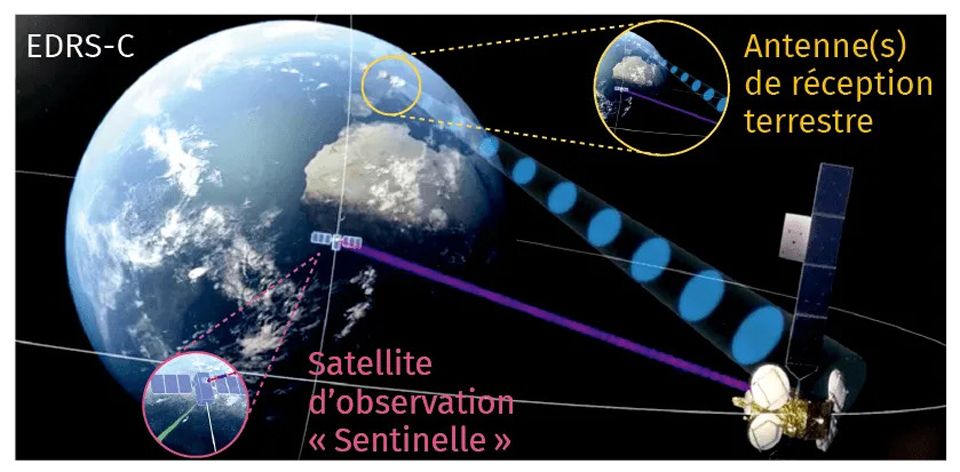
A geostationary satellite is generally said to be located 36,000 km from Earth. More precisely, it orbits 42,164 km from the Earth's center. With a speed of 3,075 km/s, or 10,800 km/h, this makes it a synchronous object, hence its stable position as seen from Earth. Earth.
In comparison, the International Space Station (ISS), which orbits at an altitude of 400 km and circles the Earth in 1 hour and 35 minutes, is much faster, at approximately 29,000 km/h.
It is also necessary that the geostationary satellite be located directly above the equator.
A geostationary satellite is generally said to be located 36,000 km from Earth. More precisely, it orbits 42,164 km from the Earth's center. With a speed of 3,075 km/s, or 10,800 km/h, this makes it a synchronous object, hence its stable position as seen from Earth. Earth.
In comparison, the International Space Station (ISS), which orbits at an altitude of 400 km and circles the Earth in 1 hour and 35 minutes, is much faster, at approximately 29,000 km/h.
It is also necessary that the geostationary satellite be located directly above the equator.
While Leonardo da Vinci imagined concepts that could not be realized at the time due to a lack of technology, such as the parachute, the submarine, or the helicopter, this particular position of geostationary satellites was conceived even before the first satellite, Sputnik, was launched by the Soviets on October 4, 1957.
In fact, the author of 2001: A Space Odyssey, the British scientist Arthur C. Clarke, had foreseen the potential of satellites in geostationary orbit for human telecommunications in 1945, twelve years before Sputnik. Nineteen years before the Americans launched the first geostationary satellite, Syncom-3, into orbit in 1964.
Needless to say, the main satellites we see passing overhead at nightfall, illuminated by the Sun, are at much greater distances than Earth. 800 km is the average. Geostationary satellites are completely invisible, too far away and with no apparent movement.
A spectacle that has been unsettling for some time now: the "trains" of satellites launched by Elon Musk's SpaceX, the Starlinks, which will weave a vast spiderweb around the Earth and strengthen 5G. Our planet is gradually being enveloped by these objects for various purposes, and their numbers are constantly increasing. Regardless of their presence, we skywatchers can rest assured that there will always be enough space between these satellites to allow us to contemplate the stars, the galaxies, and dream about the stars. Infinity.
In fact, the author of 2001: A Space Odyssey, the British scientist Arthur C. Clarke, had foreseen the potential of satellites in geostationary orbit for human telecommunications in 1945, twelve years before Sputnik. Nineteen years before the Americans launched the first geostationary satellite, Syncom-3, into orbit in 1964.
Needless to say, the main satellites we see passing overhead at nightfall, illuminated by the Sun, are at much greater distances than Earth. 800 km is the average. Geostationary satellites are completely invisible, too far away and with no apparent movement.
A spectacle that has been unsettling for some time now: the "trains" of satellites launched by Elon Musk's SpaceX, the Starlinks, which will weave a vast spiderweb around the Earth and strengthen 5G. Our planet is gradually being enveloped by these objects for various purposes, and their numbers are constantly increasing. Regardless of their presence, we skywatchers can rest assured that there will always be enough space between these satellites to allow us to contemplate the stars, the galaxies, and dream about the stars. Infinity.