





All this is happening above our heads
The Southern Cross and the Legionnaire.
Every legionnaire today is intimately familiar with the current regiments and their deployments. Some participated in their most recent missions and interventions: the Balkans, Afghanistan, the Sahel. A glance at their decorations is enough to convince oneself, as Napoleon might have said to his veterans at Austerlitz, that "they were there."
For others, older members of our veterans' associations, the memory of the Gulf War, Kolwezi, North Africa, and, more rarely, Indochina, is also etched on their chests.
But these heroic deeds should not make us forget all those units, admittedly less well-known and now defunct, that contributed to maintaining peace, stabilizing our borders, providing aid to populations, and safeguarding France's presence in what we called our colonies. Algeria was the birthplace of the Legion. And on this land, to which they tirelessly returned after their hard-fought battles, to heal their wounds and rebuild their battered ranks, the Legion established numerous small outposts in the Sahara Desert, as it would later do in Indochina, in the Delta, and in the jungle.
Some of these units bore the insignia of the Cross of Agadez, or Southern Cross. These were the CSPL, the Saharan Motorized Company of the Legion.
It would be far too lengthy to mention all these units that proudly displayed the seven-flamed grenade. Life is made up of choices.
Therefore, keeping the "connection" from the heavens—that is, the Southern Cross—as our guiding thread, let us humbly recall some of these ephemeral garrisons established in the middle of nowhere, where the legionnaire once again demonstrated his incredible ability to adapt to climatic, territorial, and human conditions. Apologies in advance to our veterans who may have served in companies not listed here.

The Southern Cross, a superb constellation.
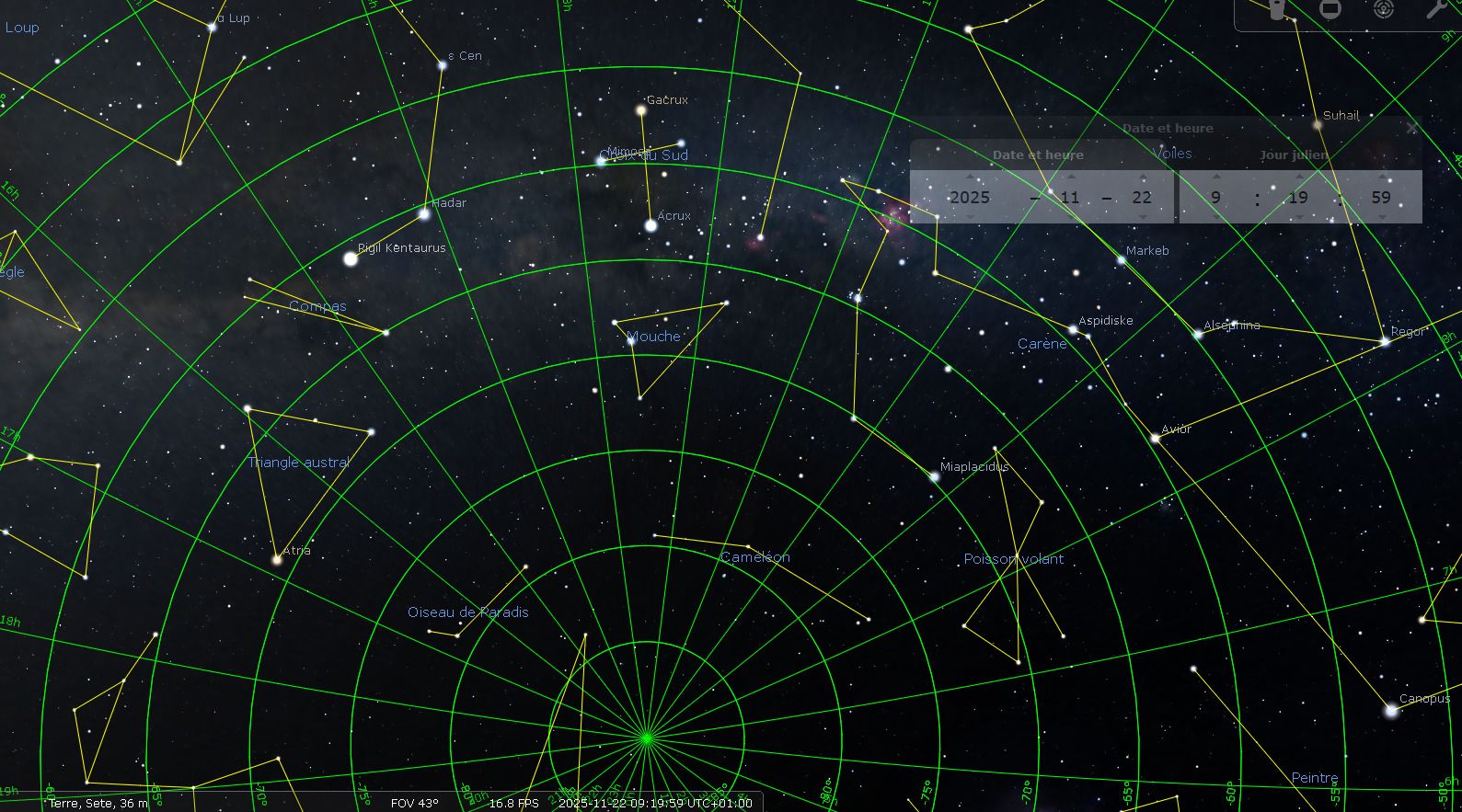
The Southern Cross is a magnificent constellation which, like the Big Dipper in the Northern Hemisphere, helps with orientation.
To find south, start with this diamond-shaped constellation and extend its long diagonal downwards approximately four times. The celestial South Pole has no prominent star. It is located in the constellation Octans, the precursor to the Sextant.
This constellation is not currently visible from France. You have to travel towards the equator to see it. And even then, not all the time.
In fact, in the Sahara, it appears just above the horizon, due south, when it crosses the meridian, that is, when it is directly above the South Pole.
Our comrades from the 3rd Foreign Infantry Regiment (3°REI) in Kourou see it between 20 and 26 degrees at its highest point, while from Dzaoudzi, it stands majestically in the sky between 39 and 45 degrees.
Some countries have the Southern Cross on their flags, such as Brazil, Australia, New Zealand, Papua New Guinea, and Samoa.
The CSPL (Airborne Commando Training Center)
In the hostile terrain of the Sahara in southern Algeria, it goes without saying that patrols and communications were not conducted with a Michelin map in hand or by reading a GPS.
Like the airmen, or like our comrades in the navy, the sky was their guide for navigation. We naturally return to the Southern Cross, so dear to these peoples, such as the Tuareg.
Like the airmen, or like our comrades in the navy, the sky was their guide for navigation. We naturally return to the Southern Cross, so dear to these peoples, such as the Tuareg.
1st CSPL 1st ESPL (Airborne Commando Training Center)
On January 1, 1961, the 1st C.S.P.L. was renamed the 1st Saharan Motorized Squadron of the Foreign Legion (1st E.S.P.L.E.) "by a simple change of name"; it operated in the Laghouat and Ghardaïa sector.
The last Legion officer killed in Algeria, Lieutenant GÉLAS, died in its ranks during an ambush set by rebels on August 9, 1962, near Laghouat. On September 12, 1962, the squadron was stationed in Reggan where it actively participated in the protection of military sites in the Sahara.
On March 31, 1963, upon the disbandment of the 1st E.S.P.L., its elements formed the squadron of the 2nd REI. Then, on June 1, 1963, the 5th Motorized Company of the 2nd Foreign Infantry Regiment (2nd REI)

2nd C.S.P.L.
It was created on March 15, 1946, by splitting off from the 1st C.S.P.L., with which it shared the traditions of the mounted companies and the motorized company of the 1st Foreign Regiment. An autonomous unit forming a corps, its first garrison was in Ouargla.
In 1948, its base was established in Laghouat; its vehicles operated along the Saharan tracks as far as the Fezzan region. In 1954, it participated in peacekeeping operations in Tunisia, in the Gafsa region. During the Algerian War, in the Laghouat region, threatened by incursions from the Djebel Amour and the Ouled Naïl massif, it carried out several years of pacification efforts. His finest feat of arms took place on December 7, 1956, in the Bou-Guergour mountains.
On March 31, 1963, the 2nd C.S.P.L. was disbanded at Laghouat; its elements formed the 1st Motorized Company of the 4th REI.

3rd CSPL
Created in Sidi-Bel-Abbès on February 1, 1949, the 3rd CSPL inherited the missions of the Tinghert Saharan Company, which had been disbanded on January 31, 1949. In February and March 1949, its platoons were stationed in Fezzan, at Fort Leclerc, near the Sebha oasis.
For more than seven years, the 3rd CSPL maintained the French presence in a vast and desert territory. On November 30, 1956, it left Fort Leclerc and, after a 3,000-kilometer journey, experienced the harsher realities of operational life in El-Goléa, then Messad, and finally in the Laghouat sector.
The company consisted of three motorized platoons (Dodge 6x6), an armored platoon (AM M8), a command platoon, and a recovery echelon.
The 3rd C.S.P.L. was disbanded on March 31, 1963, in Laghouat, becoming the 7th, then the 3rd Motorized Company of the 4th REI
For more than seven years, the 3rd CSPL maintained the French presence in a vast and desert territory. On November 30, 1956, it left Fort Leclerc and, after a 3,000-kilometer journey, experienced the harsher realities of operational life in El-Goléa, then Messad, and finally in the Laghouat sector.
The company consisted of three motorized platoons (Dodge 6x6), an armored platoon (AM M8), a command platoon, and a recovery echelon.
The 3rd C.S.P.L. was disbanded on March 31, 1963, in Laghouat, becoming the 7th, then the 3rd Motorized Company of the 4th REI

4th C.S.P.L.
After a short existence (August-September 1955), the 24th Motorized Company of the Foreign Legion (24th C.P.L.E.), based in Ain-Sefra, was renamed the 4th Saharan Motorized Company of the Foreign Legion (4th C.S.P.L.) on January 1, 1956.
On February 19, 1957, following the pacification of the Ain-Sefra territory, the 4th C.S.P.L. relocated to Colomb-Béchar. Its operational activities were particularly marked by its major role on March 27, 1960, during the decapitation of an entire wilaya (province) near Colomb-Béchar.
On March 31, 1963, it became the 2nd Motorized Company of the 2nd REI (Foreign Legion Infantry Regiment).

2nd Foreign Infantry Regiment
7th Motorized Company
On April 30, 1964, the 1st, 4th, and 6th Motorized Companies and a Training Center (EMT) of the disbanded 4th Foreign Regiment were incorporated into the 2nd Foreign Infantry Regiment (2nd REI). The corresponding units of the 2nd Foreign Regiment were disbanded, except for the 4th Company, which became the 7th Motorized Company, specifically tasked with officer training and the instruction of young volunteer recruits.
This unit was based at "CROZÉ" in Colomb-Béchar. On July 1, 1967, when the regiment left the Sahara to join the naval base at Mers-el-Kébir, the 7th Company reverted to its former number.

Foreign Regiments Disciplinary Company
In 1955, the Foreign Regiments Disciplinary Company (C.D.R.E.), arriving from Colomb-Béchar, was stationed in Djenien-Bou-Rezg. The post it occupied, built in 1888, was located in a wide, flat valley along the Oran-Colomb-Béchar-Ain-Sefra railway line.
The C.D.R.E., with its officers and disciplinary officers, participated in peacekeeping operations in its sector, near the Moroccan border. In June 1963, this "monastery of last resort" was transformed into a Saharan disciplinary section attached to the 5th Foreign Infantry Regiment (5th REI), then to the 2nd Foreign Infantry Regiment (2nd REI). It was disbanded on July 1, 1964.

1st Saharan Motorized Battery of the Legion
1st B.S.P.L.
Much less well-known, on April 1, 1941, the Saharan Motorized Battery (B.S.P.L.) became the 1st Saharan Motorized Battery of the Legion (1st B.S.P.L.) following the creation of a second battery.
In November 1942, when German and Italian troops were preparing to resist the Allied advance in Tunisia, the 1st B.S.P.L. was part of a Saharan Legion group and blocked the enemy's path towards Biskra and Négrine. From February to April 1943, the battery participated in numerous battles.
It was dissolved on December 1, 1943, to free up its personnel for the benefit of combat units being formed for future battles in Europe.

4th Foreign Legion Infantry Regiment
2nd Company
Reggan, April 24 and 25, 1964. In the presence of General Lefort, Inspector of the Legion, General Spitzer, former commanding officer of the 1st Foreign Cavalry Regiment (1er REC), Colonels Caillaud, commanding the 2nd Foreign Parachute Regiment (2nd REP), Le Vert, commanding the 2nd Foreign Infantry Regiment (2nd REI), and de Broissia, commanding the 1st Foreign Cavalry Regiment (1er REC), the ceremonies marking the dissolution of the 4th Foreign Infantry Regiment, commanded by Colonel Brulé, took place.
Many officers and non-commissioned officers from the 2nd Foreign Parachute Regiment (2nd REP), the 1st Foreign Cavalry Regiment (1st REC), and the 2nd Foreign Infantry Regiment (2nd REI) came to express their support for their comrades in the 4th Foreign Regiment. The vigil, arms presentation ceremony, and parade took place in a somber atmosphere.

1st Foreign Infantry Regiment
10th Mixed Company
The 3rd Battalion of the 1st Foreign Regiment, to which the 10th Company belongs, has existed since the regiment's creation in 1841.
Since the First World War, the battalion has been stationed in southern Algeria (Ain-Sefra region). The 10th Company is garrisoned in Colomb-Béchar. From 1938, the unit was employed in fortification work in the Tébessa sector, then in southern Tunisia. On November 16, 1940, the 3rd Battalion returned to southern Algeria missions of the 66th Southern Company, disbanded. On December 1, 1940, it adopted the new designation of 10th "Mixed" Company, like all the other units of the regiment.
Disbanded on March 1, 1943.

The Southern Cross and Today's Regiments
6th Foreign Engineer Regiment (6th REG)
Created on July 1, 1984, at L'Ardoise, the 6th REG saw its ranks swell with legionnaires from the CRTRLE (Foreign Legion Training Center) of Canjuers, commanded by Captain Kampmeyer, and legionnaires from all the other regiments.
Quickly expanding to three combat companies, it boasted brilliant lieutenants among its leadership, many of whom would become commanding officers: Nebois, Breuille, and Rittimann, among others.
As an Operational Support Officer (OSA), Lieutenant Colonel Blanchard guided the first steps of the new recruits (CDC) as they discovered the Legion environment. As an Operational Support Officer (OS), Svonimir Skender knew each legionnaire. Another pillar of this structure was Norbert Toquet.
On October 12, 1984, the Regiment received its flag from General Imbot.
With such men, things were bound to click, and very quickly, the 6th Foreign Engineer Regiment (6°REG), later renamed the 1st Foreign Engineer Regiment (1°REG), became an indispensable part of the French Army's structure.
Short-term missions followed one after another.
1987 saw the first operational deployment of the 6th Foreign Engineer Regiment (6°REG), commanded by Colonel Martial. Lieutenant Delemarle's section from the 1st Company arrived in Moussoro, Chad, to serve as an engineering element during Operation Sparrowhawk, which provided support to the local government against Libyan forces. In November, the section was followed by the 1st and 3rd Companies.
During this mission, Staff Sergeant Stevo Panic became the first man in the regiment to be killed in action: his vehicle struck a mine.
The 1st Company distinguished itself during its deployment to Chad and received a commendation from the Army.
Since then, legionnaires from Laudun have contributed their expertise in demining, providing aid to civilian populations, and maintaining peace to all areas of operation.
The turbulent times ahead will undoubtedly provide them with further opportunities to add to their glorious history.

The 2nd Foreign Engineer Regiment
Just 25 years ago, the Legion's newest addition was born: the 2nd Foreign Engineer Regiment.
Under the leadership of its Commanding Officer, Colonel Pascal Nebois, it immediately demonstrated its exceptional capabilities, not only by contributing its expertise to combat engineering missions, but also by adapting in record time to the harsh conditions of high peaks. The mountains became its playground.
Just 25 years ago, the Legion's newest addition was born: the 2nd Foreign Engineer Regiment.
Under the leadership of its Commanding Officer, Colonel Pascal Nebois, it immediately demonstrated its exceptional capabilities, not only by contributing its expertise to combat engineering missions, but also by adapting in record time to the harsh conditions of high peaks. The mountains became its playground.
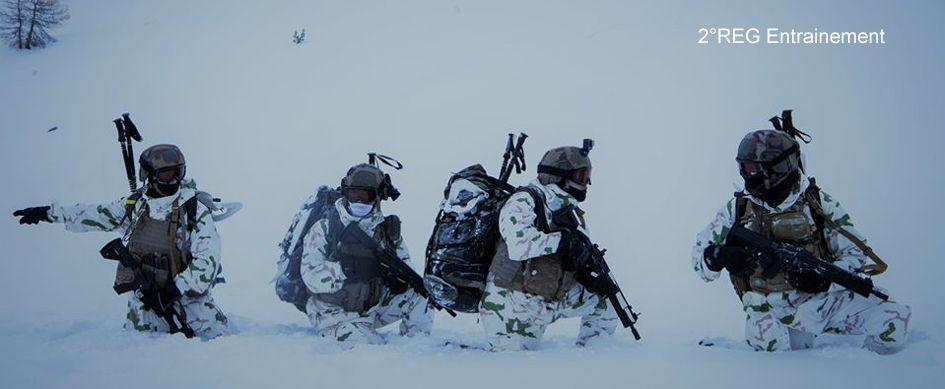
Just as the legionnaires of the 13th Company donned their skis for the snows of Narvik, the legionnaires of the 2nd Foreign Engineer Regiment (2°REG) would gain a lasting understanding of the extreme conditions that the mountains present. Valloire, Chamonix, and many other training centers would witness the legionnaires train, hone their skills, toughen themselves, and master this unforgiving natural environment. Avalanches would serve as a stark reminder of the harsh reality, such as the one on January 18, 2016. To better carry out their missions, they must obtain new qualifications: the BASM (Basic Mountaineering and Military Skiing Certificate), among others.
But he is not confined to the peaks of the Alps. Duty calls him elsewhere, such as to the Sahel with Operation Barkhane.
Hostile terrain is in the Legionnaire's DNA. Yesterday in the Sahara, today on the tracks of Mali with Operation Barkhane.
A new operation means creating a new insignia. The Southern Cross beckons.
I recently mentioned how fortunate the legionnaires of St. Christol are to be able to admire the sky from a higher altitude than usual. The Big Dipper must seem close to them.
But if I am to believe the insignia created during Operation Barkhane, they were not indifferent to the Southern Cross, since they adopted it as their emblem.
We therefore have two Engineer Regiments that have worked in the desert with these four stars as their emblem, guiding their steps. There too, they fulfilled their mission with the motto: Sometimes destroy, often build, always serve with Honor and Fidelity.
The universality of the Legion, capable of serving at all times and in all places. The eternal Legion.

If the Southern Cross is not visible to us in mainland France, it remains so for our comrades on active duty, such as in French Guiana or Mayotte.
Our units will apparently be called upon less and less to serve on African soil, but if they were to set foot there again, there is no doubt that the gaze of our legionnaires would be fixed on this magnificent constellation that guided so many steps of our predecessors in this desert where they were the sentinels of an advanced world.
As in the past, is not this distant horizon, even today, a destiny to fulfill, a goal to reach: the unattainable star?
Today, this is just the reflection of an astronomy enthusiast who served in the ranks of the Legion and who respects it deeply our ancestors are at the forefront. This connection I wanted to establish between the Southern Cross and the Legion units may seem childish, but on closer inspection, by turning the glorious pages of the Legion's golden book backwards, the connection isn't so far-fetched.
Laying out roads, building bridges, digging tunnels. The legionnaire builder contributed his knowledge and his sweat to the development of the territories where he served. More Majorum.

Who better than Captain Borelly found the right words to speak of our legionnaires?
We have wild dreams sometimes, when we're on the road,
And I found myself thinking,
Before this unique style and this imposing presence,
How might we not be able to pass?
We have wild dreams sometimes, when we're on the road,
And I found myself thinking,
Before this unique style and this imposing presence,
How might we not be able to pass?
