




EDITORIAL 5
The French Foreign Legion and Art
By Louis Perez y Cid
For over two centuries, military painting and sculpture have occupied a unique place in French artistic creation. Masters such as Horace Vernet (1789-1863), Édouard Detaille (1848-1912), and Alphonse de Neuville (1835-1885) shaped a true visual tradition where historical realism, the exaltation of courage, and the memory of battles intertwine. This lineage of artists gave rise to a powerful, often monumental, iconography that tells the story of both the evolution of the French army and the spirit of those who serve it.

The French Foreign Legion, a Source of Artistic Inspiration
Among these military figures that have become sources of inspiration, the French Foreign Legion occupies a special position. An elite corps of international prestige, the Legion has inspired numerous painters, illustrators, and sculptors who have sought to capture the silhouette of the legionnaire, his ruggedness, his camaraderie, and the intensity of the theaters of operation in which he serves. From Charles Fouqueray to Pierre Benigni, from uniform illustrators to sculptors like Charles-Henri Pourquet, art dedicated to the Legion blends documentary accuracy, epic sweep, and a profound respect for the corps' traditions.
This artistic legacy, at the crossroads of myth and reality, now comprises a body of work that bears witness not only to French military history but also to the human and universal dimension of the legionnaire. This article is devoted to this intersection of art and memory.

Art Dedicated to the French Foreign Legion
Anonymity,
an iconography born with the colonial campaigns (1830s–1880s)
From its creation in 1831, the French Foreign Legion participated in the Algerian campaigns. These theaters of operation quickly attracted military painters specializing in the “picturesque African.”
While the Legion was not yet represented as an independent subject, it already appeared in the large-scale compositions of painters traveling with the army, notably Horace Vernet, whose scenes of battles and marching columns laid the visual foundations for the first legionnaires within the Army of Africa: rugged uniforms, scorching sun, endless marches, bivouac scenes, and in particular, the capture of Constantine (1837).
Charles Fouqueray (1869-1956), illustrator of military magazines, poster artist, history painter, and also official painter of the Navy, is not primarily known as a "painter of the Legion," but he did produce depictions of the Foreign Legion, integrated into his work on the French army overseas as well as on the First World War.
.jpg?t=aeb8a500_42ca_451a_ab7f_8e5528b4f20b)
1920–1960: The Golden Age of Legionary Representation
This period saw the birth of a Legionary aesthetic based on the harshness of the terrain, the exoticism of the locations, and the solidarity among combatants. This era witnessed the emergence of a true iconography of identity.
In painting:
The legionnaire became instantly recognizable, with his white kepi, Saharan uniform, imposing figure, and presence in desert or mountain landscapes.
The campaigns in Morocco, the Levant, and later Indochina inspired many military artists and illustrators.
.jpg?t=aeb8a500_42ca_451a_ab7f_8e5528b4f20b)
Maurice Mahut (1878-1929) is best known for his military paintings and illustrations and was the official painter of the French Foreign Legion. He created the sketches for the Foreign Legion war memorial, which sculptor Charles-Henri Pourquet completed in 1931.
.jpg?t=aeb8a500_42ca_451a_ab7f_8e5528b4f20b)
Pierre Benigni (1878-1956), a student of Édouard Detaille, became, after Maurice Mahut, the official military painter of the Legion, immortalizing the infantry regiments, mounted companies, and cavalry regiments.
His works, which have become iconic, depict legionnaires in combat, on the march, or in scenes of daily life, always with a great sensitivity to the human dimension of the soldier.
He created all the illustrations for the 1931 edition of the Golden Book of the French Foreign Legion (1831–1931).
His works, which have become iconic, depict legionnaires in combat, on the march, or in scenes of daily life, always with a great sensitivity to the human dimension of the soldier.
He created all the illustrations for the 1931 edition of the Golden Book of the French Foreign Legion (1831–1931).
.jpg?t=aeb8a500_42ca_451a_ab7f_8e5528b4f20b)
Louis Frégier (1929–2014) Appointed an Army Painter at a very young age, he is primarily known for his military drawings, specializing in the First Empire and the First World War. A professor of visual arts, he taught for seventeen years (1951–1968) at the teacher training college in Aix-en-Provence. He illustrated the first three-volume edition of "Honor and Fidelity. This is the Legion," published in 1969, by Louis Gaultier and Charles Jacquot.
.jpg?t=aeb8a500_42ca_451a_ab7f_8e5528b4f20b)
Sculpture and ceramics of the French Foreign Legion.
Many sculptors, both well-known and lesser-known, have created works on the theme of the French Foreign Legion, such as André Paltrie (1938-2016), the army's official sculptor and painter.
Here, we will discuss two sculptors, modelers, and ceramicists who dedicated a large part of their lives exclusively to Legionary art.
Rudy Just, of German origin and a former non-commissioned officer in the French Foreign Legion, became the Legion's official ceramist. He began his work in Sidi Bel Abbès, then followed the regiment to Aubagne in 1962. He created a multitude of paintings, iconic statues, and ceramics for all Legion units, notably for the Legion Headquarters in Aubagne, which remain symbolic to this day. For three decades, every legionnaire was familiar with Mr. Just's work.
.jpg?t=aeb8a500_42ca_451a_ab7f_8e5528b4f20b)
Guy Paris, a graduate of the Marseille School of Fine Arts, was employed in 1957 by the Institution for Invalids of the Foreign Legion (IILE) in Puyloubier after his military service in Morocco and Algeria. He was tasked with creating a ceramics workshop for the benefit of the disabled residents. Intended for a short term, he remained there until 2000. Under his direction, the ceramics workshop was established, and little by little, with patience and generosity, he achieved the remarkable feat of transforming our former legionnaires, scarred by war, into santon makers and ceramic artisans. Mr. Paris became a pillar of the Institution.
After 43 years of activity, training ceramicists, creating works, and innovating in art ceramics inspired by the Legion, he was able to pass on a high-quality workshop, renowned throughout the Legion and far beyond.
An artist of great rigor, he was awarded the title of Meilleur Ouvrier de France (MOF) in 1988 (date of memory).
Today, in 2025, at 90 years old, he spends one day a week at the workshop, volunteering his time. A fine example of Legionnaire solidarity.
After 43 years of activity, training ceramicists, creating works, and innovating in art ceramics inspired by the Legion, he was able to pass on a high-quality workshop, renowned throughout the Legion and far beyond.
An artist of great rigor, he was awarded the title of Meilleur Ouvrier de France (MOF) in 1988 (date of memory).
Today, in 2025, at 90 years old, he spends one day a week at the workshop, volunteering his time. A fine example of Legionnaire solidarity.
.jpg?t=aeb8a500_42ca_451a_ab7f_8e5528b4f20b)
1960–2000, Former Legionnaire Artists.
We are talking about three Legionnaire artists, some famous, others less so, who worked modestly for many years to promote the image and art of the Legion.
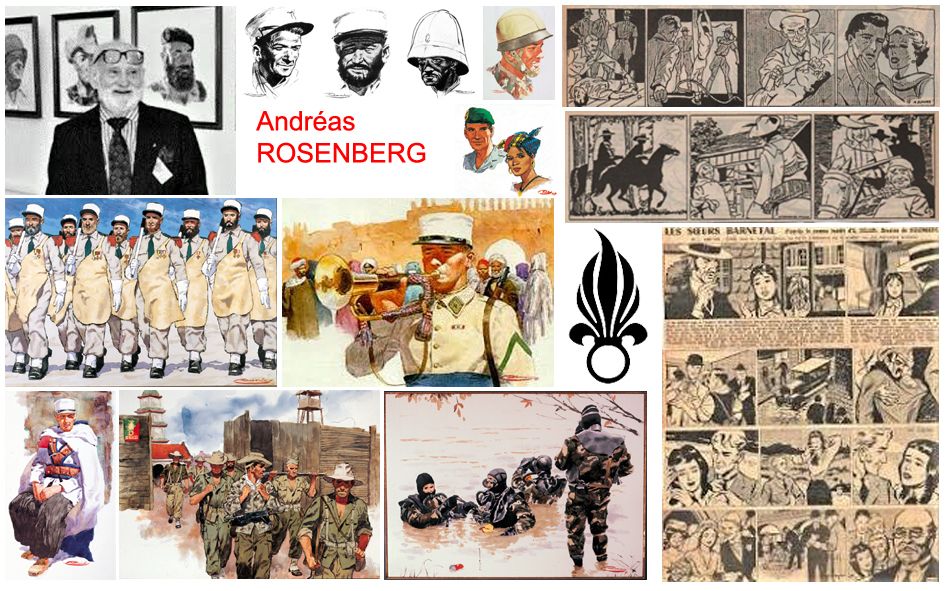
The painter Andreas Rosenberg was born in 1906 in Czernowitz, in the Austro-Hungarian Empire, where he spent the first 30 years of his life. A Doctor of Law from the University of Vienna and an apprentice at the School of Applied Arts, he quickly gravitated towards men's fashion design.
Throughout his long life, he pursued three artistic disciplines simultaneously: men's fashion designer, official painter for the French Army, and comic book artist. He died in 2002 in Paris.
As a young man, he worked primarily abroad, first in Italy, then in France.
When war broke out, he enlisted in the French Foreign Legion in 1939 for five years.
He was stationed in Sidi Bel Abbes, Algeria, with his friend and the renowned painter Hans Hartung. Thanks to a colonel who was an amateur watercolorist, he was able to organize his first exhibition in Algiers. In 1944, he obtained an official contract as an army painter, a position he held until his death.
After creating numerous watercolors of the Army of Africa, he continued this work after the war, enjoying considerable renown.
He became one of the key figures in shaping the Legion's postwar visual identity. In particular, he established the style of the seven-flamed grenade emblem, which is still in use today.
Rudy Burda (1929-1991), of Austrian origin, a former warrant officer in the French Foreign Legion, was the official illustrator for the magazine *Képi Blanc*. He was so closely associated with the magazine that many had no idea what a soldier he had been. Few, no doubt, knew that he had parachuted into Dien Bien Phu; he never spoke of it.
In his article illustrations, headlines, humor pages, and posters, his style shines through in the clean, precise lines and the humor of his caricatures.
His characters are never malicious, his humor never cruel, because the artist was sociable and friendly. For some thirty years, the entire Legion was familiar with Burda's humor.
At the 5th Foreign Regiment, on Mururoa Atoll, he created a huge mural on the ocean wall with the help of a few conscripts and an old GMC truck that served as a ladder and transport for his paint pots. The parade ground became more beautiful than ever, much to the delight of the legionnaires.
In the Pacific, remnants of the mural still survive, despite neglect and the elements.
In his article illustrations, headlines, humor pages, and posters, his style shines through in the clean, precise lines and the humor of his caricatures.
His characters are never malicious, his humor never cruel, because the artist was sociable and friendly. For some thirty years, the entire Legion was familiar with Burda's humor.
At the 5th Foreign Regiment, on Mururoa Atoll, he created a huge mural on the ocean wall with the help of a few conscripts and an old GMC truck that served as a ladder and transport for his paint pots. The parade ground became more beautiful than ever, much to the delight of the legionnaires.
In the Pacific, remnants of the mural still survive, despite neglect and the elements.

Louis Perez y Cid, your humble servant. Little to add that isn't in the biography on this site. Except that Andreas Rosenberg advised me on watercolor painting, and my friend Burda trained me in cartooning and layout for the magazine "Képi Blanc," for which I later became the official illustrator.
Much later, Guy Paris taught me the art of clay and fire, ceramics, for two years, so that I could take over his workshop at the IILE (International Legion of Foreign Legion).
Much later, Guy Paris taught me the art of clay and fire, ceramics, for two years, so that I could take over his workshop at the IILE (International Legion of Foreign Legion).

2000 to present.
Official Army Painters.
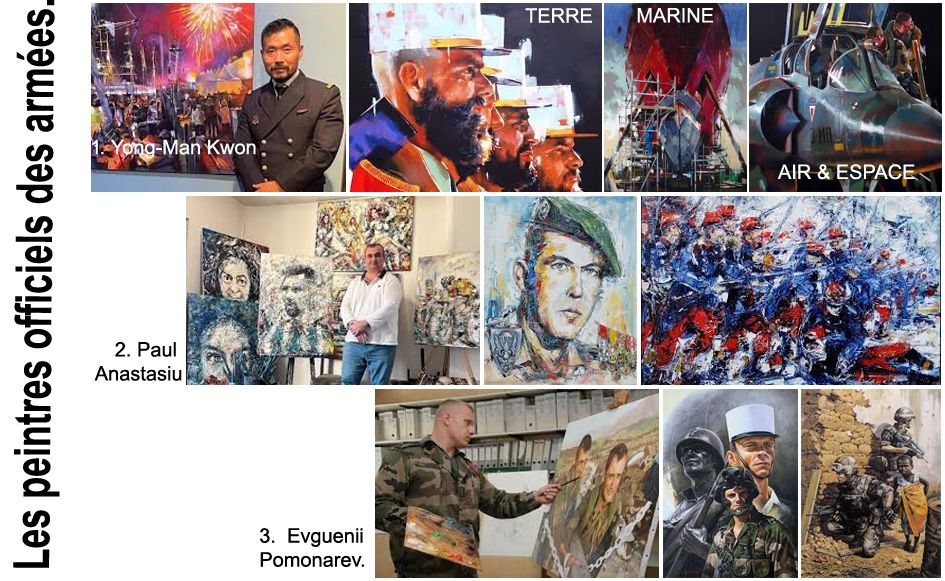
Yong-Man Kwon and Evguenii Pomonarev, two accomplished artists who became legionnaires, served successively as official illustrators for the magazine Képi Blanc.
At the end of their contracts, they applied for and obtained the title of Official Army Painters.
Paul Anastasiu, originally a sculptor, served in the 1st Foreign Engineer Regiment (1°REG).
His departure and the influence of the painter Louis Frégier led him to apply for and obtain the title of Official Painter of the Armed Forces.
Three very different painters, who are the pride of the Legion, and whom you can discover more about than we can here by clicking on the artists' names below.
1. The painter Yong-Man Kwon. Official Painter of the Armed Forces, Official Painter of the Navy, and Official Painter of the Air and Space Force.
2. The painter Paul Anastasiu. Official Painter of the Armed Forces.
3. The painter Evgenii Pomonarev. Official Painter of the Armed Forces.
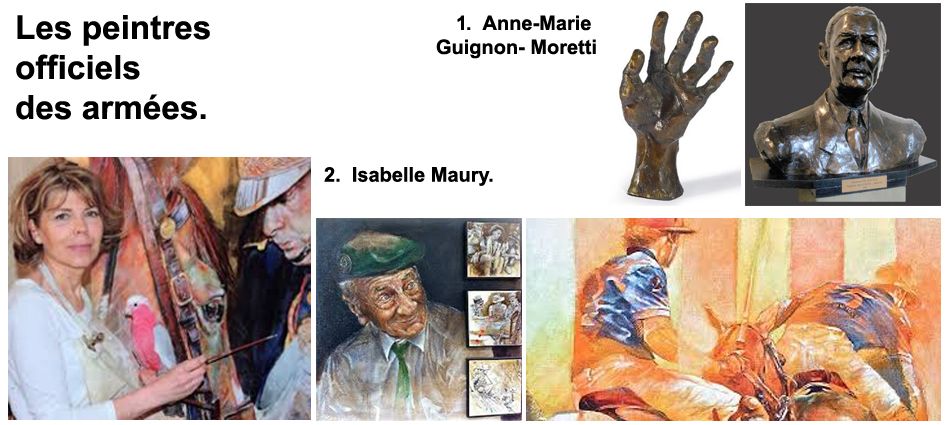
Let's not forget two wives of former members of the Foreign Legion.
1. The sculptor Anne-Marie Guignon-Moretti. Official Painter of the Armed Forces. Wife of General Guignon.
2. The painter Isabelle Maury. Official Painter of the Armed Forces. Widow of Lieutenant Colonel Lanteres
1. The sculptor Anne-Marie Guignon-Moretti. Official Painter of the Armed Forces. Wife of General Guignon.
2. The painter Isabelle Maury. Official Painter of the Armed Forces. Widow of Lieutenant Colonel Lanteres
Today.
Art dedicated to the French Foreign Legion oscillates between tradition and renewal.
The official painters of the Armed Forces continue to depict the modern missions of the corps (Chad, the Balkans, Afghanistan, the Sahel).
New illustrators, often specializing in uniformology or narrative military art, perpetuate the Legion's visual heritage.
The Legion as artistic heritage
The French Foreign Legion is now a true object of art and memory, whose visual codes—the white kepi, the uniform, the gestures—are internationally recognized and continue to inspire contemporary artists, painters, and sculptors.
Photography, memory in images.
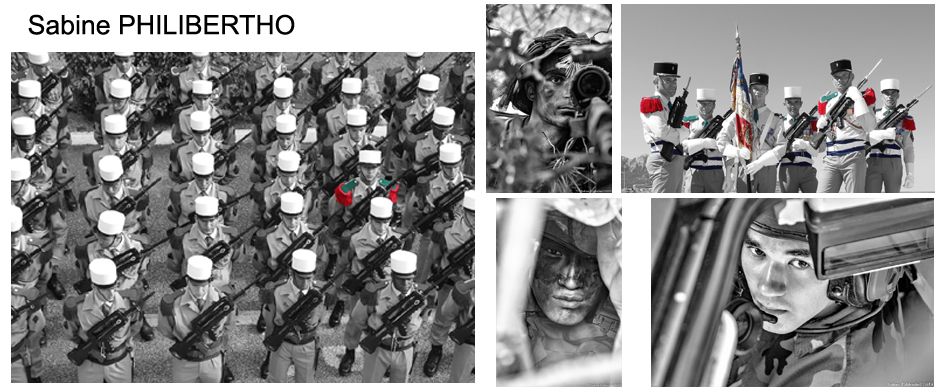
Closer to our time, photography has allowed us to capture the reality of Legionnaire life. From field shots to intimate portraits, it tells what words alone cannot express. Let us pay tribute here to Sabine Filibertho, a civilian who has worked at the 1st Foreign Cavalry Regiment (1er REC) for over three decades. Her photo collection tells the story of this famous Legion regiment for more than thirty years.
The art of former Legionnaires: a living memory.
Many former Legionnaires become artists after their service, whether amateur or professional. Their art is often marked by their military experience, blending memories, emotions, and a search for meaning.
At Édition Légion Arts, our ambition is to give these artists new visibility by showcasing their works, whether they focus on the Legion or not, and by creating a unique space for expression.
Why collect art related to the Legion?
For three reasons: to preserve a cultural and historical heritage, to own unique pieces, often steeped in history, and to directly support former Legionnaire artists, most of whom are adopted French citizens, who uphold the values of this country.
In short, the French Foreign Legion is more than a military force; it is a universal source of artistic inspiration. In painting, sculpture, and photography, it continues to live on through the creations of those who knew or admired it.