



All this is happening above our heads
For the past few years, our lifestyles have been disrupted by the advent of tools at our disposal, such as computers and mobile phones. Social media floods us with an immeasurable amount of information from sources ranging from the plausible to the fantastical.
“In the old days,” before a book was published, its content was verified, modified if necessary, and could even lead to legal action.
Today, you don’t need to possess knowledge to claim the right to disseminate and share it. Any fool can enter our homes and spew their ideas through our screens. A new profession has emerged: influencer. Previously, it was called sales representative.
And the worst is yet to come. Artificial intelligence is taking its place in this deluge. Every day, stunned, we witness this drama unfolding before our eyes. We no longer know if this information is real or entirely fabricated.
It's no wonder that weak minds are so easily disturbed.
In my remarks today, I will only mention a recent IFOP poll: 9% of French people believe the Earth is flat, and this figure rises to 24% among teenagers.
“In the old days,” before a book was published, its content was verified, modified if necessary, and could even lead to legal action.
Today, you don’t need to possess knowledge to claim the right to disseminate and share it. Any fool can enter our homes and spew their ideas through our screens. A new profession has emerged: influencer. Previously, it was called sales representative.
And the worst is yet to come. Artificial intelligence is taking its place in this deluge. Every day, stunned, we witness this drama unfolding before our eyes. We no longer know if this information is real or entirely fabricated.
It's no wonder that weak minds are so easily disturbed.
In my remarks today, I will only mention a recent IFOP poll: 9% of French people believe the Earth is flat, and this figure rises to 24% among teenagers.
Our Earth, what is its shape?
A few reminders.
Thales of Miletus (625-547 BC) was the first to truly consider the question of the Earth's shape.
Pythagoras, the Greek philosopher, was the first to declare that the Earth is spherical.
Its shape is more accurately described as that of a sphere, slightly flattened at the poles due to its rotation.
Aristotle (384-322 BC) provided some evidence for this by observing the rounded shape of the Earth's shadow on the Moon during eclipses. When the Earth passes between the Moon and the Sun, we see the Earth's shadow gradually cover the lunar disk. The Greeks had already observed that this shadow is circular, meaning that the Earth must necessarily be either a sphere or a flat disk.
Knowing from the experience with ships that the Earth was not flat, they could undoubtedly conclude that the sphericity hypothesis was the most plausible.
Thales of Miletus (625-547 BC) was the first to truly consider the question of the Earth's shape.
Pythagoras, the Greek philosopher, was the first to declare that the Earth is spherical.
Its shape is more accurately described as that of a sphere, slightly flattened at the poles due to its rotation.
Aristotle (384-322 BC) provided some evidence for this by observing the rounded shape of the Earth's shadow on the Moon during eclipses. When the Earth passes between the Moon and the Sun, we see the Earth's shadow gradually cover the lunar disk. The Greeks had already observed that this shadow is circular, meaning that the Earth must necessarily be either a sphere or a flat disk.
Knowing from the experience with ships that the Earth was not flat, they could undoubtedly conclude that the sphericity hypothesis was the most plausible.
_(1).jpg?t=aeb8a500_42ca_451a_ab7f_8e5528b4f20b)
Twenty-two centuries ago, Eratosthenes (276-194 BC) not only provided further proof of the Earth's roundness, but also became famous for precisely calculating its size.
He had observed that on June 21st, the Sun illuminated the bottom of wells in Syene when it reached its highest point near the zenith. But in Alexandria, at the same time, a stick cast a shadow of 7°. He knew the distance between the two cities, 800 km; from this, he deduced the Earth's circumference with astonishing accuracy: 39,375 kilometers compared to some 40,000 kilometers for current estimates.
He had observed that on June 21st, the Sun illuminated the bottom of wells in Syene when it reached its highest point near the zenith. But in Alexandria, at the same time, a stick cast a shadow of 7°. He knew the distance between the two cities, 800 km; from this, he deduced the Earth's circumference with astonishing accuracy: 39,375 kilometers compared to some 40,000 kilometers for current estimates.
_(1).jpg?t=aeb8a500_42ca_451a_ab7f_8e5528b4f20b)
It was by watching ships disappear over the horizon that, as early as the 4th century BC, the ancient Greeks are said to have discovered that the Earth is round. Indeed, they noticed that a ship heading out to sea seemed to gradually sink below the horizon until it disappeared, which could not happen if the Earth were flat. As it moves away, the hull clearly disappears before the mast. This probably led Greek astronomers to believe that the Earth was not flat, without necessarily concluding that it was spherical.
.jpg?t=aeb8a500_42ca_451a_ab7f_8e5528b4f20b)
Finally, the observation of the stars provides a third piece of evidence.
Two people in relatively distant locations, observing the portion of the sky just above the horizon at the same time, do not see the same stars: some remain hidden for one and are visible to the other, and vice versa.
However, if the Earth were flat, the two observers should see exactly the same stars.
On the other hand, on a spherical Earth, the two distant observers see slightly offset portions of the celestial sphere.
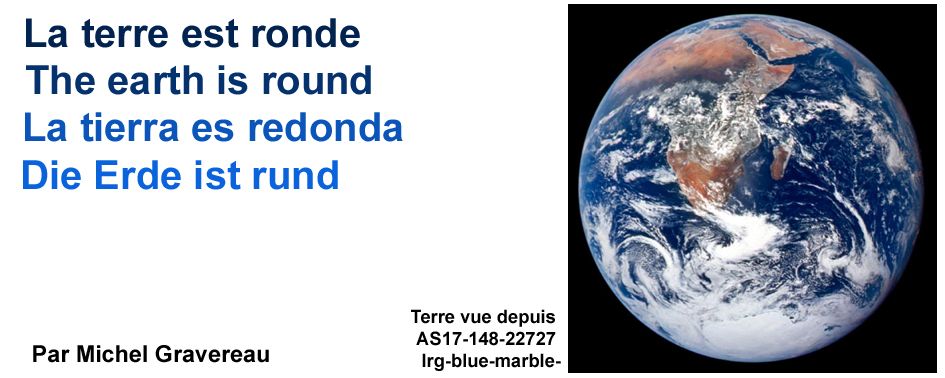
This is why the stars visible from the Southern Hemisphere and those visible from the Northern Hemisphere are not the same. This had been suspected for 2,500 years, and known with certainty for several centuries, but it wasn't until the early 1960s that irrefutable proof of our planet's shape was obtained. It was indeed with the advent of the space age and its artificial satellites that the first photographs revealing the Earth in all its roundness were taken.
In 1960, the first in a long line, the American weather satellite Tiros-1 took 23,000 pictures of the Earth's surface and atmosphere.
We could endlessly elaborate on all the evidence at our disposal, challenge the flat-Earthers to explain how to orbit a satellite around something flat, to take us to the edge of the disk that opens onto the abyss, to tell us why the Sun doesn't rise at the same time in Nice, Montpellier, and Bordeaux.
And why Felix Baumgartner, 40 km from at altitude, in 2012, did he see the Earth perfectly round before launching into his terrifying parachute jump?
Two people in relatively distant locations, observing the portion of the sky just above the horizon at the same time, do not see the same stars: some remain hidden for one and are visible to the other, and vice versa.
However, if the Earth were flat, the two observers should see exactly the same stars.
On the other hand, on a spherical Earth, the two distant observers see slightly offset portions of the celestial sphere.
This is why the stars visible from the Southern Hemisphere and those visible from the Northern Hemisphere are not the same. This had been suspected for 2,500 years, and known with certainty for several centuries, but it wasn't until the early 1960s that irrefutable proof of our planet's shape was obtained. It was indeed with the advent of the space age and its artificial satellites that the first photographs revealing the Earth in all its roundness were taken.
In 1960, the first in a long line, the American weather satellite Tiros-1 took 23,000 pictures of the Earth's surface and atmosphere.
We could endlessly elaborate on all the evidence at our disposal, challenge the flat-Earthers to explain how to orbit a satellite around something flat, to take us to the edge of the disk that opens onto the abyss, to tell us why the Sun doesn't rise at the same time in Nice, Montpellier, and Bordeaux.
And why Felix Baumgartner, 40 km from at altitude, in 2012, did he see the Earth perfectly round before launching into his terrifying parachute jump?
.jpg?t=aeb8a500_42ca_451a_ab7f_8e5528b4f20b)
It doesn't matter. There's none so blind as he who will not see. It's simply a shame to see that progress can send the most vulnerable back to time immemorial, those who are ready to believe the first person who comes along and their wildest ideas.
Let's continue to dream and make intelligent use of scientific progress. I invite you to embark on the Japanese probe Kaguya, which between 2007 and 2009 orbited the Moon and was able to admire the Earth in all its splendor.
Let's continue to dream and make intelligent use of scientific progress. I invite you to embark on the Japanese probe Kaguya, which between 2007 and 2009 orbited the Moon and was able to admire the Earth in all its splendor.