





All this is happening above our heads
The Moons of the Solar System.
For a very long time, we only spoke of one Moon, our own, Earth's Moon. Certainly, other bodies orbiting certain planets were known, such as those orbiting Jupiter since Galileo discovered them in 1609, but humans called them "satellites."
Since the launch of numerous man-made satellites of all kinds—communication, weather, military, etc.—the term "satellite" has been applied to them, and the natural satellites of the planets have taken the official name "moon."
Since the launch of numerous man-made satellites of all kinds—communication, weather, military, etc.—the term "satellite" has been applied to them, and the natural satellites of the planets have taken the official name "moon."

Are there moons around all the planets?
Of the eight planets, only six have them.
Indeed, Mercury and Venus have no moons.
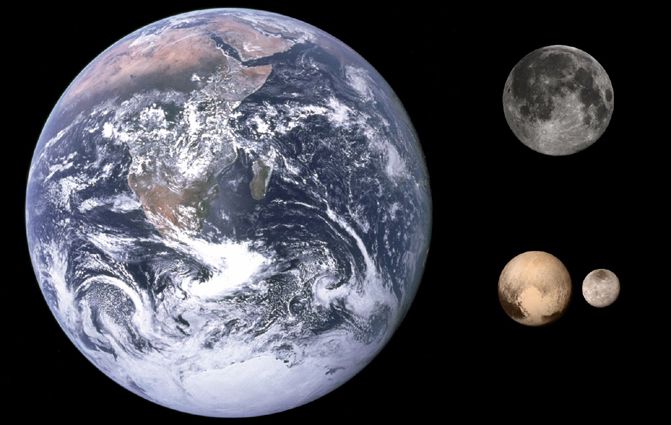
Earth has one, 3,476 km in diameter. Earth is considered the poor relation in terms of the number of its moons, as the other planets have plenty.
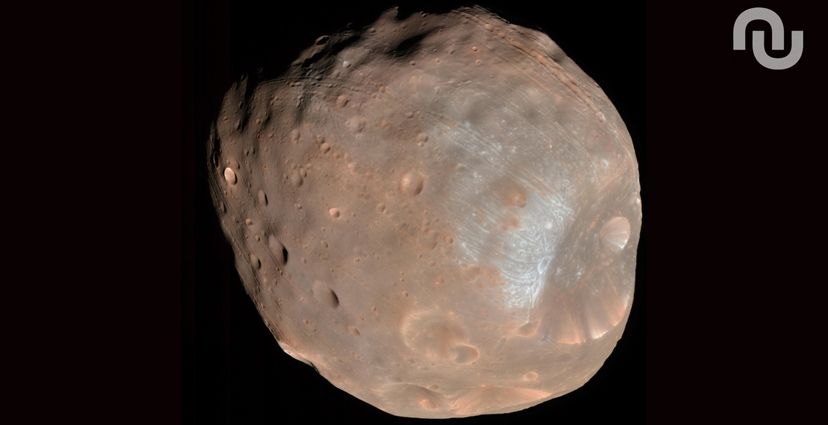
Mars has two. They are small, just a few kilometers across, and are named Phobos and Deimos. Discovered in 1877, astronomers believe they are two asteroids captured by Mars' gravitational field. These two names recall the horses that pulled the chariot of the god of war, Ares for the Greeks, and Mars for the Romans. They evoke Fear and Terror.
Indeed, Mercury and Venus have no moons.
Earth has one, 3,476 km in diameter. Earth is considered the poor relation in terms of the number of its moons, as the other planets have plenty.
Mars has two. They are small, just a few kilometers across, and are named Phobos and Deimos. Discovered in 1877, astronomers believe they are two asteroids captured by Mars' gravitational field. These two names recall the horses that pulled the chariot of the god of war, Ares for the Greeks, and Mars for the Romans. They evoke Fear and Terror.
Jupiter has 97 officially recognized moons, 72 numbered and 57 named. Most were discovered by the Pioneer and Voyager probes sent to explore the solar system in the 1970s. As a side note, when I started studying astronomy a long time ago, we learned that 12 "satellites" orbited Jupiter. Five had names: Amalthea, Io, Europa, Ganymede, and Callisto. The others had Roman numerals.
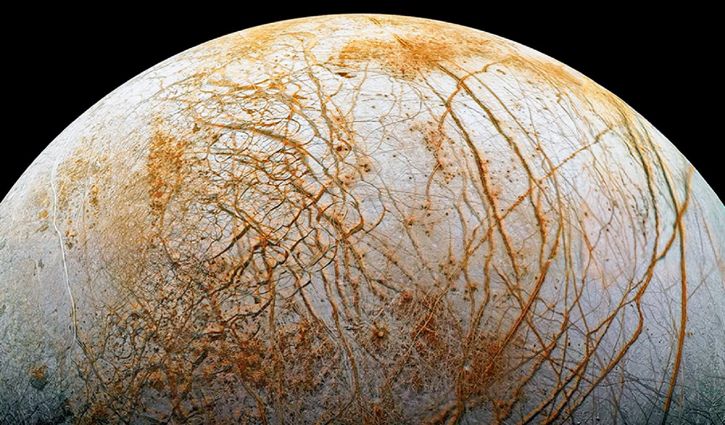
Most of these moons are less than 100 km in diameter and resemble large pebbles. One of these moons is of particular interest to astronomers: Europa. It is an icy ball beneath whose ice sheet a liquid ocean has been detected. In their quest for extraterrestrial life, scientists are preparing a probe called Europa Clipper, which will soon be launched to explore this body. I will certainly talk about it again.
Most of these moons are less than 100 km in diameter and resemble large pebbles. One of these moons is of particular interest to astronomers: Europa. It is an icy ball beneath whose ice sheet a liquid ocean has been detected. In their quest for extraterrestrial life, scientists are preparing a probe called Europa Clipper, which will soon be launched to explore this body. I will certainly talk about it again.
On Io, active volcanoes, like those on Earth, attest to the phenomenal gravitational pull of its parent planet, Jupiter.
Beyond Jupiter, Saturn, in addition to its rings, has more than 63 known moons. But observations have identified 274 small moons orbiting in Saturn's belt. The largest, Titan, easily visible in an average telescope, is 1.5 times the size of the Moon. Titan is larger than Mercury and, very unusually, possesses an atmosphere of nitrogen and methane. The Huygens probe, landed in January 2005, detected oceans of oil there. Don't think for a second that Total is going to install an oil pipeline!
This presence of oil poses a real problem because we are so far from the Sun that the temperature hovers around -200 degrees Celsius.
Oil is produced from the decomposition of living organisms. That's all it takes to interest the scientific world.
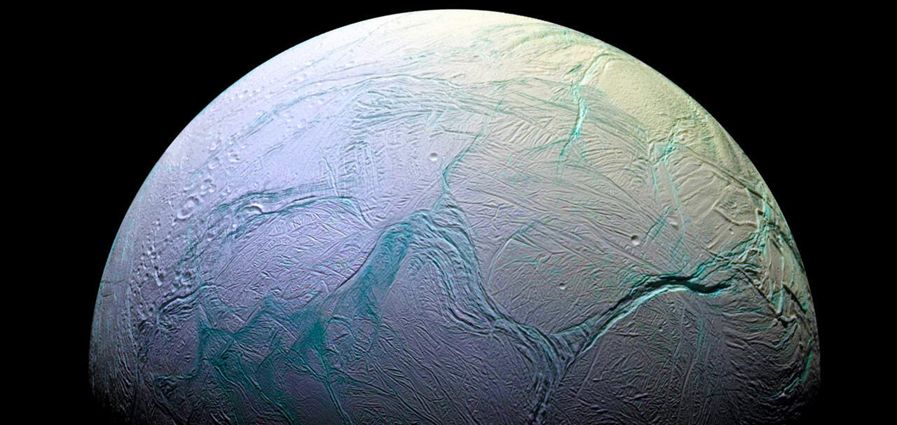
Just like Europa around Jupiter, a moon of Saturn is attracting the attention of scientists for the same reasons: Enceladus. It also has liquid water. One day…
Beyond Jupiter, Saturn, in addition to its rings, has more than 63 known moons. But observations have identified 274 small moons orbiting in Saturn's belt. The largest, Titan, easily visible in an average telescope, is 1.5 times the size of the Moon. Titan is larger than Mercury and, very unusually, possesses an atmosphere of nitrogen and methane. The Huygens probe, landed in January 2005, detected oceans of oil there. Don't think for a second that Total is going to install an oil pipeline!
This presence of oil poses a real problem because we are so far from the Sun that the temperature hovers around -200 degrees Celsius.
Oil is produced from the decomposition of living organisms. That's all it takes to interest the scientific world.
Just like Europa around Jupiter, a moon of Saturn is attracting the attention of scientists for the same reasons: Enceladus. It also has liquid water. One day…
Uranus also has a host of 29 moons.
It was traditional to give names related to mythology. But in the case of Uranus, since it was discovered in 1781 by an Englishman, William Herschel, the moons inherited names from Shakespearean plays. Among the main planets are Miranda, Umbriel, Ariel, Oberon, and Titania.
Neptune, the most distant planet, currently has 16 moons. Its largest, Triton, offered a curious sight during Voyager 2's flyby. Nitrogen geysers erupted vertically in its sky, then cascaded off at right angles. What was this phenomenon? A big question indeed.
Although Pluto has not been considered a planet since August 24, 2006, a word about it. It has five moons, the largest of which, Charon, is almost as large as Pluto itself. This explains its gravitational pull, causing it to orbit the Sun in a sinusoidal, corkscrew-like path. This is one of the reasons Pluto was reclassified. Its orbit is perturbed by its moon.
Here is a table showing the current positions of the different moons in our solar system. It is bound to evolve as observation methods continue to improve and probes are deployed in situ to compensate for our distance from these marvelous planets.
With a telescope that you can buy…or receive as a gift, you can stroll along the edge of our moon's craters and observe the dance of Jupiter's four moons, the Galileans. They are visible even with a good pair of binoculars. Seeing Titan, in the extension of Saturn's rings, is also possible with an average telescope. For the others, you'll have to travel to the major observatories.
Good observation.
It was traditional to give names related to mythology. But in the case of Uranus, since it was discovered in 1781 by an Englishman, William Herschel, the moons inherited names from Shakespearean plays. Among the main planets are Miranda, Umbriel, Ariel, Oberon, and Titania.
Neptune, the most distant planet, currently has 16 moons. Its largest, Triton, offered a curious sight during Voyager 2's flyby. Nitrogen geysers erupted vertically in its sky, then cascaded off at right angles. What was this phenomenon? A big question indeed.
Although Pluto has not been considered a planet since August 24, 2006, a word about it. It has five moons, the largest of which, Charon, is almost as large as Pluto itself. This explains its gravitational pull, causing it to orbit the Sun in a sinusoidal, corkscrew-like path. This is one of the reasons Pluto was reclassified. Its orbit is perturbed by its moon.
Here is a table showing the current positions of the different moons in our solar system. It is bound to evolve as observation methods continue to improve and probes are deployed in situ to compensate for our distance from these marvelous planets.
With a telescope that you can buy…or receive as a gift, you can stroll along the edge of our moon's craters and observe the dance of Jupiter's four moons, the Galileans. They are visible even with a good pair of binoculars. Seeing Titan, in the extension of Saturn's rings, is also possible with an average telescope. For the others, you'll have to travel to the major observatories.
Good observation.