






All this is happening above our heads
The Moon: Creation and Hidden Side. 1/2
By Michel Gravereau
When this text is published, the media will undoubtedly be reporting on a current global event: for over 50 years, three men and one woman have been orbiting the Moon in the Orion capsule, before humans establish a permanent base, likely next year.
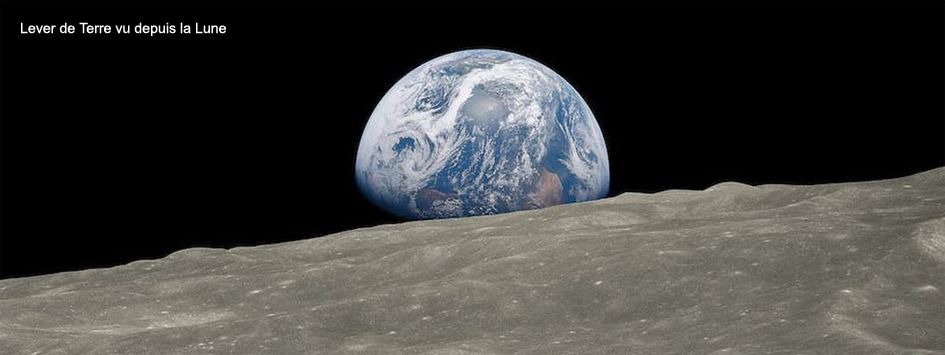
This will remind older generations of that memorable Christmas night in 1968 when Apollo 8, carrying Frank Borman, James Lovell, and William Anders, orbited our natural satellite, the final rehearsal for the historic day of July 20, 1969.
The Moon. The one that attracts all eyes, that is involved in so many supposed dramas, that stirs our oceans with the ebb and flow of the tides, the moon of gardeners.
But do we know the latest news about this Moon, its creation, and especially what its hidden side is? Let's try to shed some light on the subject.
Its creation.
A long time ago, when I started studying astronomy, four theories were debated about its creation. It seems that today, only one is accepted.
Our satellite, the Moon, was born from a tremendous collision 4.5 billion years ago: that of the very young Earth with a celestial body the size of Mars (half the size of Earth). The force of the impact pulverized part of our planet's mantle. These debris, ejected into space, would then have formed a ring of matter around Earth, before quickly coalescing to give birth to a single celestial body: the Moon.
A long time ago, when I started studying astronomy, four theories were debated about its creation. It seems that today, only one is accepted.
Our satellite, the Moon, was born from a tremendous collision 4.5 billion years ago: that of the very young Earth with a celestial body the size of Mars (half the size of Earth). The force of the impact pulverized part of our planet's mantle. These debris, ejected into space, would then have formed a ring of matter around Earth, before quickly coalescing to give birth to a single celestial body: the Moon.
.jpg?t=aeb8a500_42ca_451a_ab7f_8e5528b4f20b)
During the collision, the object responsible for the cataclysm must have been traveling on a trajectory close to that of Earth and struck it tangentially. Upon impact, it is imagined that its metallic core, composed of iron and nickel, would fuse with Earth's core.
Then, under the combined gravitational pull of Earth and the Sun, the debris would clump together, forming lumps that would grow and then clump together into even larger lumps, eventually forming the Moon. The entire process would have taken only about a thousand years.
Then, under the combined gravitational pull of Earth and the Sun, the debris would clump together, forming lumps that would grow and then clump together into even larger lumps, eventually forming the Moon. The entire process would have taken only about a thousand years.
.jpg?t=aeb8a500_42ca_451a_ab7f_8e5528b4f20b)
Before the collision scenario became the accepted explanation, three other theories had been put forward to explain the Moon's formation. All of them simulated the action at the time of planetary formation, 4.5 billion years ago.
The first theory suggested that Earth captured a small body passing nearby.
The second theory posited that the very young Earth was initially surrounded by a ring of debris and dust, which would later coalesce. Finally, in the third theory, the Earth was not yet solidified and was rotating very rapidly: a fluid piece would have broken off to form the Moon.
These theories have since been abandoned.
Between 1969 and 1972, the Apollo astronauts brought back 387 kg of lunar rocks. Analysis of these rocks has helped to support the collision scenario. Indeed, it revealed not only that the Earth's crust and the lunar crust have great similarities in composition, but also that the lunar rocks do not contain light, volatile elements like hydrogen. These elements would have evaporated under the effect of the tremendous heat released during the collision.
Moon rocks and Earth's mantle: the same thing. As an old pasta commercial might have said: we have the same ones at home.
To be continued...
The first theory suggested that Earth captured a small body passing nearby.
The second theory posited that the very young Earth was initially surrounded by a ring of debris and dust, which would later coalesce. Finally, in the third theory, the Earth was not yet solidified and was rotating very rapidly: a fluid piece would have broken off to form the Moon.
These theories have since been abandoned.
Between 1969 and 1972, the Apollo astronauts brought back 387 kg of lunar rocks. Analysis of these rocks has helped to support the collision scenario. Indeed, it revealed not only that the Earth's crust and the lunar crust have great similarities in composition, but also that the lunar rocks do not contain light, volatile elements like hydrogen. These elements would have evaporated under the effect of the tremendous heat released during the collision.
Moon rocks and Earth's mantle: the same thing. As an old pasta commercial might have said: we have the same ones at home.
To be continued...