






The Legion Unvarnished 2
By Christian Morisot
Old age is, as everyone knows, the twilight of life. It is now or never, not to write one's will, but to pass on a written legacy, drawing on the memories and "eclipses" that have marked our lives. For us, legionnaires, it is also the time to take stock of these years spent in service to the Institution, which occupied the greater part of our youth.
One observation is inescapable: we are the heirs of these veterans with their remarkable destinies. In all objectivity, and without wishing to tarnish the image of this magnificent Institution, we simply wish to present—without naivety—certain aspects little known or obscured by the writers who have recounted the history of the Legion.
The motivation for such a sharing is clear: to draw upon the writings accumulated during our service to reveal, subtly woven throughout, reflections and lived anecdotes. For if no other military corps has so captivated the popular imagination, we, the living witnesses, are its only remaining witnesses. Currently, our website primarily reflects the reactions of foreign officers, although it is open to all veterans—as our comrade Michel Gravereau demonstrates to us each week.
In reality, the Legion is composed of men fleeing their countries or who have reached their breaking point—a common stereotype—but for a thousand other reasons, as there are as many motives as there are legionnaires. For many foreigners, whose national salary barely exceeds a few hundred euros, the pay, aligned with the French minimum wage, is a godsend. These young men, in excellent health, enlist and push their endurance to the extreme limits. All contribute to making the history of the Legion this dramatic and mysterious saga, of unparalleled exoticism.
Certainly, works on Camerone, Tuyen Quang, or Dien Bien Phu have stood the test of time, like the Golden Book of the French Foreign Legion. But what many historians overlook is that each legionnaire possesses a unique mentality, forged by the specific circumstances of their recruitment, and which often eludes academic narratives.
In conclusion, the legionnaire embodies a paradox: he is revered by the French, yet they are still sometimes perceived as an outsider or a social outcast, unfit for society. How can we understand that such men become such excellent soldiers? In many respects, the Legion is a mirror of society and an illustration of the values we uphold in the defense of France. This, too, is the spirit of the Oath of Camerone.
Old age is, as everyone knows, the twilight of life. It is now or never, not to write one's will, but to pass on a written legacy, drawing on the memories and "eclipses" that have marked our lives. For us, legionnaires, it is also the time to take stock of these years spent in service to the Institution, which occupied the greater part of our youth.
One observation is inescapable: we are the heirs of these veterans with their remarkable destinies. In all objectivity, and without wishing to tarnish the image of this magnificent Institution, we simply wish to present—without naivety—certain aspects little known or obscured by the writers who have recounted the history of the Legion.
The motivation for such a sharing is clear: to draw upon the writings accumulated during our service to reveal, subtly woven throughout, reflections and lived anecdotes. For if no other military corps has so captivated the popular imagination, we, the living witnesses, are its only remaining witnesses. Currently, our website primarily reflects the reactions of foreign officers, although it is open to all veterans—as our comrade Michel Gravereau demonstrates to us each week.
In reality, the Legion is composed of men fleeing their countries or who have reached their breaking point—a common stereotype—but for a thousand other reasons, as there are as many motives as there are legionnaires. For many foreigners, whose national salary barely exceeds a few hundred euros, the pay, aligned with the French minimum wage, is a godsend. These young men, in excellent health, enlist and push their endurance to the extreme limits. All contribute to making the history of the Legion this dramatic and mysterious saga, of unparalleled exoticism.
Certainly, works on Camerone, Tuyen Quang, or Dien Bien Phu have stood the test of time, like the Golden Book of the French Foreign Legion. But what many historians overlook is that each legionnaire possesses a unique mentality, forged by the specific circumstances of their recruitment, and which often eludes academic narratives.
In conclusion, the legionnaire embodies a paradox: he is revered by the French, yet they are still sometimes perceived as an outsider or a social outcast, unfit for society. How can we understand that such men become such excellent soldiers? In many respects, the Legion is a mirror of society and an illustration of the values we uphold in the defense of France. This, too, is the spirit of the Oath of Camerone.
A Malagasy Journey
Of all the countries I've had the privilege of visiting, the one that has left the deepest impression on me is, without a doubt, Madagascar, the "Red Island."
I remember one Sunday morning, after a restless night spent dancing and drinking more than was wise—it was the custom of the time and place—I set off to explore the immediate surroundings of Diego Suarez. The scenario remained largely unchanged, and, along roads and tracks, a taxi driver took me in a relic of the colonial era: a Renault 4L (1).
I remember one Sunday morning, after a restless night spent dancing and drinking more than was wise—it was the custom of the time and place—I set off to explore the immediate surroundings of Diego Suarez. The scenario remained largely unchanged, and, along roads and tracks, a taxi driver took me in a relic of the colonial era: a Renault 4L (1).
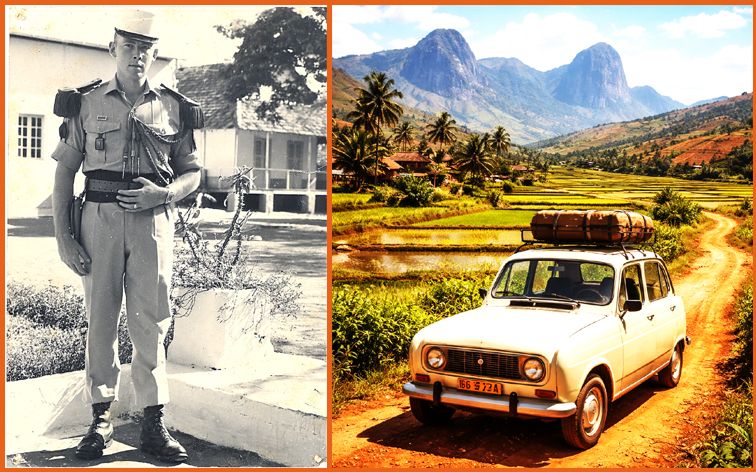
With no other company, I set off for nowhere and everywhere at once.
Ahead of us, on the roadside, people walked as if drawn to the hills that appeared in the distance, in the morning mist… I went wherever instinct led me. It's not too hot yet, but already a heavy, leaden sky heralds violent storms, the kind that come with the rainy season. I can still picture a cart pulled by two zebus ahead of us, setting its own pace on the dilapidated road. Traffic jams, dust, black smoke—life seems chaotic, joyful, but so fragile.
I love this atmosphere; I feel so much better here than in Diego Suarez... Approaching the outskirts of the upscale neighborhoods of Ambange, the capital of Malagasy cocoa, I feel immense pleasure gazing at the jacaranda trees in bloom: sparse foliage, but the purple blossoms offer a magical spectacle.
The car chooses this moment to break down in the shade of a tree, in front of a shabby hotel. While the driver profusely apologizes and absorbs the blow, waiting for possible repairs, I decide to wander around town. People turn around and stare at me in astonishment, so unusual is it to see a legionnaire in uniform in this remote corner of the world.
A man, a straw hat pulled down over his head, stands under a bridge behind a small stall, selling salvaged items: screws, bolts, empty bottles… a makeshift radio plays African music. We chat amidst the lingering stench of exhaust fumes and coal smoke wafting from the corrugated iron shacks. A little further on, a shantytown seems attached to the city like a wart; a multitude of people sleep in makeshift shelters and survive by recycling the garbage of the poor and the less poor.
My feet are in the mud, surrounded by cars, buses, and rickshaws battered and laden, they try to make their way along the potholed road. Men, women, and children carry goods on their heads, running barefoot. It's teeming, swarming! The usual sights in Africa: piles of garbage, infected canals, horrible smells in a landscape that never changes. I take photos, and as if on cue, a crowd gathers; the people I'm photographing demand a few coins to settle the "soul loans" I've made. I feel a little lost, uneasy, worried.
From nowhere, bursts of liberating laughter erupt; the atmosphere is relaxed, filled with astonishment, teasing, and shared pleasure. After that, nothing could surprise me anymore… My driver tells me the taxi is finally fixed. I hadn't thought to eat; hunger gnaws at my stomach. After a quick snack, I decided to head back to Diego. The city receded into the distance, the roar of cars giving way to the chirping of crickets.
The city became a village again, poverty reasserted itself, and it reverted to what it had momentarily ceased to be: misery. I found it very difficult to leave; perhaps this is how I could have become that rogue legionnaire, an undocumented immigrant… Arriving in Diego, I naturally fell back into my Sunday evening routine and my faithful comrades, brothers-in-arms from my nocturnal battles. The famous “Taverna,” a legendary place housed in a large colonial building, welcomed us; the evening promised to be lively, if not scandalous.
Settled on a tiny stage, a flamboyant musician coaxed his old accordion into song, entertaining and singing. The room filled up and quickly became sweltering. The "coca-rhum," which elsewhere is called "Cuba Libre" (Cuba for the rum, Coca for the United States), goes down like water. Bodies sweat, ooze, and draw closer; the "ramatous," symbols of uninhibited sexual freedom, become increasingly beautiful as the evening progresses and the "coca-rhum" is consumed. Tonight again, I have no desire to be anywhere else; the life of a young man is beautiful, and the music, beyond its sound, will still soothe the souls of lost souls.
Girls offer themselves for a beer, kids sell everything and hold out their hands for a few coins. Makeshift eateries open in the dark alleyways; inside, beautiful creatures wait for the "Wazala," this debauched white "foreigner." The weather is pleasant, the air is mild, a child sleeps bundled up in his rags right on the sidewalk, the military police pass by, I salute and smile to hide my embarrassment.
Early the next morning, I walk back to camp, Base Company, in a warm, gentle, restorative rain; the sky is black, yellow, green. Frangipani trees perfume the air and the town, a few girls try one last “Vadko” (2). Taxi drivers signal their availability by honking their horns.
It's been a full day, I don't ask myself any questions, back to the daily grind, I can't wait for next weekend, I'm going to Joffreville...
Index:
(1) The taxi.
(2) Vadko: customer, lover.
Ahead of us, on the roadside, people walked as if drawn to the hills that appeared in the distance, in the morning mist… I went wherever instinct led me. It's not too hot yet, but already a heavy, leaden sky heralds violent storms, the kind that come with the rainy season. I can still picture a cart pulled by two zebus ahead of us, setting its own pace on the dilapidated road. Traffic jams, dust, black smoke—life seems chaotic, joyful, but so fragile.
I love this atmosphere; I feel so much better here than in Diego Suarez... Approaching the outskirts of the upscale neighborhoods of Ambange, the capital of Malagasy cocoa, I feel immense pleasure gazing at the jacaranda trees in bloom: sparse foliage, but the purple blossoms offer a magical spectacle.
The car chooses this moment to break down in the shade of a tree, in front of a shabby hotel. While the driver profusely apologizes and absorbs the blow, waiting for possible repairs, I decide to wander around town. People turn around and stare at me in astonishment, so unusual is it to see a legionnaire in uniform in this remote corner of the world.
A man, a straw hat pulled down over his head, stands under a bridge behind a small stall, selling salvaged items: screws, bolts, empty bottles… a makeshift radio plays African music. We chat amidst the lingering stench of exhaust fumes and coal smoke wafting from the corrugated iron shacks. A little further on, a shantytown seems attached to the city like a wart; a multitude of people sleep in makeshift shelters and survive by recycling the garbage of the poor and the less poor.
My feet are in the mud, surrounded by cars, buses, and rickshaws battered and laden, they try to make their way along the potholed road. Men, women, and children carry goods on their heads, running barefoot. It's teeming, swarming! The usual sights in Africa: piles of garbage, infected canals, horrible smells in a landscape that never changes. I take photos, and as if on cue, a crowd gathers; the people I'm photographing demand a few coins to settle the "soul loans" I've made. I feel a little lost, uneasy, worried.
From nowhere, bursts of liberating laughter erupt; the atmosphere is relaxed, filled with astonishment, teasing, and shared pleasure. After that, nothing could surprise me anymore… My driver tells me the taxi is finally fixed. I hadn't thought to eat; hunger gnaws at my stomach. After a quick snack, I decided to head back to Diego. The city receded into the distance, the roar of cars giving way to the chirping of crickets.
The city became a village again, poverty reasserted itself, and it reverted to what it had momentarily ceased to be: misery. I found it very difficult to leave; perhaps this is how I could have become that rogue legionnaire, an undocumented immigrant… Arriving in Diego, I naturally fell back into my Sunday evening routine and my faithful comrades, brothers-in-arms from my nocturnal battles. The famous “Taverna,” a legendary place housed in a large colonial building, welcomed us; the evening promised to be lively, if not scandalous.
Settled on a tiny stage, a flamboyant musician coaxed his old accordion into song, entertaining and singing. The room filled up and quickly became sweltering. The "coca-rhum," which elsewhere is called "Cuba Libre" (Cuba for the rum, Coca for the United States), goes down like water. Bodies sweat, ooze, and draw closer; the "ramatous," symbols of uninhibited sexual freedom, become increasingly beautiful as the evening progresses and the "coca-rhum" is consumed. Tonight again, I have no desire to be anywhere else; the life of a young man is beautiful, and the music, beyond its sound, will still soothe the souls of lost souls.
Girls offer themselves for a beer, kids sell everything and hold out their hands for a few coins. Makeshift eateries open in the dark alleyways; inside, beautiful creatures wait for the "Wazala," this debauched white "foreigner." The weather is pleasant, the air is mild, a child sleeps bundled up in his rags right on the sidewalk, the military police pass by, I salute and smile to hide my embarrassment.
Early the next morning, I walk back to camp, Base Company, in a warm, gentle, restorative rain; the sky is black, yellow, green. Frangipani trees perfume the air and the town, a few girls try one last “Vadko” (2). Taxi drivers signal their availability by honking their horns.
It's been a full day, I don't ask myself any questions, back to the daily grind, I can't wait for next weekend, I'm going to Joffreville...
Index:
(1) The taxi.
(2) Vadko: customer, lover.
Share your writing
Elders of the Legion: about the Legion and other topics
Supporters: about the Legion