





All this is happening above our heads
The Spectacular Phases of the Moon
By Michel Gravereau
Since time immemorial, humankind has observed, day after day, night after night, Earth's natural satellite, the Moon, in its perpetual journey around our planet. And each day, it is different; either it reveals a little more, it is waxing, or it hides a little more from us, it is waning.

Why do we have this spectacle?
First, let's remember that the Moon is round and that the light of the Sun, our star, only illuminates half of it, as with any sphere.
The Moon orbits the Earth at approximately 480,000 km, while the Sun is infinitely farther away, at 150 million kilometers. In its journey, the Moon will therefore pass between the Earth and the Sun.
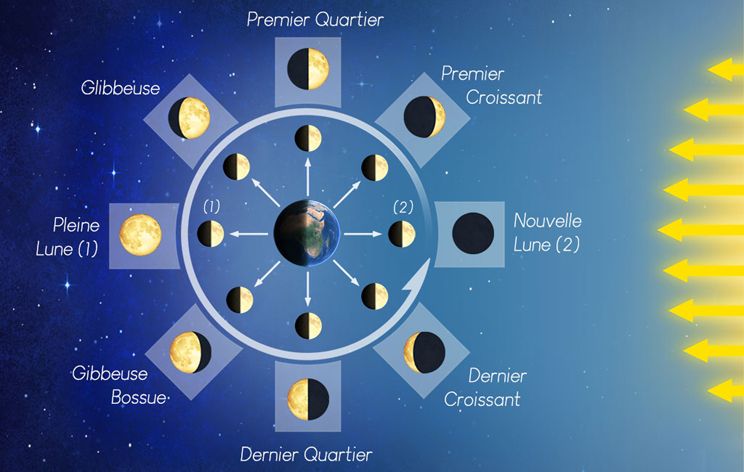
To explain this phenomenon to our children and grandchildren, I suggest you take an orange and stand near a lightbulb in the middle of the room. Position the orange facing the bulb (the Moon between the Earth and the Sun) and show the child that we can't see anything of the illuminated part of the orange. The half facing us is in shadow. This is the New Moon, NM on the calendar, completely invisible.

Then, with your arm outstretched, rotate the orange to the left. As soon as it's no longer aligned with the bulb, the orange begins to reveal part of its illuminated half. This is the crescent Moon, gradually growing larger as your arm moves to the left. When it reaches a 90° angle to the direction of the bulb, we see half an orange illuminated. This is the First Quarter Moon, FQ.
Continue this movement. We see a little more than half of it. This is the waxing gibbous moon.
When we reach the alignment of the bulb, child, and orange, the entire illuminated portion of the orange is facing us. This is the Full Moon (FU).
If we continue the orange's revolution around us, the illuminated portion decreases; we enter the waning moon.
We pass through the waning gibbous phase again to reach another right angle with the bulb: Last Quarter (LQ). We see a half-moon, once more.
Before reaching alignment with the bulb, we observe only an illuminated crescent. Then nothing. New Moon.
Continue this movement. We see a little more than half of it. This is the waxing gibbous moon.
When we reach the alignment of the bulb, child, and orange, the entire illuminated portion of the orange is facing us. This is the Full Moon (FU).
If we continue the orange's revolution around us, the illuminated portion decreases; we enter the waning moon.
We pass through the waning gibbous phase again to reach another right angle with the bulb: Last Quarter (LQ). We see a half-moon, once more.
Before reaching alignment with the bulb, we observe only an illuminated crescent. Then nothing. New Moon.
How long did it take the Moon to orbit the Earth? Approximately 29 and a half days.
During this cycle, a regular phenomenon occurs: eclipses.
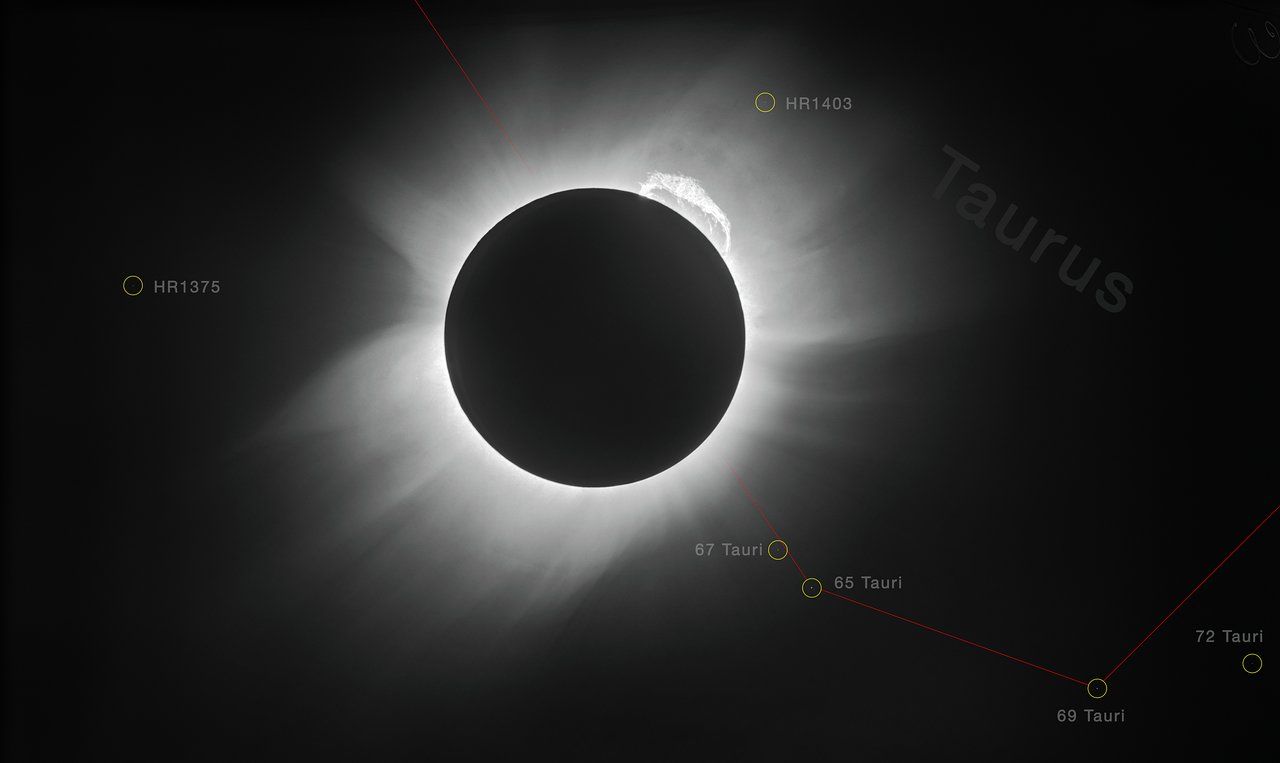
When the Moon passes directly between the Earth and the Sun, at the time of a New Moon, it completely obscures our star, plunging our planet into darkness. This happened in France on August 11, 1999, and will happen again this year on August 12 in northern Spain. This solar eclipse lasts only a few minutes. This phenomenon occurs twice a year these days.
When the Moon is opposite the Sun, during a Full Moon, sometimes, twice a year currently, it enters the Earth's shadow and is no longer illuminated by the Sun. It then takes on a coppery-red hue, and this is the spectacle of a lunar eclipse to which we are invited.
This grand celestial choreography has been orchestrated since eternity, ever since the three celestial bodies—Sun, Earth, and Moon—decided to play hide-and-seek due to their momentary alignment.
In the past, they were interpreted as signs of destiny, giving rise to numerous beliefs. Others took advantage of this to convince the world they were prophets: in 1999, during OUR solar eclipse, let's remember Paco Rabanne, the fashion designer, who announced that, according to his calculations, the Mir space station would crash into Paris at the time of the eclipse. Completely ludicrous. It's true he risked nothing: ridicule no longer kills.
For us, the phenomenon of eclipses is above all a magnificent spectacle of nature, before which our emotions are renewed with each appearance.
During this cycle, a regular phenomenon occurs: eclipses.
When the Moon passes directly between the Earth and the Sun, at the time of a New Moon, it completely obscures our star, plunging our planet into darkness. This happened in France on August 11, 1999, and will happen again this year on August 12 in northern Spain. This solar eclipse lasts only a few minutes. This phenomenon occurs twice a year these days.
When the Moon is opposite the Sun, during a Full Moon, sometimes, twice a year currently, it enters the Earth's shadow and is no longer illuminated by the Sun. It then takes on a coppery-red hue, and this is the spectacle of a lunar eclipse to which we are invited.
This grand celestial choreography has been orchestrated since eternity, ever since the three celestial bodies—Sun, Earth, and Moon—decided to play hide-and-seek due to their momentary alignment.
In the past, they were interpreted as signs of destiny, giving rise to numerous beliefs. Others took advantage of this to convince the world they were prophets: in 1999, during OUR solar eclipse, let's remember Paco Rabanne, the fashion designer, who announced that, according to his calculations, the Mir space station would crash into Paris at the time of the eclipse. Completely ludicrous. It's true he risked nothing: ridicule no longer kills.
For us, the phenomenon of eclipses is above all a magnificent spectacle of nature, before which our emotions are renewed with each appearance.