





All this is happening above our heads
Comets
By Michel Gravereau
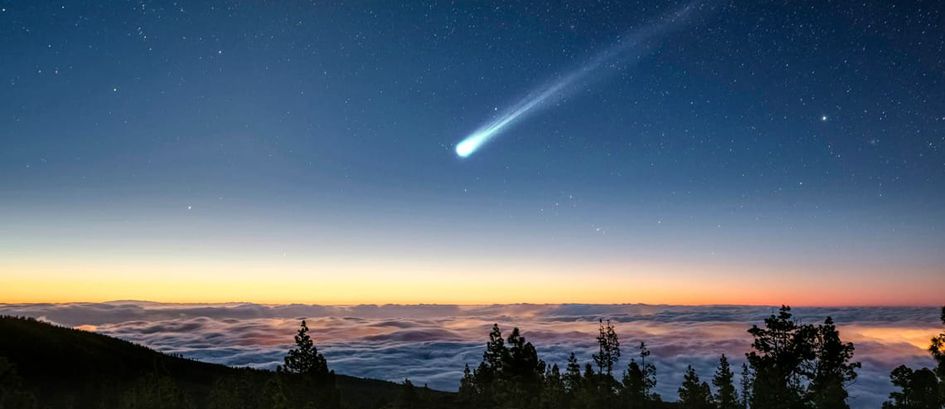
I have often addressed the topic of comets, often called "the great travelers." Where do they come from, and what do they represent?
In the past, humankind has often asked itself many questions and has been unable to help but attach undue importance to the appearance of these celestial bodies in the sky.
Imagination has gone far beyond what is reasonable.
.jpg?t=aeb8a500_42ca_451a_ab7f_8e5528b4f20b)
Where do comets come from?
First, let's see where these large rocks come from.
Surrounding the solar system, two large reservoirs provide the majority of the comets we see passing through our sky.
Surrounding the solar system, two large reservoirs provide the majority of the comets we see passing through our sky.
The Oort Cloud
The largest of these is located at the very edge of the solar system, at a distance of approximately 50,000 times the distance from the Earth to the Sun. This is the Oort Cloud. It is thought to contain some 1 trillion comets. It is imagined to be spherical.
There, in a vast, icy expanse, orbit blocks of ice and rock, the nuclei of future comets. Astronomers estimate their combined mass to be 300 times that of Earth.
They are believed to have formed at the same time as the planets, about 4.5 billion years ago, and have been waiting ever since to hurtle towards the Sun and visit our region.
There, in a vast, icy expanse, orbit blocks of ice and rock, the nuclei of future comets. Astronomers estimate their combined mass to be 300 times that of Earth.
They are believed to have formed at the same time as the planets, about 4.5 billion years ago, and have been waiting ever since to hurtle towards the Sun and visit our region.
.jpg?t=aeb8a500_42ca_451a_ab7f_8e5528b4f20b)
The Kuiper Belt.
The other reservoir is closer: it is thought to begin between Neptune and Pluto. Its distance is between 30 and 40 times that between Earth and the Sun. This is the Kuiper Belt.
It has a disk-like shape around the Sun and is much smaller than the Oort Cloud, as its estimated mass is only six times that of Earth.
The appearance of these comets also changes, as more than 100,000 nuclei larger than 100 km in diameter have been identified. It is from this region that the comets that frequently visit us originate, those that orbit the Sun in less than 20 years. Photo 3: Kuiper Belt
Astronomers wonder if Pluto, so small and atypical with its highly inclined trajectory, might have escaped from this belt.
The Sun and its retinue of planets are literally encircled by comets dormant in these two reservoirs: the Oort Cloud and the Kuiper Belt.
The Dutchman Jan H. Oort (1900–1992) was the first to consider the existence of the cometary cloud that bears his name. He also devoted himself to the study of our galaxy, the Milky Way. He revealed its spiral structure, determined its mass, and the particularities of its rotation.
The Dutch-born American Gerard P. Kuiper (1905-1973) was a specialist in the solar system. He demonstrated the presence of ice on Mars and in Saturn's rings, discovered new moons around Uranus and Neptune, and proposed the existence of the solar belt that bears his name.
It has a disk-like shape around the Sun and is much smaller than the Oort Cloud, as its estimated mass is only six times that of Earth.
The appearance of these comets also changes, as more than 100,000 nuclei larger than 100 km in diameter have been identified. It is from this region that the comets that frequently visit us originate, those that orbit the Sun in less than 20 years. Photo 3: Kuiper Belt
Astronomers wonder if Pluto, so small and atypical with its highly inclined trajectory, might have escaped from this belt.
The Sun and its retinue of planets are literally encircled by comets dormant in these two reservoirs: the Oort Cloud and the Kuiper Belt.
The Dutchman Jan H. Oort (1900–1992) was the first to consider the existence of the cometary cloud that bears his name. He also devoted himself to the study of our galaxy, the Milky Way. He revealed its spiral structure, determined its mass, and the particularities of its rotation.
The Dutch-born American Gerard P. Kuiper (1905-1973) was a specialist in the solar system. He demonstrated the presence of ice on Mars and in Saturn's rings, discovered new moons around Uranus and Neptune, and proposed the existence of the solar belt that bears his name.
Upcoming Events
This section informs you about upcoming events in the fields of pure astronomy and space exploration.
Astronomical Events
February 9: Last Quarter Moon at 1:43:07 PM
February 10: Moon at Apogee Distance from Earth: 404,576 km.
February 17: Annular solar eclipse, not visible from mainland France.
February 17: Traditional Chinese calendar: New Year.
February 17: New Moon at 1:01:09 PM.
February 18: Around 6:30 PM local time, on the western horizon, in the glow of the setting sun, the Moon, Venus, and Mercury, all three in the constellation Aquarius, will be in close conjunction.
February 24: First quarter moon at 1:27:37 PM.
February 25: Moon at perigee; distance from Earth: 370,135 km.
March 3: Total lunar eclipse, not visible from mainland France.
March 20: Spring Equinox.
May 7 and 8: Sunset under the Arc de Triomphe from the Place de la Concorde.
May 9, 10, and 11: Sunset under the Arc de Triomphe from the Champs-Élysées roundabout.
June 21: Summer Solstice.
July 31, August 1, 2, and 3: Sunset under the Arc de Triomphe from the Champs-Élysées roundabout.
August 3, 4, and 5: Sunset under the Arc de Triomphe from the Place de la Concorde.
August 12: Total solar eclipse, visible in its partial phase in mainland France.
August 28: Partial lunar eclipse in mainland France.
September 14: Venus appears behind the Moon.
September 23: Autumnal equinox.
December 21: Winter solstice.
Ursid meteor shower.
Space exploration
ISS pass: From January 21 to 31, it is visible in the evening sky.
ISS: Due to the Crew Dragon's premature return for medical reasons, French astronaut Sophie Adenot will join the crew that will launch to the ISS from Baikonur aboard a Soyuz spacecraft.
She will thus become the 11th French astronaut and the 2nd woman, the first being Claudie Aigneré.
Artemis 2 launch to the Moon: Date set: February 7.
This section informs you about upcoming events in the fields of pure astronomy and space exploration.
Astronomical Events
February 9: Last Quarter Moon at 1:43:07 PM
February 10: Moon at Apogee Distance from Earth: 404,576 km.
February 17: Annular solar eclipse, not visible from mainland France.
February 17: Traditional Chinese calendar: New Year.
February 17: New Moon at 1:01:09 PM.
February 18: Around 6:30 PM local time, on the western horizon, in the glow of the setting sun, the Moon, Venus, and Mercury, all three in the constellation Aquarius, will be in close conjunction.
February 24: First quarter moon at 1:27:37 PM.
February 25: Moon at perigee; distance from Earth: 370,135 km.
March 3: Total lunar eclipse, not visible from mainland France.
March 20: Spring Equinox.
May 7 and 8: Sunset under the Arc de Triomphe from the Place de la Concorde.
May 9, 10, and 11: Sunset under the Arc de Triomphe from the Champs-Élysées roundabout.
June 21: Summer Solstice.
July 31, August 1, 2, and 3: Sunset under the Arc de Triomphe from the Champs-Élysées roundabout.
August 3, 4, and 5: Sunset under the Arc de Triomphe from the Place de la Concorde.
August 12: Total solar eclipse, visible in its partial phase in mainland France.
August 28: Partial lunar eclipse in mainland France.
September 14: Venus appears behind the Moon.
September 23: Autumnal equinox.
December 21: Winter solstice.
Ursid meteor shower.
Space exploration
ISS pass: From January 21 to 31, it is visible in the evening sky.
ISS: Due to the Crew Dragon's premature return for medical reasons, French astronaut Sophie Adenot will join the crew that will launch to the ISS from Baikonur aboard a Soyuz spacecraft.
She will thus become the 11th French astronaut and the 2nd woman, the first being Claudie Aigneré.
Artemis 2 launch to the Moon: Date set: February 7.
.jpg?t=aeb8a500_42ca_451a_ab7f_8e5528b4f20b)